Mesopotamian Pantheon
Ereshkigal
Also known as Irkalla, Allatu
- underworld
- death
- darkness
- judgment
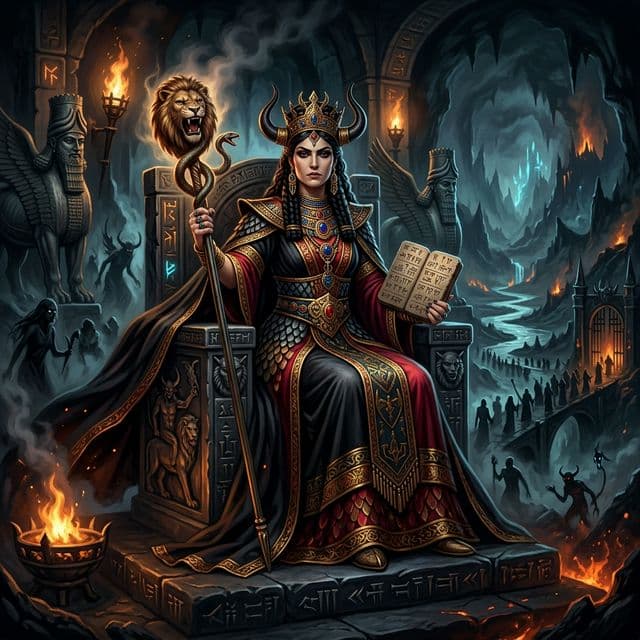
Queen of the Underworld and sister of Inanna. Ereshkigal rules the land of no return with absolute authority, from which no one, god or mortal, escapes unchanged.
About Ereshkigal
Queen of the Great Below
Ereshkigal is the absolute ruler of the underworld (Kur or Irkalla), a vast realm beneath the earth where the dead dwell in eternal twilight. Unlike later concepts of hell, the Mesopotamian underworld was not a place of punishment but simply the inevitable destination of all mortals. Ereshkigal reigns there with cold, implacable authority.
Sister and Rival of Inanna
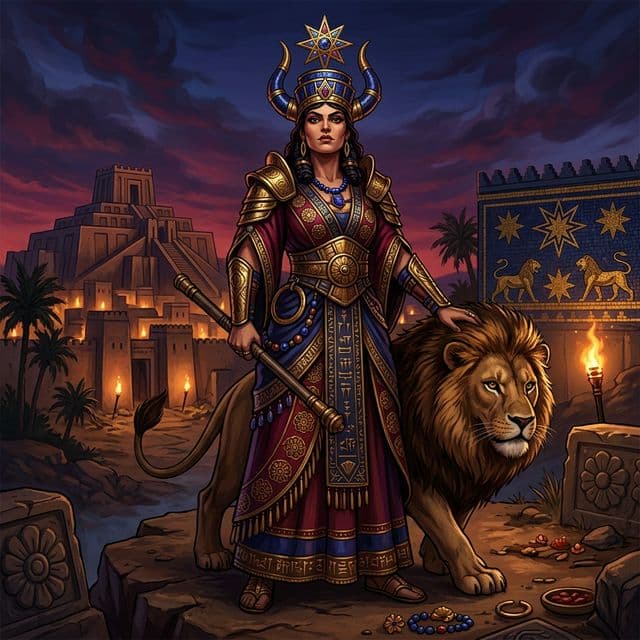
Ereshkigal is the elder sister of Inanna, and the two represent complementary opposites: life and death, sky and earth, fertility and sterility. When Inanna descended to the underworld, Ereshkigal stripped her of power at each of the seven gates and killed her, hanging her corpse on a hook. Only through divine intervention was Inanna revived, and even then Ereshkigal demanded a substitute.
The Seven Gates
To reach Ereshkigal's throne room, one must pass through seven gates, at each of which an article of clothing or jewelry is removed. This stripping symbolizes the loss of earthly status and power in death. Even the Queen of Heaven entered naked before her sister's throne.
The Lonely Queen
Ereshkigal's existence is one of profound isolation. She is cut off from the upper world, unable to enjoy the pleasures of the living gods. Her lament at the death of her husband Gugalanna (the Bull of Heaven) reveals a capacity for grief and loss that humanizes this fearsome deity.
Consort of Nergal
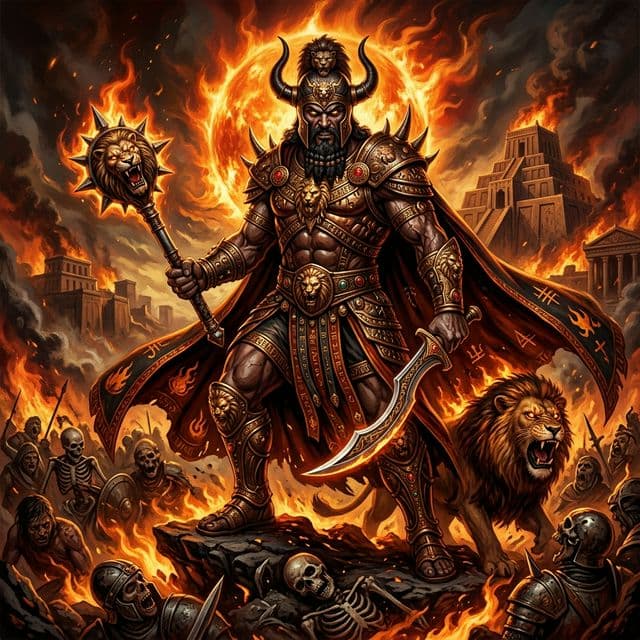
In one myth, the war god Nergal offends Ereshkigal and is summoned to the underworld. There, after a violent confrontation, they become lovers and he becomes her co-ruler, bringing the violence of plague and war into death's domain.
Origin story
When the cosmos was divided among the gods, Ereshkigal received the underworld as her domain. Abducted to the underworld in her youth (or given it as a dowry), she became its eternal queen. She was wed to Gugalanna, the Bull of Heaven, and later to the war god Nergal.
Across traditions
Parallel figures
Figures who play a role like Ereshkigal's in other traditions.
 GreekHadesIllustration
Both rule the underworld with absolute authority
Compare Ereshkigal and Hades side by side NorseHelIllustration
Both are female rulers of realms of the dead
Compare Ereshkigal and Hel side by side
Worship and cult
Temples, festivals, and practices recorded for Ereshkigal
Queen of the dead in Inanna's descent. Cult to the underworld was cautious and thin compared with Inanna's. Absence is the point: you do not throw a street fair for the grave.
Sacred sites
- Irkalla has no welcoming temple on earth
Family
In the atlas
Where Ereshkigal appears
Play the myth
Branching retellings featuring Ereshkigal: your choices decide the ending.
Sources and further reading
Source notes
These references are recorded in the catalog. Their passage wording and translation have not been checked, so quotations are not displayed here.
- Descent of Inanna
About this entry
By Elizabeth Stein for Mythos Atlas. About the author. Editorial notes are grounded in the site's cited sources and can be challenged through the contact page.
Parallels are editorial comparisons across traditions: a shared role does not, by itself, establish a shared origin.
Family relationships come from the atlas's kinship records. Ancient sources often disagree on divine genealogy.
Keep exploring
One myth a week, with its sources in a short email. The sign-up form is just below.
Genealogy
Family tree
Ereshkigal's parents, consorts, children and rivals, as recorded in the atlas.