Mesopotamian Pantheon
Gilgamesh
Also known as Bilgamesh
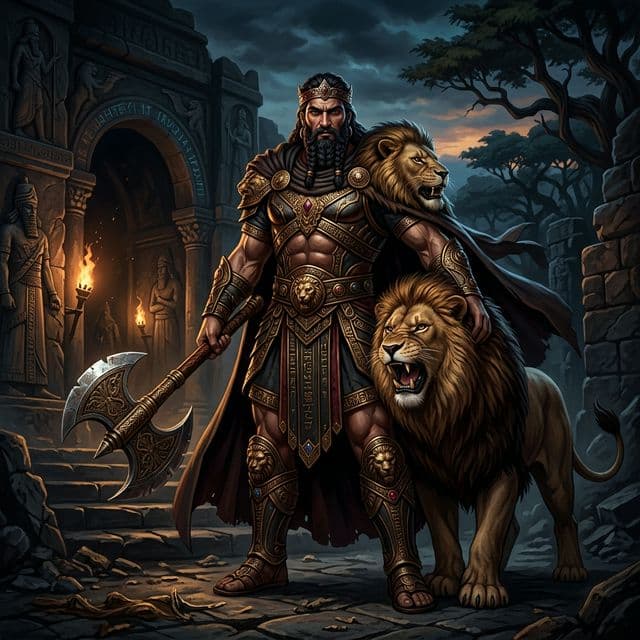
- heroism
- kingship
- mortality
- the underworld
The legendary king of Uruk, two-thirds divine and one-third mortal. Gilgamesh is the protagonist of humanity's oldest epic and a deified hero who became a judge of the underworld.
About Gilgamesh
The Hero-King of Uruk
Gilgamesh stands at the foundation of world literature as the protagonist of humanity's oldest known epic. While likely based on a historical king of Uruk around 2700 BCE, he became a legendary figure whose story explores the deepest questions of human existence: the meaning of friendship, the fear of death, and the nature of immortality.
Two-Thirds Divine
Gilgamesh was born of the goddess Ninsun and the mortal Lugalbanda, making him two-thirds divine and one-third human. This unique nature gave him superhuman strength and beauty but also mortality. His story is ultimately about the struggle to accept that even the greatest of heroes must die.
The Tyrant Transformed
In his early reign, Gilgamesh was a tyrannical king who exhausted his people with endless labor and exercised droit du seigneur over brides. The gods created Enkidu, a wild man of the steppe, to be his equal and counterbalance. Their friendship transformed Gilgamesh from tyrant to hero.
The Cedar Forest Quest
Gilgamesh and Enkidu ventured to the Cedar Forest to slay its guardian Humbaba and make their names eternal. This quest for glory would have far-reaching consequences, as killing Humbaba (and later the Bull of Heaven) brought divine retribution that claimed Enkidu's life.
The Search for Immortality
Devestated by Enkidu's death and terrified by the reality of his own mortality, Gilgamesh set out to find Utnapishtim, the survivor of the Great Flood who had been granted eternal life. His journey took him to the ends of the earth, through the tunnel beneath the mountains, and across the Waters of Death.
Acceptance
Gilgamesh failed to gain immortality, losing both the plant of youth to a serpent and his chance at eternal wakefulness. But he returned to Uruk with wisdom, understanding that his immortality lay in the walls he had built and the story of his deeds. In death, he became a judge of the underworld, achieving the divine status he had sought in life.
Origin story
Gilgamesh was born to the goddess Ninsun and the mortal king Lugalbanda. Endowed with superhuman strength and beauty but not immortality, he ruled Uruk as a tyrant until the gods created Enkidu to be his match. Their friendship transformed him, and his subsequent adventures and quest for immortality made him the subject of the world's first great literary epic.
Across traditions
Parallel figures
Figures who play a role like Gilgamesh's in other traditions.
 GreekHeraclesIllustration
Both are demigod heroes of superhuman strength who perform legendary feats
Worship and cult
Temples, festivals, and practices recorded for Gilgamesh
King first, ghost second. He appears in offering lists as a dead hero, not as a sky-god with a daily liturgy. The epic is the main temple.
Sacred sites
- Hero-cult traces at Uruk; funerary offerings in later lists
In the atlas
Where Gilgamesh appears
Sources and further reading
Source notes
These references are recorded in the catalog. Their passage wording and translation have not been checked, so quotations are not displayed here.
- Epic of Gilgamesh, Tablet I (Standard Babylonian Version)
Appears in
Ancient and classical works featuring this figure.
protagonist, king of Uruk seeking immortality after Enkidu's death (Tablets I-XI)
About this entry
By Elizabeth Stein for Mythos Atlas. About the author. Editorial notes are grounded in the site's cited sources and can be challenged through the contact page.
Parallels are editorial comparisons across traditions: a shared role does not, by itself, establish a shared origin.
Keep exploring
One myth a week, with its sources in a short email. The sign-up form is just below.
Genealogy
Family tree
Gilgamesh's parents, consorts, children and rivals, as recorded in the atlas.