Celtic Pantheon
Goibniu
Also known as Goibhniu, Govannon
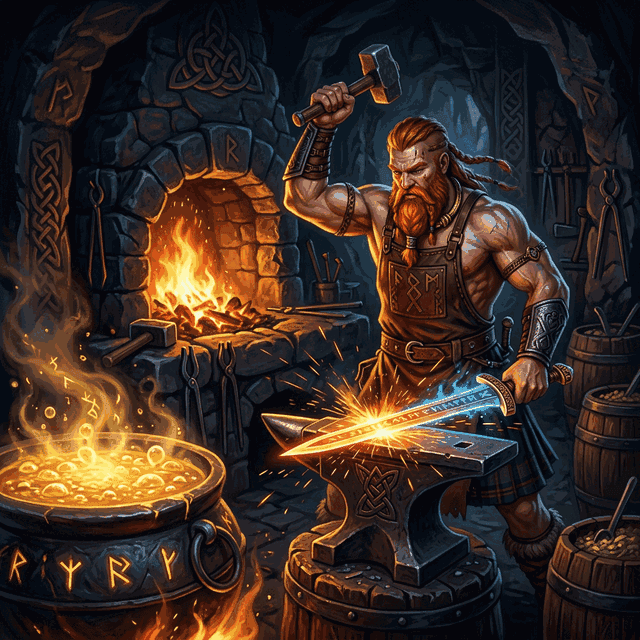
- smithing
- weapons
- brewing
- immortality
The divine smith who forges weapons that never miss and brews the ale of immortality. His hammer falls three times, and the weapon is complete.
About Goibniu
The Divine Smith
Goibniu stands at the forge of the gods, hammer in hand, crafting the weapons that defend the Tuatha Dé Danann against their enemies. He represents the sacred status of the smith in Celtic society—a figure who transforms raw earth into gleaming metal, who shapes the tools of war and agriculture alike.
The Three Brothers
Goibniu works alongside his brothers in a divine workshop. Creidhne the brazier handles the rivets and fittings; Luchta (or Luchtaine) the carpenter shapes the spear-shafts. When Creidhne throws a rivet, it fixes itself in place. When Luchta cuts a shaft, it needs no further shaping. And when Goibniu strikes his hammer three times, the weapon is complete. This tripartite craftsmanship reflects the Celtic love of threefold patterns.
The Second Battle of Mag Tuired
Before the great battle against the Fomorians, the Tuatha Dé Danann prepared for war. The smith-trio worked day and night: every broken spear was replaced overnight, every shattered sword reforged. Goibniu's weapons never failed—a spear forged by his hand would find its mark, a sword would never break. This industrious immortality of manufacture gave the Tuatha Dé Danann an insurmountable advantage.
The Feast of Goibniu
Beyond the forge, Goibniu is credited with brewing a magical ale called the Fled Goibnenn. Those who drink at this feast are preserved from age and sickness. The combination of smith and brewer may seem strange, but both crafts require mastery of fire and transformation—one turns ore to iron, the other grain to ale.
The Welsh Gofannon
In Welsh mythology, Goibniu appears as Gofannon fab Dôn, brother to Gwydion, Gilfaethwy, and Arianrhod. He slays his nephew Dylan Eil Ton, the sea-creature, with an accidental or fated blow—a deed considered one of the Three Unfortunate Blows of the Island of Britain.
Origin story
Goibniu is one of the **Trí Dé Dána**—the three gods of skill—alongside his brothers **Creidhne** (the brazier) and **Luchta** (the carpenter). Together they crafted the weapons of the Tuatha Dé Danann for the Second Battle of Mag Tuired. Goibniu worked at legendary speed: three blows of his hammer completed any weapon, and every spear he forged struck true. He also brewed the **Fled Goibnenn** (Feast of Goibniu), an ale that granted those who drank it immunity to age and disease. In the Welsh tradition, he appears as **Gofannon**, brother of the goddess Arianrhod.
Across traditions
Parallel figures
Figures who play a role like Goibniu's in other traditions.
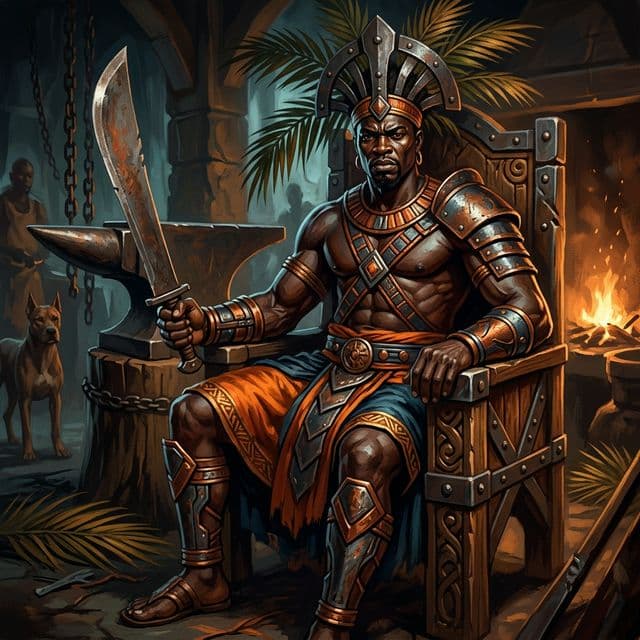 YorubaOgunIllustration
Both are divine smiths and patrons of ironworking, weapons, and technology
Compare Goibniu and Ogun side by side RomanVulcanIllustration
Both are divine smiths who forge weapons and tools for the rest of the pantheon
Compare Goibniu and Vulcan side by side
Worship and cult
Temples, festivals, and practices recorded for Goibniu
The smith who hosts the feast of immortality in the literature. Smith-gods leave tools and stories, not parish rolls. Honest absence of a festival list.
Sacred sites
- No attested temple in the surviving record
Family
Questions about Goibniu's family
- Who are Goibniu's siblings?
- Siblings of Goibniu recorded in the atlas: Dian Cécht.
Sources and further reading
Source notes
These references are recorded in the catalog. Their passage wording and translation have not been checked, so quotations are not displayed here.
- Cath Maige Tuired (trans. Gray)
About this entry
By Elizabeth Stein for Mythos Atlas. About the author. Editorial notes are grounded in the site's cited sources and can be challenged through the contact page.
Parallels are editorial comparisons across traditions: a shared role does not, by itself, establish a shared origin.
Family relationships come from the atlas's kinship records. Ancient sources often disagree on divine genealogy.
Keep exploring
One myth a week, with its sources in a short email. The sign-up form is just below.
Genealogy
Family tree
Goibniu's parents, consorts, children and rivals, as recorded in the atlas.