Egyptian Pantheon
Hathor
Also known as Het-Heru, Lady of Stars
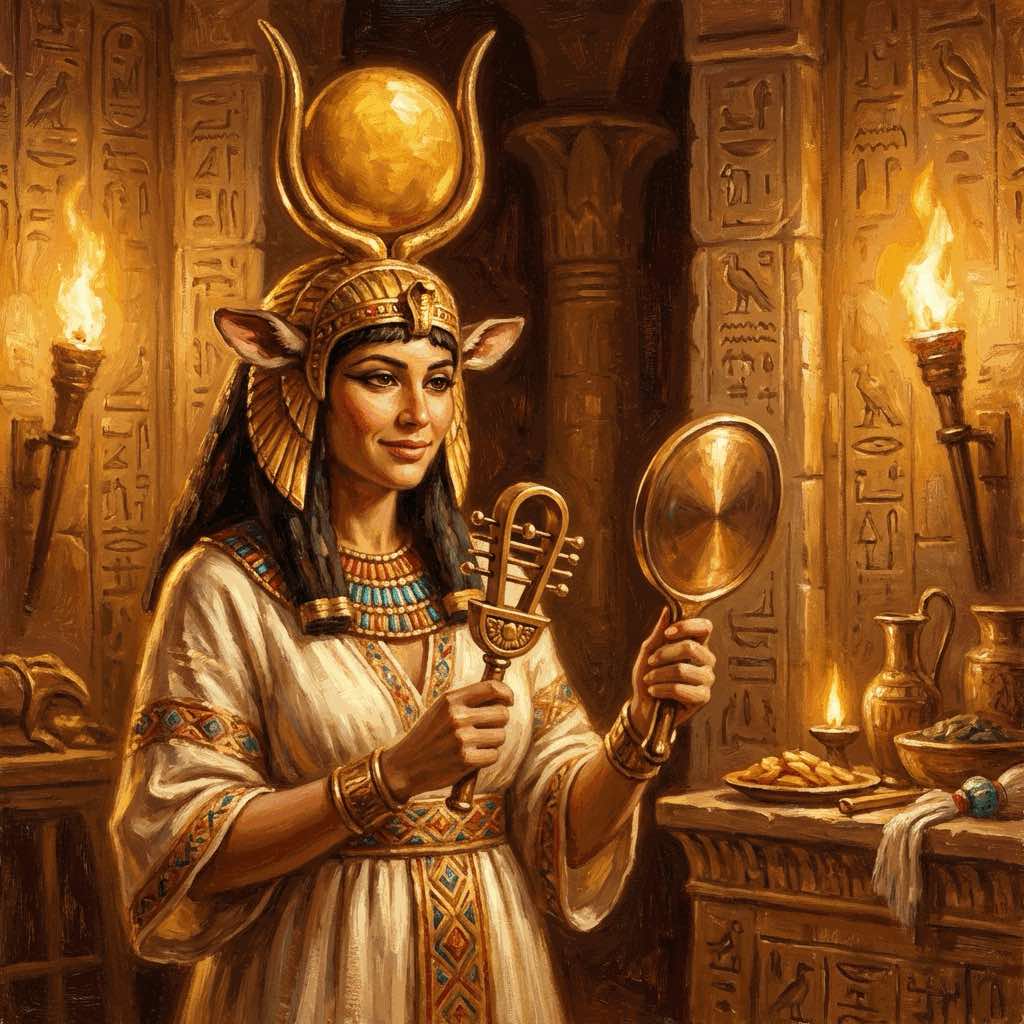
- love
- beauty
- music
- motherhood
- joy
- mining
Goddess of love, beauty, music, and motherhood. The 'Golden One' who embodies the feminine ideal. Protector of women.
About Hathor
Mistress of the West
Hathor, known as the "Golden One," is one of the most important and popular goddesses in Egyptian mythology. She embodies love, beauty, music, motherhood, joy, and feminine sexuality. As "Mistress of the West," she welcomed the dead into the afterlife, offering them food and drink.
Cosmic Mother
Hathor was considered a celestial cow goddess who gave birth to and nursed the pharaoh, making each king symbolically her son. The Milky Way was seen as milk flowing from her udders. She was the divine mother who nourished all of Egypt.
The Eye of Ra
In her fierce aspect, Hathor could become the Eye of Ra, a destructive force. In the famous myth, Ra sent her to punish rebellious humanity. As the lioness Sekhmet, she nearly destroyed all humankind until Ra flooded the fields with beer dyed red. Thinking it was blood, she drank it, became intoxicated, and transformed back into the gentle Hathor.
Music, Dance, and Sacred Animals
Hathor was the patroness of music and dance, with the sistrum rattle sacred to her worship. Cows were her sacred animals, and she was depicted either as a cow or as a woman with cow's ears and horns cradling the sun disk. Her main cult center was Dendera, which houses one of the best-preserved temples in Egypt.
Origin story
Hathor's origins trace to the earliest periods of Egyptian religion, where she was worshipped as a sky goddess, with her body forming the heavens. In some traditions, she was the wife of Horus and thus connected to kingship. In others, she was the daughter of Ra, the sun god's eye given form. As one of the oldest Egyptian deities, her worship predates written records. Her association with the cow likely stemmed from the nurturing, life-giving qualities Egyptians observed in cattle, making her a natural embodiment of divine motherhood.
Across traditions
Parallel figures
Figures who play a role like Hathor's in other traditions.
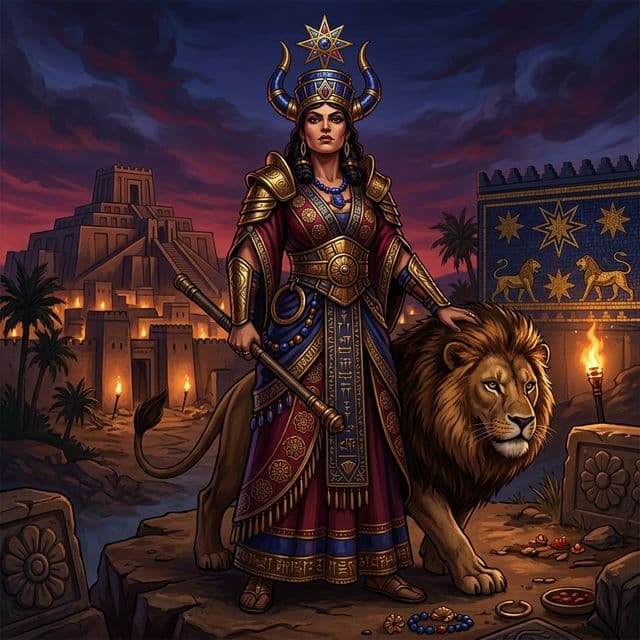 MesopotamianInannaIllustration
Both are goddesses combining love, beauty, and joyful sensuality
Compare Hathor and Inanna side by side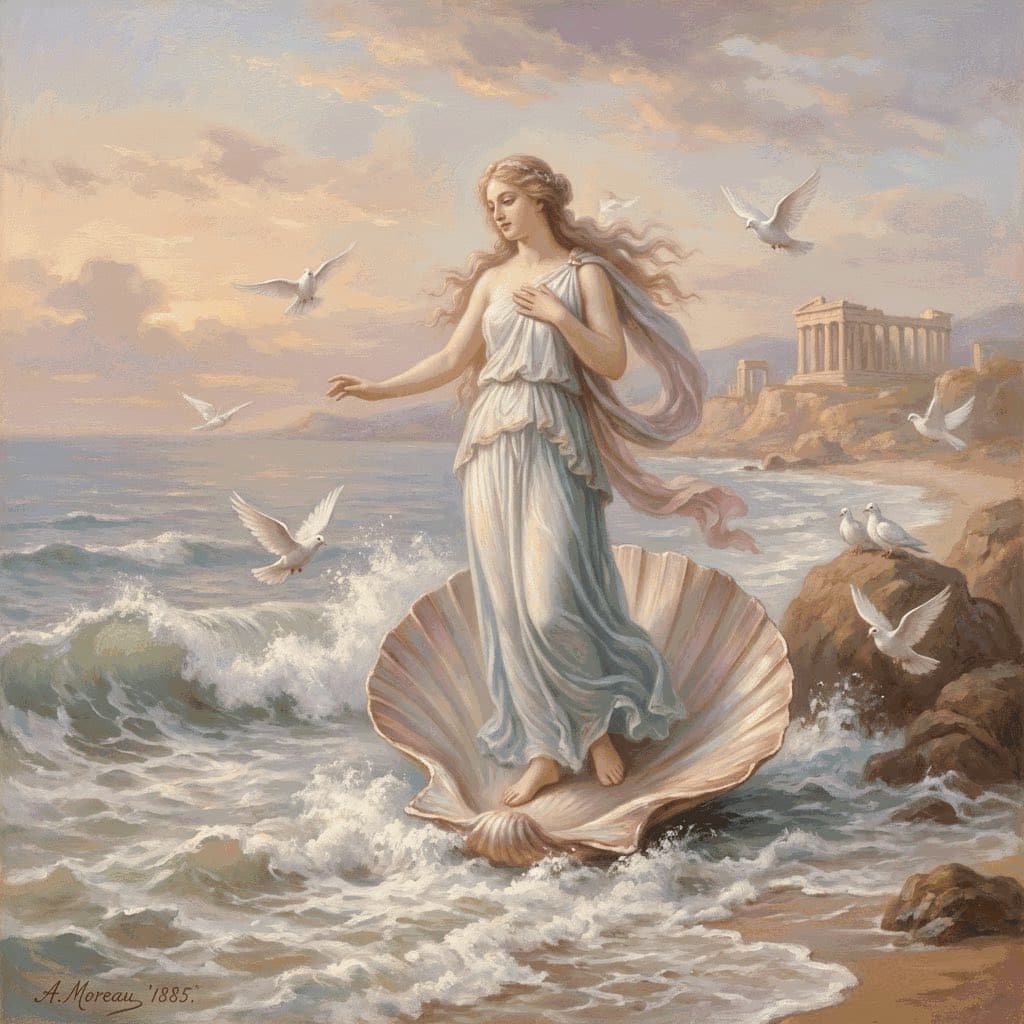 GreekAphroditeIllustration
Hathor's epithet 'the Golden One' parallels Aphrodite's 'Golden Aphrodite'; both are goddesses of love, beauty, and music
Compare Hathor and Aphrodite side by side
Worship and cult
Temples, festivals, and practices recorded for Hathor
Love, turquoise, and the sistrum. Dendera still shows the roof rituals. She can be a cow, a woman, or the angry eye. Miners in the desert left her stelae because the desert was hers too.
Sacred sites
- Dendera Temple of Hathor
- Mining-country shrines in Sinai and at Timna
Festivals
- Festival of the Beautiful Reunion (Dendera–Edfu)
- Hathor feasts of music and drunkenness
In the atlas
Where Hathor appears
In the museums
Hathor in art
Real objects in public collections, released into the public domain by the museums that hold them. Dates refer to when each object was made. Objects made within the tradition come first, later depictions after.
 (opens the museum record)
Ancient object
Menat counterpoise with figures of Hathor as a woman and a cow (opens the museum record)
A menat counterpoise, the weight balancing a beaded ceremonial necklace used in Hathor's cult, cast with images of the goddess as both a woman and a cow. The museum's own title names Hathor directly.
Sources and further reading
Source notes
These references are recorded in the catalog. Their passage wording and translation have not been checked, so quotations are not displayed here.
- Dendera temple hymns to Hathor (composite)
About this entry
By Elizabeth Stein for Mythos Atlas. About the author. Editorial notes are grounded in the site's cited sources and can be challenged through the contact page.
Parallels are editorial comparisons across traditions: a shared role does not, by itself, establish a shared origin.
Keep exploring
One myth a week, with its sources in a short email. The sign-up form is just below.
Genealogy
Family tree
Hathor's parents, consorts, children and rivals, as recorded in the atlas.