Celtic Pantheon
Midir
Also known as Midhir, Midir of Brí Léith
- otherworld
- pride
- horses
Lord of the Otherworld at Brí Léith, whose love for the mortal woman Étaín sparked wars between the fairy realms and the High King of Ireland.
About Midir
The Proud One
Midir the Proud is one of the great lords of the Tuatha Dé Danann, master of the síd at Brí Léith and central figure in one of the most romantic tales in Irish mythology. His love for Étaín spans centuries and the boundaries between worlds.
The Wooing of Étaín
The tale of Tochmarc Étaíne ("The Wooing of Étaín") is one of the most beloved stories in the Irish mythological cycle. Midir fell in love with the beautiful Étaín and made her his wife. His first wife Fuamnach, consumed with jealousy, used magic to transform Étaín into a pool of water, then a worm, then a jewel-colored fly. The wind blew Étaín across Ireland for seven years, and she was eventually swallowed by a mortal woman, reborn as a human child.
The Loss and Recovery
One thousand and twelve years after her transformation, Étaín—now mortal and married to Eochaid Airem, High King of Ireland—had forgotten her former life. Midir came to Tara and challenged Eochaid to games of fidchell (a board game). After losing deliberately several times, Midir wagered one kiss from Étaín. Eochaid agreed, Midir won—and when he kissed Étaín, her memories returned. They rose through the skylight as two swans and fled to Brí Léith.
The War with Eochaid
The High King was not content to lose his queen. He raised an army and dug into the síd mounds of Ireland, violating the Otherworld, until Midir released Étaín—or so it seemed. Midir had sent fifty women who looked identical to Étaín. Eochaid chose, but chose his own daughter by Étaín rather than Étaín herself, leading to incestuous tragedy. The tale is a meditation on memory, identity, and the dangers of meddling with the fairy realm.
The Three Cranes
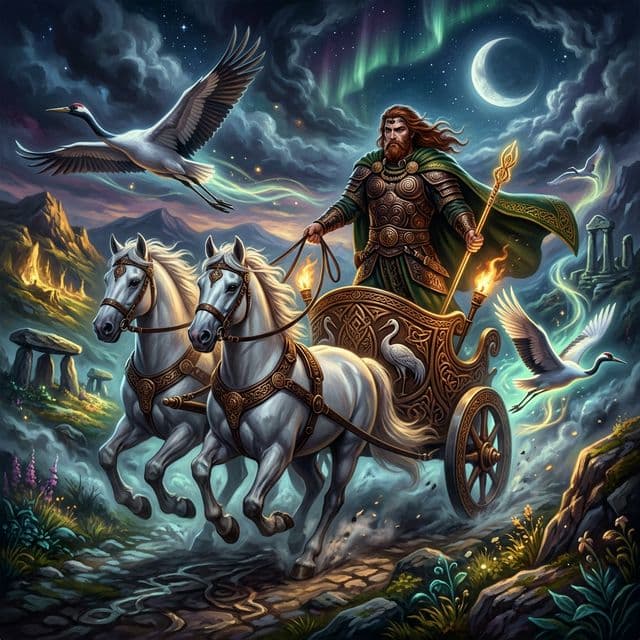
Midir's síd is guarded by three malevolent cranes who sit at the entrance and discourage travelers: one cries "Do not come!", another "Keep away!", the third "Go past!" These birds of ill-omen may be transformed enemies or guardians of the Otherworld's secrets.
Origin story
Midir is a son of **the Dagda** and a lord of the Tuatha Dé Danann. He rules the síd of **Brí Léith** (near modern Ardagh in County Longford), one of the greatest fairy mounds of Ireland. He fostered **Aengus Óg** and helped him win Brú na Bóinne from the Dagda. Midir's own great tale is his love for **Étaín**: his first wife Fuamnach, jealous of Étaín's beauty, transformed her into a fly and drove her from the Otherworld. After a thousand years and several rebirths, Étaín became a mortal queen of Ireland. Midir found her, won her back through a game of fidchell, and carried her away to the síd—sparking war between the fairy realm and the High King.
Worship and cult
Temples, festivals, and practices recorded for Midir
Tochmarc Etaine is the dossier. Sid mounds, not inscribed altars. Do not dress a literary rival of the Dagda as a reconstructed festival god.
Sacred sites
- Bri Leith in the sagas
Family
Questions about Midir's family
- Who are Midir's siblings?
- Siblings of Midir recorded in the atlas: Aengus Óg.
In the atlas
Where Midir appears
Stories
Sources and further reading
Source notes
These references are recorded in the catalog. Their passage wording and translation have not been checked, so quotations are not displayed here.
- Lady Gregory, Gods and Fighting Men (1904)
About this entry
By Elizabeth Stein for Mythos Atlas. About the author. Editorial notes are grounded in the site's cited sources and can be challenged through the contact page.
Parallels are editorial comparisons across traditions: a shared role does not, by itself, establish a shared origin.
Family relationships come from the atlas's kinship records. Ancient sources often disagree on divine genealogy.
Keep exploring
One myth a week, with its sources in a short email. The sign-up form is just below.
Genealogy
Family tree
Midir's parents, consorts, children and rivals, as recorded in the atlas.