Celtic Pantheon
Ogma
Also known as Ogmios, Oghma, Ogma Grianainech
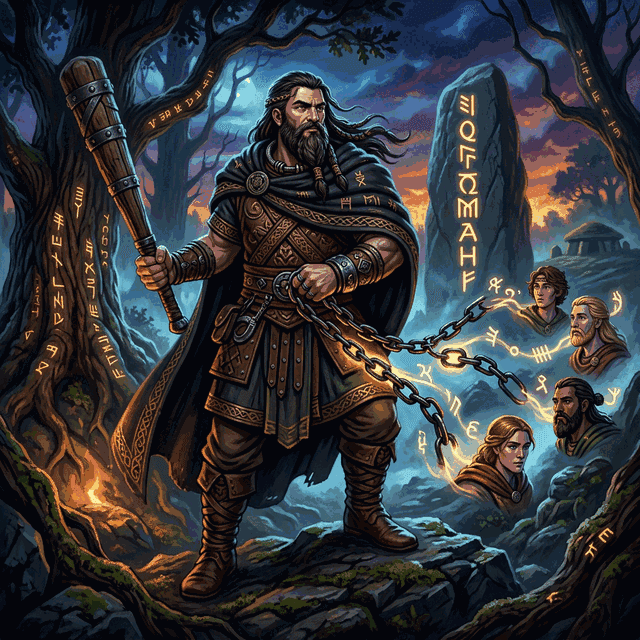
- eloquence
- language
- learning
- strength
Inventor of the Ogham alphabet and champion of the Tuatha Dé Danann. His eloquence binds listeners with chains of gold that flow from his tongue.
About Ogma
The Binding Tongue
Ogma embodies the paradox of eloquence: words that are stronger than force, speech that binds more surely than chains. He is both warrior and poet, champion and scholar—reflecting the Celtic reverence for the power of language and the status of the filí (poet-seer) in early Irish society.
Inventor of Ogham
Ogham is the earliest form of writing in Ireland, consisting of strokes and notches carved along the edge of standing stones. Each letter is named for a tree (birch, rowan, ash, etc.), connecting language to the natural world. According to the medieval text Auraicept na n-Éces ("The Scholar's Primer"), Ogma invented this script as a proof of his ingenuity, designed so that only the learned could understand it.
Ogmios: The Eloquent Hercules
The Greek satirist Lucian, visiting Gaul in the 2nd century CE, described a local god named Ogmios who puzzled him. Unlike the youthful Greek Heracles, Ogmios was depicted as an old man—yet he led a band of happy followers by delicate gold chains attached to his tongue and their ears. A local explained: the Celts believed that true strength lay in eloquence, which increases with age rather than fading. The willing prisoners represent souls captivated by persuasive speech.
Champion of the Tuatha Dé Danann
During the reign of Bres, when the Tuatha Dé Danann were oppressed, Ogma was reduced to carrying firewood—a humiliation for a god of his stature. In the Second Battle of Mag Tuired, he fought as champion, slaying the Fomorian king Indech and capturing his magical sword Orna. After the battle, this sword recounted all its deeds when unsheathed—a fitting trophy for the god of language.
The Face of the Sun
Ogma bears the epithet Grianainech ("Sun-Faced"), connecting him to light and clarity. This solar aspect links eloquence to illumination: the good speaker brings matters from darkness into understanding.
Origin story
Ogma is the son of **Elatha**, a Fomorian king, and therefore half-brother to the Dagda, Lugh, and Bres. Despite his mixed heritage, he fought for the Tuatha Dé Danann as their champion. In the Second Battle of Mag Tuired, he slew **Indech**, king of the Fomorians, and retrieved the sword **Orna**, which could recount the deeds it had performed when drawn. Ogma is credited with inventing **Ogham**, the earliest Irish writing system, whose letters are named after trees. The Greek writer Lucian described **Ogmios**, the Gaulish equivalent, as an old man leading willing captives by gold chains attached to his tongue—a vivid image of persuasive speech.
Across traditions
Parallel figures
Figures who play a role like Ogma's in other traditions.
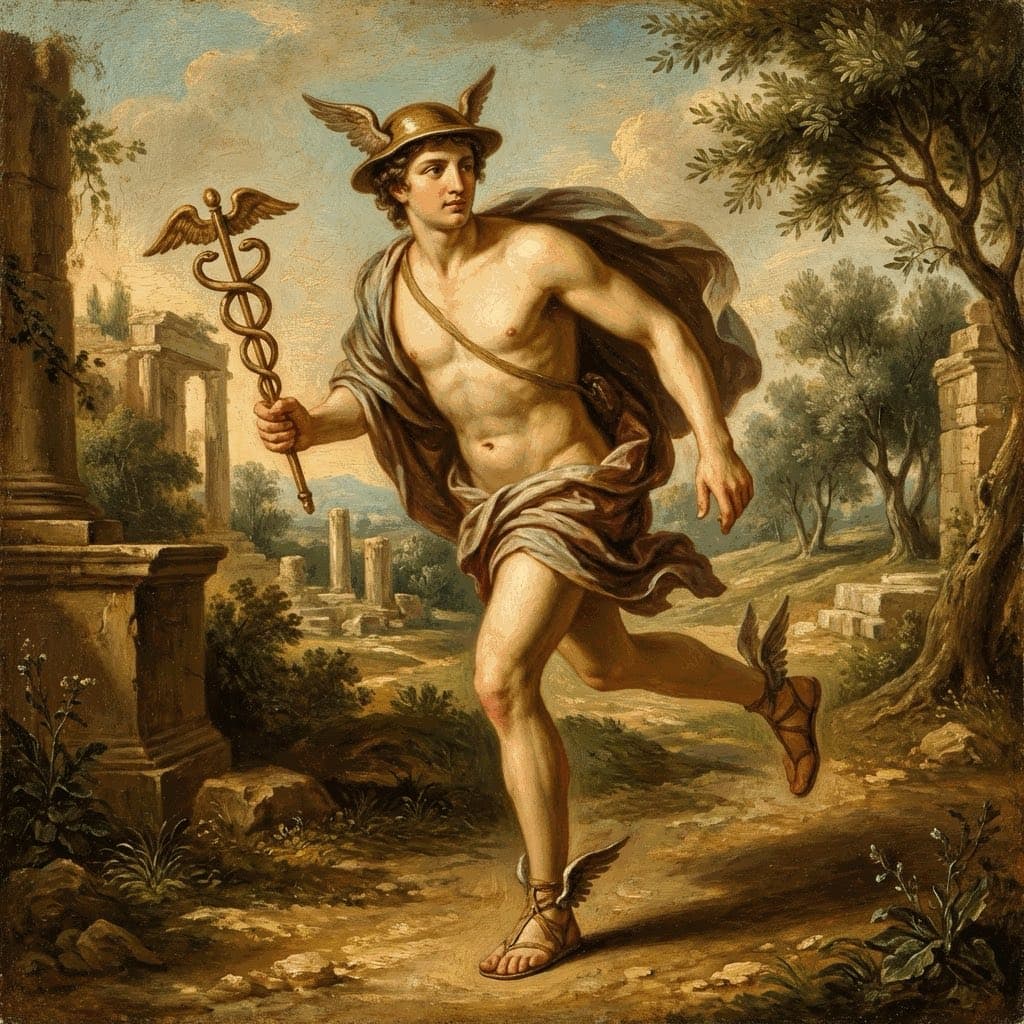 GreekHermesIllustration
Both are gods of eloquence, language, and learning
Compare Ogma and Hermes side by side
Worship and cult
Temples, festivals, and practices recorded for Ogma
Ogham and the strong-man of the Tuatha. Irish saga, not a recovered temple list. Treat him as a literary champion unless a site turns up.
Sacred sites
- No attested temple in the surviving record
Family
Questions about Ogma's family
- Who are Ogma's siblings?
- Siblings of Ogma recorded in the atlas: The Dagda.
Sources and further reading
Source notes
These references are recorded in the catalog. Their passage wording and translation have not been checked, so quotations are not displayed here.
- Cath Maige Tuired (trans. Gray)
About this entry
By Elizabeth Stein for Mythos Atlas. About the author. Editorial notes are grounded in the site's cited sources and can be challenged through the contact page.
Parallels are editorial comparisons across traditions: a shared role does not, by itself, establish a shared origin.
Family relationships come from the atlas's kinship records. Ancient sources often disagree on divine genealogy.
Keep exploring
One myth a week, with its sources in a short email. The sign-up form is just below.
Genealogy
Family tree
Ogma's parents, consorts, children and rivals, as recorded in the atlas.