Japanese Pantheon
Raijin
Also known as Raiden
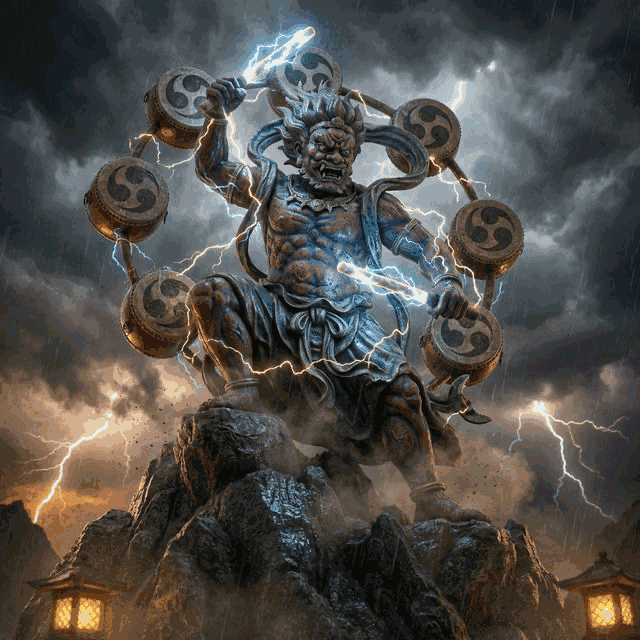
- thunder
- lightning
- storms
God of thunder, lightning, and storms. Depicted as a demon beating drums to create thunder. Works with Fujin (wind god).
About Raijin
The Thunder Kami
Raijin (also called Raiden) is the fearsome god of thunder and lightning, one of the most visually striking figures in Japanese mythology. He is typically depicted as a muscular demon with wild hair, surrounded by a ring of drums that he beats with ferocious energy to create the rumbling of thunder.
Iconography
Raijin's appearance reflects the Buddhist and folk influences that shaped his worship. He is shown with oni-like features—sharp fangs, horns, and red or blue skin—wearing only a loincloth of tiger skin. His drum circle, called taiko, produces both thunder and the sound that drives away evil spirits. The tomoe symbol, representing swirling thunderclouds, is closely associated with his worship.
Partnership with Fujin
Raijin and his brother Fujin (the wind god) are almost always depicted together, representing the complementary forces of storm and wind. Their most famous artistic representation adorns the gates of Sensoji Temple in Tokyo's Asakusa district, where massive statues of both gods guard the Kaminarimon (Thunder Gate). Together, they embody the awesome power of nature that inspires both fear and reverence.
Cultural Significance
In Japanese folklore, children are warned to cover their navels during thunderstorms, lest Raijin steal them. This belief connects him to both fear and the fertility-bringing rains essential for rice cultivation. Farmers have long prayed to Raijin for life-giving storms while also seeking protection from lightning strikes. His image appears on temple decorations, festival floats, and as a popular subject in tattoo art.
Origin story
According to myth, Raijin was born during the primordial creation period, emerging alongside the forces of nature themselves. Some traditions connect him to the thunder kami born from Izanami's decaying body in Yomi, the land of the dead. Over time, Buddhist influences shaped his iconic demonic appearance, transforming him into the fierce drum-beating figure known today.
Across traditions
Parallel figures
Figures who play a role like Raijin's in other traditions.
 NorseThorIllustration
Both are thunder gods who produce storms by striking a drum/hammer and are depicted as fearsome, muscular warriors
Compare Raijin and Thor side by side ChineseLei GongIllustration
Both are drum-wielding thunder gods who punish wrongdoing with lightning
Compare Raijin and Lei Gong side by side
Worship and cult
Temples, festivals, and practices recorded for Raijin
Drums at the gate. Farmers feared him; temples put him at the threshold as a guardian, not as a god you visit for counsel. Cult is apotropaic.
Sacred sites
- Temple gate statues with Fujin
- Local thunder shrines; no single national parish
Family
Questions about Raijin's family
- Who are Raijin's siblings?
- Siblings of Raijin recorded in the atlas: Fujin.
Sources and further reading
Source notes
These references are recorded in the catalog. Their passage wording and translation have not been checked, so quotations are not displayed here.
- Kojiki, Yomi episode (Chamberlain), with later folk identification
About this entry
By Elizabeth Stein for Mythos Atlas. About the author. Editorial notes are grounded in the site's cited sources and can be challenged through the contact page.
Parallels are editorial comparisons across traditions: a shared role does not, by itself, establish a shared origin.
Family relationships come from the atlas's kinship records. Ancient sources often disagree on divine genealogy.
Keep exploring
One myth a week, with its sources in a short email. The sign-up form is just below.
Genealogy
Family tree
Raijin's parents, consorts, children and rivals, as recorded in the atlas.