Mesopotamian Pantheon
Tiamat
Also known as Tamtu, Thalassa
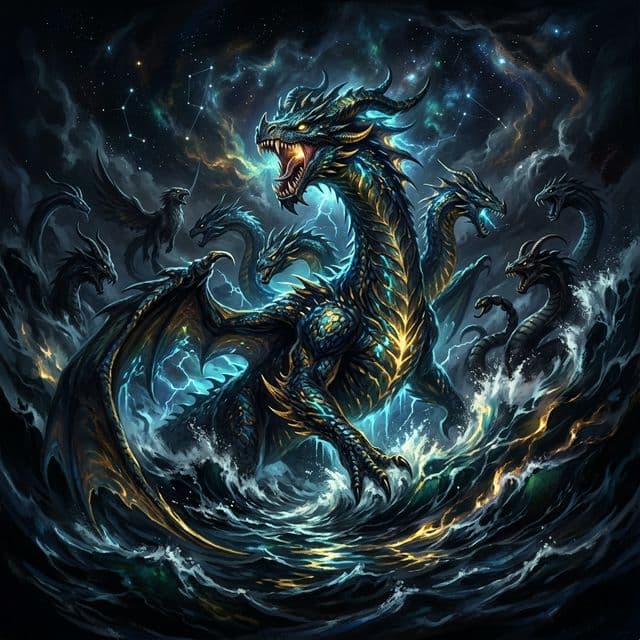
- primordial waters
- salt sea
- chaos
- creation
The primordial goddess of the salt sea and chaos dragon. Tiamat is the mother of the first gods and, after being slain by Marduk, became the raw material from which the universe was fashioned.
About Tiamat
The Primordial Mother
Tiamat represents the salt water of the primeval ocean, complementing her consort Apsu who embodied fresh water. Their mingling produced the first generation of gods. She is both creative and destructive, nurturing mother and terrifying dragon, embodying the ambivalent power of the primordial chaos from which order emerged.
Mother of Gods
From the union of Tiamat and Apsu came Lahmu and Lahamu, then Anshar and Kishar, and eventually the younger gods who would people the cosmos. Tiamat initially tolerated her noisy divine children, even when their clamor disturbed Apsu's rest. Only after Ea killed Apsu did Tiamat turn against her descendants.
The Chaos Dragon
When Tiamat went to war against the younger gods, she transformed into a vast dragon and created eleven monster-types to serve as her army: the Viper, the Dragon, the Sphinx, the Great Lion, the Mad Dog, the Scorpion-man, Dragonflies, the Fish-man, the Bull-man, Kulullu, and the Centaur. Leading them was her new consort Kingu, to whom she gave the Tablet of Destinies.
World-Body
Tiamat's greatest significance comes in death. When Marduk slew her, he split her body like a shellfish. Half became the sky, half the earth. Her eyes became the sources of the Tigris and Euphrates, her tail was bent up to form the heavens, her crotch supported the sky. The ordered cosmos exists within and upon her carcass.
Legacy
Tiamat's image as the primordial chaos dragon influenced countless later traditions, from the Hebrew tehom (deep) in Genesis to the Greek Thalassa to the dragon combat myths found throughout the ancient Near East and Mediterranean. She represents the necessary chaos that must be conquered for creation to exist.
Origin story
In the beginning, there was only salt water (Tiamat) and sweet water (Apsu), mingling together in the primordial void. From their union emerged the first gods. When the younger gods grew noisy, Apsu sought to destroy them but was killed by Ea. Tiamat mourned but was eventually persuaded to avenge him, transforming into a chaos dragon and creating an army of monsters.
Across traditions
Parallel figures
Figures who play a role like Tiamat's in other traditions.
 NorseYmirIllustration
Both are primordial beings from whose bodies the world is created
Compare Tiamat and Ymir side by side GreekGaiaIllustration
Both are primordial mothers who turn against the younger gods
Compare Tiamat and Gaia side by side
Worship and cult
Temples, festivals, and practices recorded for Tiamat
Primordial sea, cut up to make the world. Babylon's New Year recites her defeat. That is not a petitioning cult.
Sacred sites
- No attested temple in the surviving record
Festivals
- Enuma Elish recited at Akitu — about her death, not to her
In the atlas
Where Tiamat appears
Sources and further reading
Source notes
These references are recorded in the catalog. Their passage wording and translation have not been checked, so quotations are not displayed here.
- Enuma Elish, Tablet I
Appears in
Ancient and classical works featuring this figure.
Primordial salt-water sea dragon and mother of monsters who wages war against the younger gods (Tablets I-IV)
About this entry
By Elizabeth Stein for Mythos Atlas. About the author. Editorial notes are grounded in the site's cited sources and can be challenged through the contact page.
Parallels are editorial comparisons across traditions: a shared role does not, by itself, establish a shared origin.
Keep exploring
One myth a week, with its sources in a short email. The sign-up form is just below.
Genealogy
Family tree
Tiamat's parents, consorts, children and rivals, as recorded in the atlas.