Japanese Pantheonmyth
Amaterasu and the Heavenly Cave
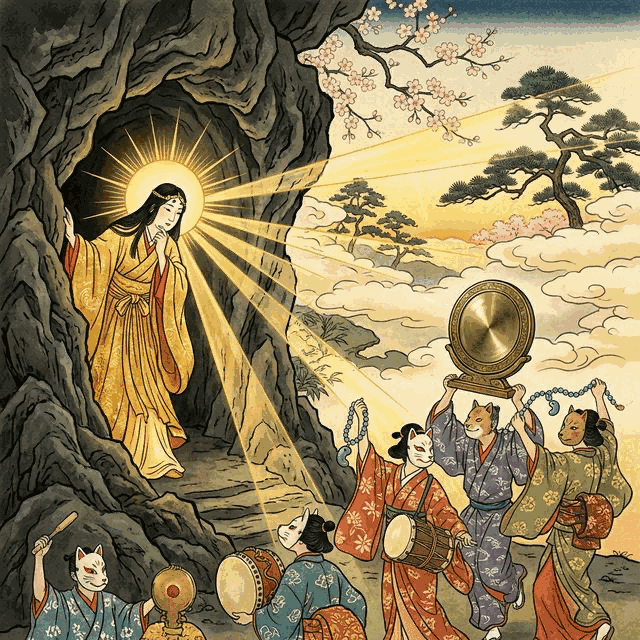
When Susanoo's violence drives Amaterasu into hiding in a cave, the world falls into darkness. The gods devise a plan to lure her out, restoring light to the world. Explains the importance of ritual.
An editorial retelling
The story
The Storm God's Rampage
Susanoo, the storm god, was jealous of his sister Amaterasu, the sun goddess. He went on a destructive rampage in her realm of the High Plain of Heaven. He destroyed her rice fields, defecated in her sacred halls, and finally threw a flayed pony through the roof of her weaving hall, killing one of her attendants.
Terrified and outraged, Amaterasu fled into the Heavenly Rock Cave (Ama-no-Iwato) and sealed the door shut. Instantly, the world was plunged into eternal night. Chaos reigned, and evil spirits swarmed in the darkness.
The Divine Plan
The eight hundred myriad kami gathered by the Heavenly River to figure out how to coax the sun back. Omoikane, the god of wisdom, devised a plan. They made a mirror (Yata no Kagami) and jewels (Yasakani no Magatama) and hung them on a Sakaki tree outside the cave.
Then, the goddess Ame-no-Uzume overturned a tub and began a wild, erotic dance upon it, stomping her feet and exposing herself. The gathered gods laughed and cheered so uproariously that the ground shook.
The Return of Light
Inside the cave, Amaterasu was puzzled. "Why are they celebrating when the world is dark?" She opened the stone door just a crack to peek out. "Why do you laugh?"
Uzume replied, "We rejoice because there is a new goddess here more illustrious than you!" At that moment, they held up the mirror. Amaterasu, seeing her own brilliant reflection and thinking it was another sun goddess, stepped forward in fascination.
A string god who was waiting in the shadows grabbed her hand and pulled her out, and a straw rope (shimenawa) was quickly tied across the entrance so she could not return. Light flooded the world once more, chasing away the shadows and evil spirits.
Listen or change reading mode
Highlights
Susanoo's pranks drive the sun into a cave. The world goes dark. Ame-no-Uzume performs a lewd dance to make the gods laugh. Amaterasu is lured out by a mirror and her own curiosity.
Why it matters
Explains the solar eclipse and the winter solstice. The mirror and jewels became part of the Imperial Regalia of Japan.
Quick answers
- What is the story of Amaterasu and the Heavenly Cave about?
- When Susanoo's violence drives Amaterasu into hiding in a cave, the world falls into darkness. The gods devise a plan to lure her out, restoring light to the world. Explains the importance of ritual.
- What themes does Amaterasu and the Heavenly Cave explore?
- The atlas lists these themes for Amaterasu and the Heavenly Cave: shared responsibility, power of laughter/arts, and restoration of order.
Sources and further reading
By Elizabeth Stein for Mythos Atlas. About the author. Editorial notes are grounded in the site's cited sources and can be challenged through the contact page.
Ancient sources
Quotations, paraphrases and verification notes. Each passage states what has been checked.
“So thereupon the Heaven-Shining-Great-August-Deity, terrified at the sight, closed [behind her] the door of the Heavenly Rock-Dwelling, made it fast, and retired.”
Kojiki · Part I, §XVI (p. 63)
Translation: Basil Hall Chamberlain
The Kojiki, trans. Basil Hall Chamberlain (1882), Sacred Texts 1919 web transcription; English-only replacement of prior unverified wording. Exact punctuation, bracketed interpolation, and wording checked against the cited English transcription. Japanese text was not retained or certified. English transcription checked 2026-09-23.
Read source“Then the Plain of High Heaven shook, and the eight hundred myriad Deities laughed together.”
Kojiki · Part I, §XVI (pp. 64–65)
Translation: Basil Hall Chamberlain
The Kojiki, trans. Basil Hall Chamberlain (1882), Sacred Texts 1919 web transcription; English-only replacement of prior unverified wording. Exact wording checked against the cited English transcription. Japanese text was not retained or certified. English transcription checked 2026-09-23.
Read sourceWorks cited
Keep exploring
One myth a week, with its sources in a short email. The sign-up form is just below.