Hindu Pantheonmyth
Samudra Manthan - Churning of the Ocean
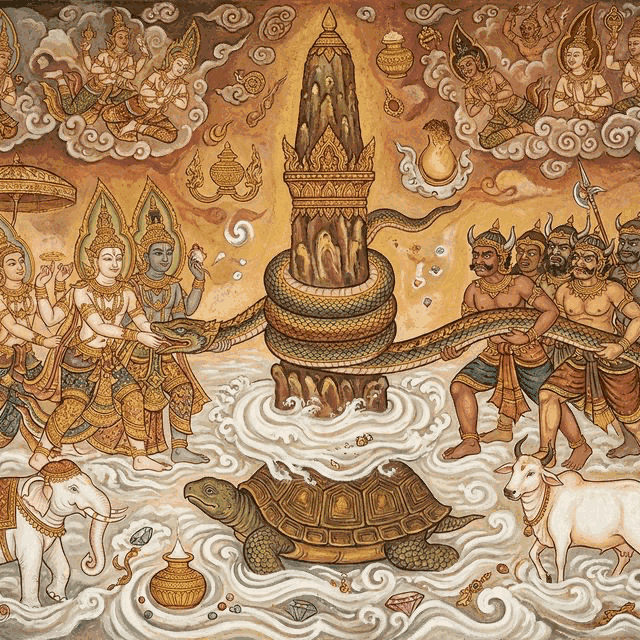
Gods and demons cooperate to churn the cosmic ocean to obtain amrita (nectar of immortality). Various precious things emerge, including Lakshmi, before finally the nectar appears.
An editorial retelling
The story
The Curse of Durvasa
Once, the Devas (gods) lost their glory and strength due to a curse from the sage Durvasa. The Asuras (demons) seized the opportunity to defeat them and take control of the universe. Desperate, the gods appealed to Vishnu, the Preserver.
Vishnu advised them to churn the Milky Ocean (Ksheera Sagara) to obtain Amrita, the nectar of immortality, which would restore their power. However, the task was too great for the gods alone. They had to form a diplomatic alliance with their enemies, the Asuras, promising to share the nectar.
The Great Churning
They used Mount Mandara as the churning rod and the giant serpent Vasuki as the rope. The gods held the tail, and the demons held the head (which spat poison). But the mountain began to sink into the ocean floor. Vishnu assumed his Kurma (tortoise) avatar, diving to the bottom to support the mountain on his back.
As they churned for a thousand years, the ocean first produced Halahala, a deadly poison that threatened to destroy all creation. Shiva, the Destroyer, stepped forward and drank the poison to save the world. Parvati, his consort, gripped his throat to stop the poison from reaching his stomach, turning his neck blue (hence his name Neelakantha).
Treasures of the Deep
Continued churning released fourteen distinct treasures (Ratnas), including:
- Kamadhenu, the wish-fulfilling cow
- Airavata, the white elephant
- The Moon (Chandra)
- Lakshmi, the goddess of wealth, who immediately chose Vishnu as her consort.
The Deception
Finally, Dhanvantari, the physician of the gods, emerged holding the pot of Amrita. The Asuras immediately snatched it. Chaos ensued.
Vishnu then transformed into Mohini, a breathtakingly beautiful enchantress. She distracted the Asuras and offered to distribute the nectar fairly. Mesmerized by her beauty, the Asuras agreed. Mohini seated the gods and demons in separate rows. She served the nectar only to the gods. One demon, Rahu, disguised himself as a god and took a sip. The Sun and Moon spotted him, and Vishnu cut off his head. Since the nectar had touched his throat, his head remained immortal (Rahu) while his body died (Ketu), causing eclipses by swallowing the sun and moon.
The gods, now immortal, defeated the Asuras and restored order to the cosmos.
Listen or change reading mode
Highlights
Vishnu as Kurma (the tortoise) supports the mountain. Shiva drinks the poison Halahala. Lakshmi emerges from the ocean. Vishnu as Mohini tricks the Asuras to give the nectar only to the gods.
Why it matters
Explain the origin of many divine items, the eclipses (Rahu/Ketu), and Shiva's blue throat. It symbolizes the spiritual process of churning one's mind to reach self-realization.
Quick answers
- What is the story of Samudra Manthan - Churning of the Ocean about?
- Gods and demons cooperate to churn the cosmic ocean to obtain amrita (nectar of immortality). Various precious things emerge, including Lakshmi, before finally the nectar appears.
- What themes does Samudra Manthan - Churning of the Ocean explore?
- The atlas lists these themes for Samudra Manthan - Churning of the Ocean: cooperation, greed vs wisdom, and divine intervention.
Sources and further reading
By Elizabeth Stein for Mythos Atlas. About the author. Editorial notes are grounded in the site's cited sources and can be challenged through the contact page.
Works cited
Keep exploring
One myth a week, with its sources in a short email. The sign-up form is just below.