Chinese Pantheonepic
Journey to the West
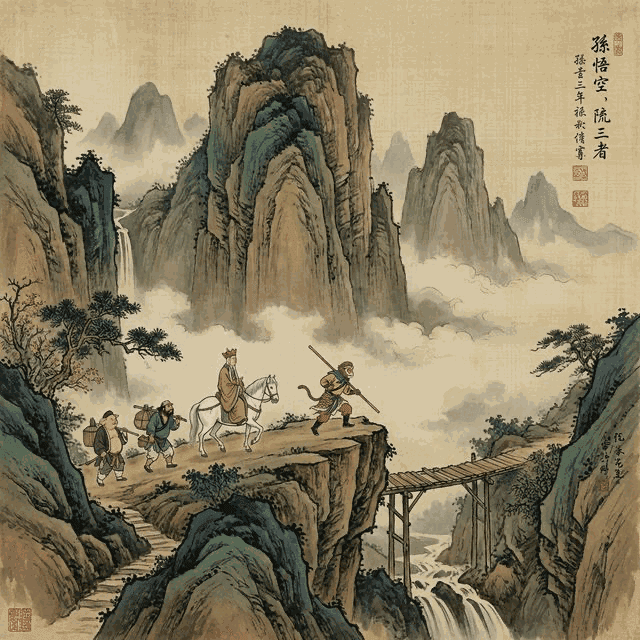
The legendary pilgrimage of the monk Tang Sanzang and his disciples (including Sun Wukong) to retrieve sacred Buddhist scriptures.
An editorial retelling
The story
The Monkey King
Sun Wukong was born from a stone egg atop the Mountain of Flowers and Fruit. He learned Taoist arts, mastered the 72 transformations, acquired a 13,500-pound cudgel that could shrink to the size of a needle, and erased his name from the Book of Life and Death. After wreaking havoc in Heaven and declaring himself the Great Sage Equal to Heaven, he was imprisoned under a mountain by the Buddha for 500 years.
The Pilgrimage
Decades later, the bodhisattva Guanyin arranged his release on the condition that he protect the monk Tang Sanzang on a journey to India (the West) to retrieve Buddhist sutras. They were joined by two other disciples seeking redemption: Zhu Bajie (Pigsy), a lecherous pig-demon, and Sha Wujing (Sandy), a river ogre.
The 81 Tribulations
The journey was a gauntlet of 81 trials. Demons sought to eat the monk's flesh to gain immortality. Beautiful spirits tried to seduce them. They faced flaming mountains, spider-women, and white-bone spirits.
Sun Wukong was the powerhouse, using his golden eyes to see through disguises and his cudgel to smash monsters. However, the monk constantly punished Wukong for his violence using a magical headache-inducing headband. The tension between the pacifist monk and the violent warrior is central to the story.
Enlightenment
After fourteen years and 108,000 miles, they reached Vulture Peak, received the scriptures from the Buddha, and returned to China. Wukong was granted Buddhahood for his service, becoming the Victorious Fighting Buddha. The story is a metaphor for the journey toward enlightenment, taming the 'monkey mind' (restless thoughts) through discipline.
Listen or change reading mode
Highlights
Sun Wukong's rebellion and imprisonment. The journey with Pigsy and Sandy. Battling the White Bone Spirit. Reaching the Western Heaven.
Why it matters
One of the Four Great Classical Novels of China. Sun Wukong is one of the most popular literary characters in East Asia.
Quick answers
- What is the story of Journey to the West about?
- The legendary pilgrimage of the monk Tang Sanzang and his disciples (including Sun Wukong) to retrieve sacred Buddhist scriptures.
- What themes does Journey to the West explore?
- The atlas lists these themes for Journey to the West: redemption, discipline, loyalty, and Buddhist philosophy.
Sources and further reading
By Elizabeth Stein for Mythos Atlas. About the author. Editorial notes are grounded in the site's cited sources and can be challenged through the contact page.
Works cited
Wu Cheng'en
Keep exploring
One myth a week, with its sources in a short email. The sign-up form is just below.