Hindu Pantheonepic
The Mahabharata
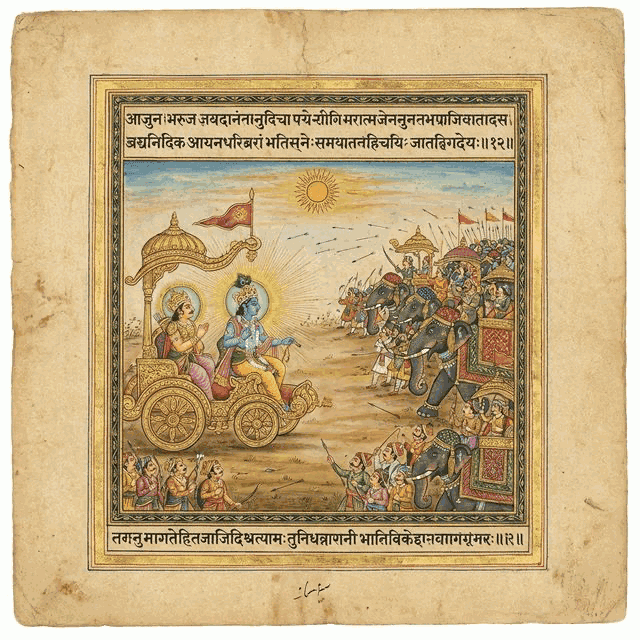
Epic saga of the conflict between the Pandavas and Kauravas for the throne of Hastinapura, culminating in the great Kurukshetra war. Contains the Bhagavad Gita.
An editorial retelling
The story
The Game of Dice
The dynastic struggle centered on two sets of cousins: the five Pandavas (sons of Pandu, though divinely fathered) and the one hundred Kauravas (sons of the blind king Dhritarashtra). Current King Duryodhana of the Kauravas, jealous of the Pandavas' prosperity, invited the eldest Pandava, Yudhishthira, to a rigged game of dice.
Yudhishthira, bound by honor and addicted to gambling, lost everything: his kingdom, his brothers, himself, and finally their shared wife, Draupadi. The Kauravas humiliated Draupadi in the court, attempting to disrobe her, but Krishna miraculously made her sari endless, protecting her dignity. The Pandavas were sentenced to thirteen years of exile.
The Bhagavad Gita
When the exile ended, the Kauravas refused to return the kingdom. War became inevitable. The armies gathered at Kurukshetra. Arjuna, the greatest archer of the Pandavas, looked across the battlefield and saw his cousins, teachers, and elders arrayed against him. Overcome with grief at the prospect of killing his kin, he dropped his bow.
Krishna, acting as Arjuna's charioteer (and revealed as the Supreme God), paused time to deliver the Bhagavad Gita. He taught Arjuna about the immortality of the soul, the duty of a warrior (dharma), and the path of selfless action (Karma Yoga). He urged Arjuna to fight not for gain, but to uphold righteousness.
The Great War
The war lasted eighteen days and involved millions of warriors. It was a war of devastating weaponry and complex morality. The code of chivalry broke down. The great grandsire Bhishma fell on a bed of arrows. The teacher Drona was tricked into laying down his arms. Karna, the secret eldest brother of the Pandavas fighting for the enemy, was killed while his chariot wheel was stuck.
In the end, the Pandavas won, but the victory was pyrrhic. Almost all the warriors on both sides were dead. The 100 Kauravas were slain. The Pandavas ruled for 36 years, seeking redemption for the sins of the war, before renouncing the world and climbing the Himalayas to reach heaven.
Listen or change reading mode
Listen to the recording (about 3 min, AI-narrated)
Highlights
The game of dice and humiliation of Draupadi. Krishna delivering the Bhagavad Gita to Arjuna. The 18-day war of Kurukshetra where righteousness triumphs at great cost.
Why it matters
The longest epic poem known to man. It is a comprehensive guide to life, ethics, philosophy, and governance in Hinduism.
Quick answers
- What is the story of The Mahabharata about?
- Epic saga of the conflict between the Pandavas and Kauravas for the throne of Hastinapura, culminating in the great Kurukshetra war. Contains the Bhagavad Gita.
- What themes does The Mahabharata explore?
- The atlas lists these themes for The Mahabharata: dharma, karma, futility of war, and divine will.
Sources and further reading
By Elizabeth Stein for Mythos Atlas. About the author. Editorial notes are grounded in the site's cited sources and can be challenged through the contact page.
Ancient sources
Quotations, paraphrases and verification notes. Each passage states what has been checked.
“I am the mighty world-destroying Time, here made manifest for the purpose of infolding the world.”
Srimad-Bhagavad-Gita · 11.32 (p. 259)
Translation: Swami Swarupananda
Early-20th-century Swami Swarupananda translation, public-domain Sacred Texts web transcription; English-only replacement of prior unverified wording. Exact wording checked against the cited page at verse 32. Sacred Texts identifies the translation as English and public domain; only the English transcription was reviewed. English transcription checked 2026-09-23.
Read source“Discriminating then between righteousness, and unrighteousness, and understanding what is meant by covetousness and having recourse to exertion fight without arrogance, for victory is there where righteousness is.”
Mahabharata, Bhishma Parva · Book 6, Section XXI, Arjuna’s reply to Yudhishthira
Translation: Kisari Mohan Ganguli
Ganguli translation, Internet Sacred Text Archive transcription; replaces the unsupported Udyoga Parva attribution. English excerpt checked against the cited transcription on 2026-09-23; no original-language text is supplied. This replaces the previously unverified passage.
Read sourceWorks cited
Vyasa
Keep exploring
One myth a week, with its sources in a short email. The sign-up form is just below.