Mythos Atlas

Hindu Pantheonepic

The Ramayana

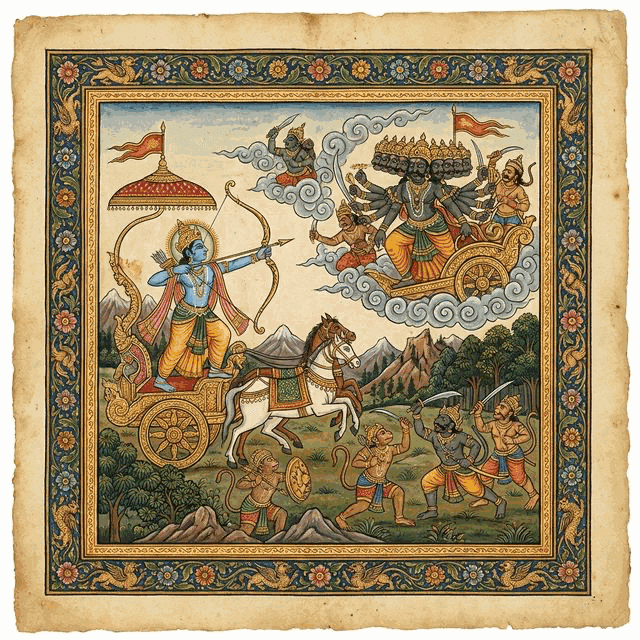
Illustration of the myth "The Ramayana" from the Hindu Pantheon
Illustrative imageStory illustration. Historical objects are identified separately with their museum records. Generated with an AI image model; not a historical artifact. About our images

Epic tale of Prince Rama's exile, the abduction of his wife Sita by demon king Ravana, and the great war to rescue her. Demonstrates the ideals of dharma, duty, devotion, and righteous conduct.

An editorial retelling

The story

The Perfect Prince

Rama, the eldest son of King Dasharatha of Ayodhya, was the embodiment of virtue and the perfect heir. He was also an avatar of the preserver god Vishnu, born to rid the world of the demon king Ravana. However, on the eve of his coronation, his stepmother Kaikeyi invoked an old boon, forcing the king to banish Rama to the forest for fourteen years and crown her own son, Bharata, instead.

Rama accepted his father's command without resentment, honoring his dharma (duty). He departed for the wilderness, accompanied by his devoted wife Sita (avatar of Lakshmi) and his loyal brother Lakshmana.

The Abduction of Sita

In the forest of Dandaka, the trio lived as ascetics, battling demons who threatened the sages. Their presence attracted the attention of Ravana, the ten-headed Rakshasa king of Lanka. Ravana engineered a diversion: a golden deer that Sita desired. While Rama and Lakshmana were drawn away, Ravana engaged Sita, kidnapped her, and flew her south to his island fortress of Lanka.

Sita, fiercely loyal to Rama, refused Ravana's advances and was held captive in the Ashoka garden, dreaming of her rescue.

The Search and the War

Rama and Lakshmana began a desperate search. They forged an alliance with the Vanaras (monkey race), led by the exiled king Sugriva and his mighty general Hanuman. Hanuman, son of the wind god, leaped across the ocean to Lanka, found Sita, and assured her of Rama's coming. He then allowed himself to be captured, set his tail on fire, and burned down the golden city of Lanka before escaping.

The monkey army built a bridge of floating stones across the ocean. Rama led his forces to Lanka, where a terrible war raged. Ravana, protected by boons that made him immune to gods and demons (but not humans), was formidable. But Rama, fighting as a mortal man, eventually pierced Ravana's heart with the Brahmastra weapon.

The Trial by Fire

With Ravana dead, Sita was freed. But Rama, bound by the strict codes of honor and public perception, hesitated to accept her back, fearing rumors about her purity after living in another man's house. To prove her chastity, Sita entered a blazing fire. Agni, the fire god, carried her out unharmed, testifying to her absolute purity.

Rama revealed he knew her truth all along but needed the world to witness it. They returned to Ayodhya, where Rama was crowned king (Ram Rajya), establishing a golden age of righteousness.
Listen or change reading mode

Listen to the recording (about 4 min, AI-narrated)

Text-to-speech is not supported in your browser.

Highlights

Rama accepts 14 years of exile. Sita is kidnapped by Ravana. Hanuman burns Lanka. Rama kills Ravana. Sita performs the Agni Pariksha (trial by fire) to prove her purity.

Why it matters

The Ramayana presents the ideals of human relationships: the ideal son, brother, wife, and king. It is a cornerstone of Hindu ethics and culture.

Quick answers

What is the story of The Ramayana about?
Epic tale of Prince Rama's exile, the abduction of his wife Sita by demon king Ravana, and the great war to rescue her. Demonstrates the ideals of dharma, duty, devotion, and righteous conduct.
What themes does The Ramayana explore?
The atlas lists these themes for The Ramayana: dharma (duty), devotion, honor, and good vs evil.

One myth, many tellings

How do major Ramayanas tell Sita's abduction and ordeal?

There is no single Ramayana. Later devotional tellings protect Sita from Ravana's touch: Kamban has him carry away her cottage without touching her, and the Adhyatma and Tulsidas versions have Ravana carry off only an illusory Sita.

  1. 1 · 200 BCEValmiki Ramayana
  2. 2 · 1150 CEKamba Ramayanam
  3. 3 · 1400 CEAdhyatma Ramayana
  4. 4 · 1575 CETulsidas, Ramcharitmanas
  • Told this way
  • Told differently
  • Not narrated here
  • Text lost or broken
  • Shaded source: comparison baseline

1. Valmiki Ramayana

Ralph T. H. Griffith, The Rámáyan of Válmíki (1870–1874)

composed c. 5th century BCE to 3rd century CE

Primary source · comparison baseline

Read the passage (opens a new tab)
The golden deer
Told this wayMárícha becomes the golden deer, and Ráma goes to hunt him (Griffith, Book III, Canto XLIII).
Ravana takes Sita
Told this wayRávana clasps Sítá and sets her in his car (Griffith, Book III, Canto XLIX).
Hanuman finds her in Lanka
Told this wayHanumán searches the ashoka grove and finds her there (Griffith, Book V, Cantos XIV–XV).
War and Ravana's death
Told this wayRávana dies in the battle (Griffith, Book VI, Canto CX).
Sita's trial by fire
Told this waySítá answers the charge and is restored after the battle (Griffith, Book VI, Cantos CXVII–CXX).
Sita's later banishment
Told this wayNot in Griffith's Books I–VI, which end at the consecration (Book VI, Canto CXXX). The banishment is told in the Uttara Kanda, often printed as Book VII and widely regarded as a later addition; that book is not in the edition linked here.

2. Kamba Ramayanam

V. S. Mudaliar, condensed English version (1970)

12th century

Medieval

The golden deer
Told this wayMaricha appears as a golden deer and Rama hunts him (Mudaliar, Aranya Kandam).
Ravana takes Sita
Told differentlyRemembering a curse, Ravana does not seize Sita. He digs out her hut and carries her inside it (Mudaliar, Aranya Kandam).
Hanuman finds her in Lanka
Told this wayHanuman finds her in the ashoka grove, guarded by rakshasis (Mudaliar, Sundara Kandam).
War and Ravana's death
Told this wayRavana is killed; Vibhishana is crowned, and Hanuman tells Sita (Mudaliar, Yuddha Kandam).
Sita's trial by fire
Told this waySita leaps into the fire. The fire-god brings her out unburnt and returns her to Rama (Mudaliar, Yuddha Kandam).
Sita's later banishment
Not narrated hereThis six-kandam version ends at Rama's coronation and does not tell a later banishment.

3. Adhyatma Ramayana

Lala Baij Nath translation (Sacred Books of the Hindus, 1912)

c. 14th-15th century

Medieval

Read the passage (opens a new tab)
The golden deer
Told this wayMaricha becomes a golden deer and the illusory Sita asks Rama to catch it (Baij Nath, Aranya Kanda, chapters VI–VII).
Ravana takes Sita
Told differentlyRama tells Sita to leave a shadow of herself and live in the fire for a year. She does, and Ravana takes the shadow (Aranya Kanda, chapter VII, verses 1–4).
Hanuman finds her in Lanka
Told this wayHanuman finds her under a shimshapa tree in the ashoka grove (Sundara Kanda, chapter III).
War and Ravana's death
Told this wayRama's arrow tears out Ravana's heart and he falls (Yuddha Kanda, chapter XI, verses 69–75).
Sita's trial by fire
Told differentlyThe fire returns the Sita entrusted to it in the forest. The illusory Sita disappears (Yuddha Kanda, chapter XIII, verses 19–21).
Sita's later banishment
Told this wayRama tells Lakshmana to leave her near Valmiki's ashram (Uttara Kanda, chapter IV, verses 55–59).

4. Tulsidas, Ramcharitmanas

F. S. Growse, The Ramayana of Tulsi Das (1883)

1574-c. 1577

Medieval

Read the passage (opens a new tab)
The golden deer
Told this wayMaricha takes a golden deer's form and Rama hunts him (Growse, Forest, doha 22).
Ravana takes Sita
Told differentlySita enters the fire and leaves an image of herself (Forest, doha 19). Ravana seats that Sita in his chariot (doha 24).
Hanuman finds her in Lanka
Told this wayHanuman goes to the ashoka grove and sees her there (Growse, The Beautiful, after doha 7; her mourning is doha 8).
War and Ravana's death
Told this wayRama shoots thirty-one shafts: one dries the nectar in Ravana's navel and the others strike off his heads and arms. The earth reels as he falls (Growse, Lanka, chhand 29).
Sita's trial by fire
Told differentlySita enters the fire. Her shadow and the stain of disgrace are consumed, and Fire leads her back to Rama (Growse, Lanka, dohas 105–106).
Sita's later banishment
Not narrated hereGrowse's introduction says the Sequel omits Sita's exile and tells the story of Kakabhushundi instead.

Dates are approximate. For manuscripts copied long after composition, the chronology uses the estimated date of the telling.

Sources and further reading

By Elizabeth Stein for Mythos Atlas. . Editorial notes are grounded in the site's cited sources and can be challenged through the contact page.

Ancient sources

Quotations, paraphrases and verification notes. Each passage states what has been checked.

Direct quotation

“Ráma in truth and goodness bold Is Virtue's self in human mould, The sovereign of the world confessed As Indra rules among the Blest.”

Ramayana, Book III · Canto XXXVII, Márícha’s Speech, four lines beginning “Ráma in truth”

Translation: Ralph T. H. Griffith

1870–1874; Sacred Texts transcription. Canto numbering belongs to this English edition; verse whitespace normalized. English transcription checked 2026-09-23. Replaces prior unverified wording; no original-language text is supplied or certified.

Read source
Direct quotation

“He laid it on the twisted cord, He turned the point at Lanká's lord, And swift the limb-dividing dart Pierced the huge chest and cleft the heart, And dead he fell upon the plain Like Vritra by the Thunderer slain.”

Ramayana, Yuddha Kanda · Book VI, Canto CX, Rávan’s Death; six lines beginning ‘He laid it on the twisted cord’

Translation: Ralph T. H. Griffith

Griffith translation, Internet Sacred Text Archive transcription; this canto numbering belongs to the cited English edition. English excerpt checked against the cited transcription on 2026-09-23; no original-language text is supplied. This replaces the previously unverified passage.

Read source

Works cited

  1. Ramayanaprimary

    Valmiki

Keep exploring

One myth a week, with its sources in a short email. The sign-up form is just below.

Free to read, no ads. Optional support.