Hindu Pantheon
Brahma
Also known as Pitamaha, Svayambhu
- creation
- knowledge
- time
- universe
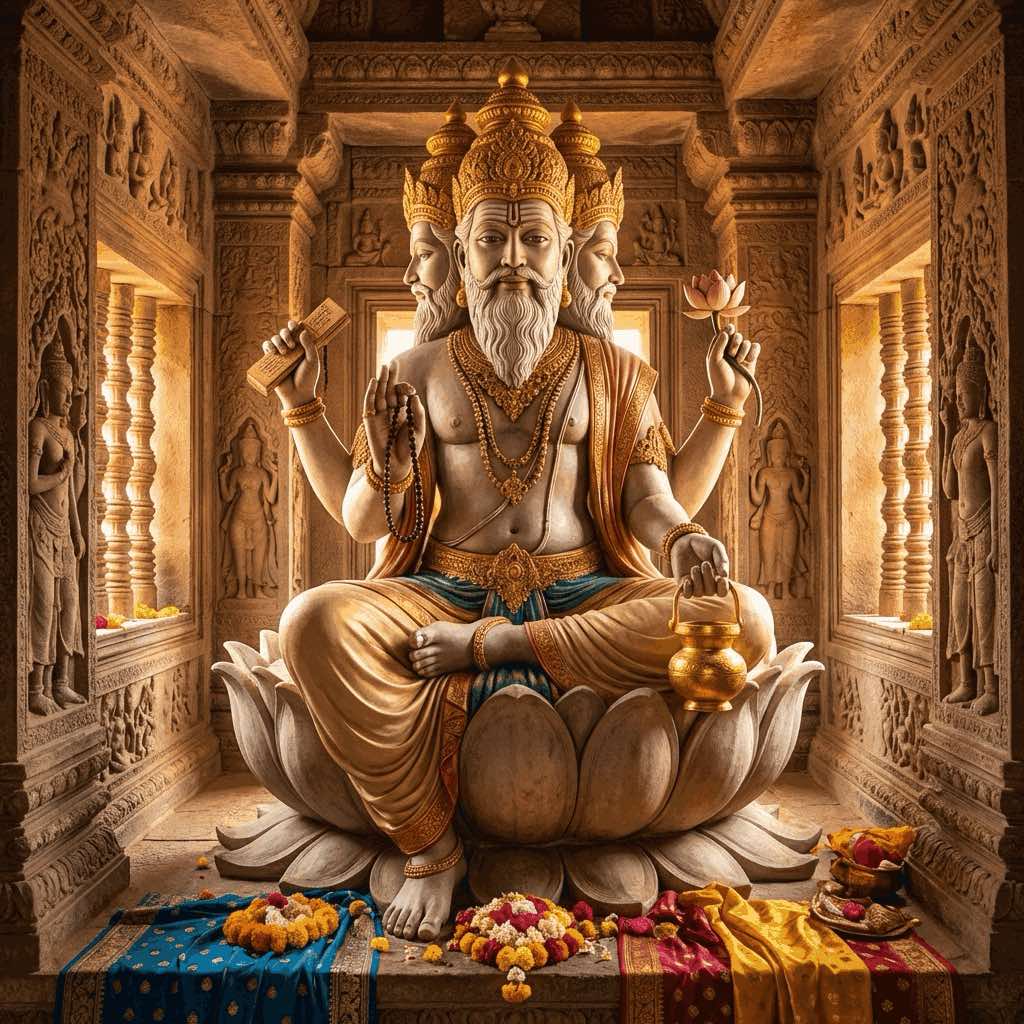
The creator god and first member of the Trimurti. Brahma created the universe and all creatures. Depicted with four heads facing the four directions, representing omniscience.
About Brahma
The Creator of the Universe
Brahma is the first god of the Hindu Trimurti (trinity), the cosmic creator who brings forth the universe at the beginning of each cycle of existence. He is depicted with four heads facing the cardinal directions, symbolizing his all-seeing nature and the four Vedas that emanated from his mouths.
The Four Vedas
From Brahma's four heads came the Rigveda, Yajurveda, Samaveda, and Atharvaveda—the foundational scriptures of Hinduism. He holds prayer beads (akshamala), a water pot (kamandalu), the Vedas, and a lotus, representing his roles in creation and knowledge.
Brahma's Curse
Despite being the creator, Brahma has few temples dedicated to him. Legend says that Shiva cursed him for lying about finding the end of a cosmic pillar of light. His consort Saraswati is the goddess of knowledge, arts, and music.
Cosmic Time
A single day of Brahma (Kalpa) equals 4.32 billion human years. The universe is created at dawn and dissolved at dusk, to be recreated again. The mantra "Om Brahmane Namah" honors him.
Origin story
Brahma emerged from a golden egg (Hiranyagarbha) or from a lotus growing from Vishnu's navel. He created the world and all beings, including the gods and sages.
Across traditions
Parallel figures
Figures who play a role like Brahma's in other traditions.
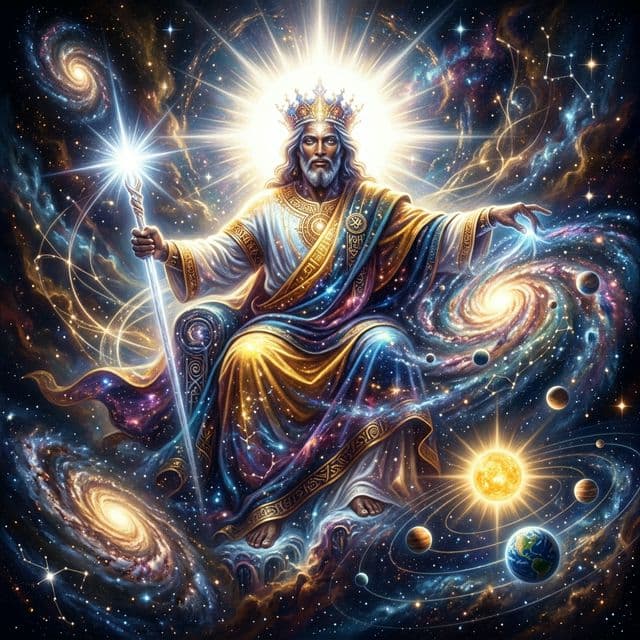 YorubaOlodumareIllustration
Both are the remote supreme creator deity of their pantheon, rarely worshipped directly compared to more active gods
Compare Brahma and Olodumare side by side
Worship and cult
Temples, festivals, and practices recorded for Brahma
Creator with almost no temples. Pushkar is the exception pilgrims name. The four heads, the Vedas, and the curse of Shiva are how later Hinduism explains the empty calendar. Worship is the Gayatri and the idea of creation, not a festival circuit.
Sacred sites
- Brahma temple at Pushkar, the rare major seat
- Smaller Brahma shrines, often paired with a curse-story explaining the scarcity
Festivals
- Kartik Purnima at Pushkar
Family

In the atlas
Where Brahma appears
Stories
In the museums
Brahma in art
Real objects in public collections, released into the public domain by the museums that hold them. Dates refer to when each object was made. Objects made within the tradition come first, later depictions after.
 (opens the museum record)
Ancient object
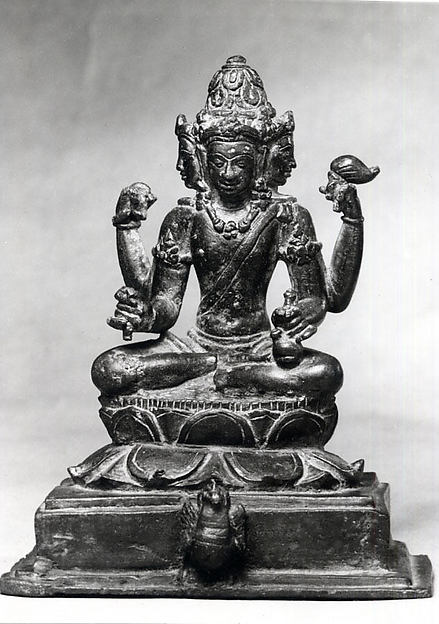
Seated Brahma (opens the museum record)
A Central Javanese bronze the museum titles Seated Brahma, showing the creator god enthroned on a lotus. It reflects the spread of Hindu bronze-casting traditions to Java.
 (opens the museum record)
Ancient object
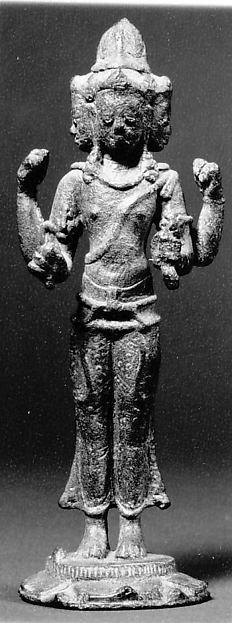
Brahma with Silver Eyes (opens the museum record)
A Javanese bronze the museum titles Brahma with Silver Eyes, its inlaid eyes a refinement typical of fine Central Javanese metalwork.
Sources and further reading
Source notes
These references are recorded in the catalog. Their passage wording and translation have not been checked, so quotations are not displayed here.
- Vishnu Purana (trans. Dutt, after Wilson)
Appears in
Ancient and classical works featuring this figure.
Anticipated in the Golden Womb (Hiranyagarbha) and Prajapati, the singular Lord of all created things (Hymn 10.121)
About this entry
By Elizabeth Stein for Mythos Atlas. About the author. Editorial notes are grounded in the site's cited sources and can be challenged through the contact page.
Parallels are editorial comparisons across traditions: a shared role does not, by itself, establish a shared origin.
Family relationships come from the atlas's kinship records. Ancient sources often disagree on divine genealogy.
Keep exploring
One myth a week, with its sources in a short email. The sign-up form is just below.
Genealogy
Family tree
Brahma's parents, consorts, children and rivals, as recorded in the atlas.