Chinese Pantheon
Chang'e
Also known as Lady in the Moon, Moon Goddess, Heng'e
- moon
- beauty
- immortality
- loneliness
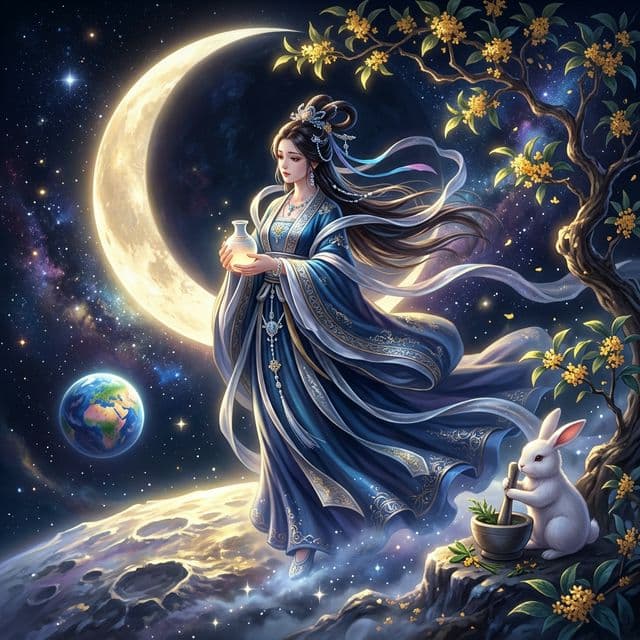
The goddess of the moon who lives in the Lunar Palace. She became immortal after drinking an elixir meant for her husband Hou Yi, and now dwells eternally on the moon with only a jade rabbit for company.
About Chang'e
The Lady in the Moon
Chang'e is the solitary goddess of the moon, forever separated from her beloved husband, the archer Hou Yi. Her story is one of Chinese mythology's most poignant tales, exploring themes of sacrifice, immortality, and eternal loneliness.
The Archer's Wife
Chang'e was the beautiful wife of Hou Yi, the divine archer who saved the world by shooting down nine of the ten suns that threatened to scorch the earth. For this heroic act, the Jade Emperor stripped Hou Yi and Chang'e of their immortality and banished them to live as mortals.
The Elixir of Immortality
Desperate to regain their immortality, Hou Yi journeyed to the Queen Mother of the West (Xi Wangmu) on Mount Kunlun. She gave him a single dose of the elixir of immortality - enough for two people to live forever, or enough for one person to ascend to Heaven.
The Fateful Choice
What happened next varies by version. In some tellings, Chang'e selfishly stole the elixir when Hou Yi was away. In others, she swallowed it to prevent it from falling into the hands of Hou Yi's treacherous apprentice Feng Meng. In the most sympathetic version, she sacrificed her chance at shared immortality with her husband to prevent a wicked man from gaining divine power.
Eternal Isolation
After drinking the entire elixir, Chang'e floated up to the moon, where she has dwelled ever since in the Cold Lunar Palace. Her only companions are the Jade Rabbit (who endlessly pounds the elixir of immortality in a mortar) and Wu Gang (who eternally chops at a self-healing osmanthus tree). She gazes down at the earth, forever separated from her husband.
The Mid-Autumn Festival
On the fifteenth day of the eighth lunar month, when the moon is fullest, the Chinese celebrate the Mid-Autumn Festival. Families gather to eat mooncakes, admire the full moon, and remember Chang'e. It is said that Hou Yi would set out fruits and cakes as offerings to his wife, gazing up at the moon where she dwells.
Origin story
Chang'e was the beautiful wife of the archer Hou Yi. When the Queen Mother of the West gave her husband a single dose of the elixir of immortality, Chang'e drank it all and floated up to the moon, where she has lived in solitude ever since.
Across traditions
Parallel figures
Figures who play a role like Chang'e's in other traditions.
 GreekArtemisIllustration
Both are moon goddesses associated with beauty and isolation
Compare Chang'e and Artemis side by side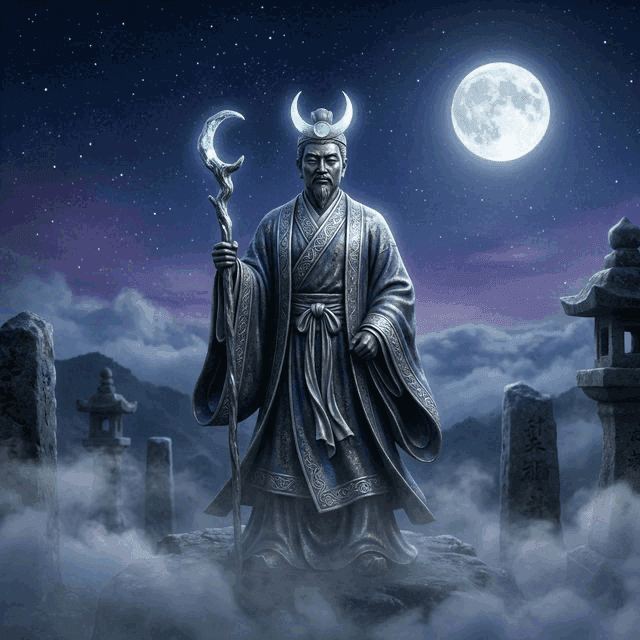 JapaneseTsukuyomiIllustration
Both are moon deities living in eternal isolation from a former companion
Compare Chang'e and Tsukuyomi side by side
Worship and cult
Temples, festivals, and practices recorded for Chang'e
Mooncakes and a story about exile. Household observance beats priesthood. She is watched, not processed through a city.
Sacred sites
- Moon-gazing, not a large temple network
Festivals
- Mid-Autumn Festival
Family

In the atlas
Where Chang'e appears
In the museums
Chang'e in art
Real objects in public collections, released into the public domain by the museums that hold them. Dates refer to when each object was made. Objects made within the tradition come first, later depictions after.
 (opens the museum record)
Later depiction
The Moon Goddess Chang E (opens the museum record)
A Ming-dynasty hanging scroll the museum titles The Moon Goddess Chang E, showing the goddess who, in the best-known version of her myth, drank an elixir of immortality and rose to live on the moon.
Sources and further reading
Source notes
These references are recorded in the catalog. Their passage wording and translation have not been checked, so quotations are not displayed here.
- Li Shangyin, "Chang'e" (poem)
About this entry
By Elizabeth Stein for Mythos Atlas. About the author. Editorial notes are grounded in the site's cited sources and can be challenged through the contact page.
Parallels are editorial comparisons across traditions: a shared role does not, by itself, establish a shared origin.
Family relationships come from the atlas's kinship records. Ancient sources often disagree on divine genealogy.
Keep exploring
One myth a week, with its sources in a short email. The sign-up form is just below.
Genealogy
Family tree
Chang'e's parents, consorts, children and rivals, as recorded in the atlas.