Aztec Pantheon
Mayahuel
Also known as She of the Maguey Plant, The Woman of 400 Breasts
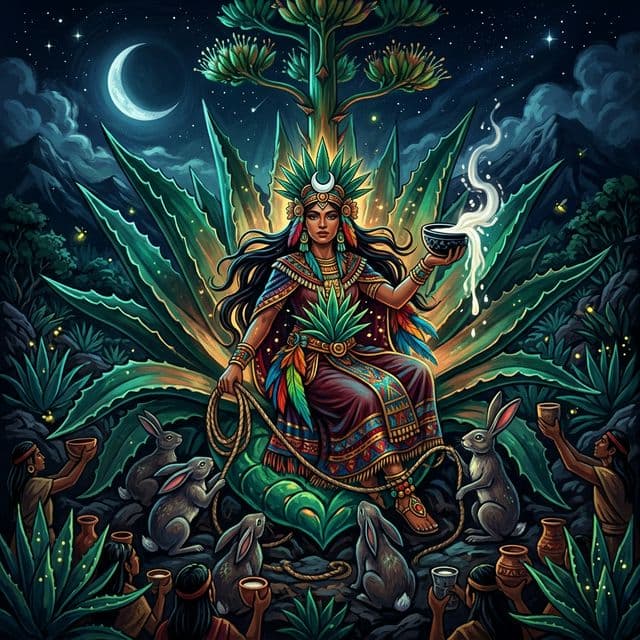
- maguey
- pulque
- fertility
- nourishment
- intoxication
The goddess of the maguey plant and its fermented drink pulque. Mayahuel is depicted with 400 breasts to nurse her 400 children, the Centzon Totochtin (400 Rabbits) of intoxication.
About Mayahuel
Goddess of the Maguey
Mayahuel was the Aztec goddess of the maguey (agave) plant, from which pulque is fermented. The maguey was called "metl" and was sacred, providing fiber for rope and cloth, needles from its spines, food from its heart, and above all, pulque, the milky fermented beverage central to Aztec religious ceremonies.
The 400 Rabbits
Mayahuel was mother to the Centzon Totochtin ("400 Rabbits"), the gods of drunkenness. Each rabbit represented a different form or degree of intoxication. She is depicted with 400 breasts to nurse her countless offspring. The phrase "400 rabbits" was an idiom meaning "innumerable."
The Discovery of Pulque
In myth, Mayahuel discovered that the maguey plant, when its heart is pierced, produces sweet sap called aguamiel. When fermented, this becomes pulque. She taught this knowledge to humanity, making her a culture hero as well as a goddess.
Cosmic Tragedy
One myth tells how Quetzalcoatl fell in love with Mayahuel and brought her down from the heavens. Her grandmother, a tzitzimime (star demon), pursued them. When she caught them, she tore Mayahuel apart. Quetzalcoatl buried her bones, and from them grew the first maguey plant.
Sacred Intoxication
Pulque was not for casual consumption. It was sacred to the gods and used in religious ceremonies. Only priests, the elderly, and those participating in rituals were permitted to drink it freely. Unauthorized drunkenness was severely punished.
Origin story
Mayahuel lived in the sky with her grandmother, a tzitzimime. Quetzalcoatl ascended and convinced her to flee with him, but her grandmother pursued them. When caught, the tzitzimime tore Mayahuel apart. Quetzalcoatl buried her remains, and from them sprouted the first maguey plant.
Across traditions
Parallel figures
Figures who play a role like Mayahuel's in other traditions.
 GreekDionysusIllustration
Both are deities of intoxicating beverages with cults involving sacred drunkenness
Compare Mayahuel and Dionysus side by side
Worship and cult
Temples, festivals, and practices recorded for Mayahuel
The agave is the temple. Pulque was a restricted drink; her cult is the plant, the sap, and the risk of excess.
Sacred sites
- Maguey fields more than a stone house
Festivals
- Pulque rites; 400 rabbits as her drunken children
In the atlas
Where Mayahuel appears
Sources and further reading
Source notes
These references are recorded in the catalog. Their passage wording and translation have not been checked, so quotations are not displayed here.
- Florentine Codex
About this entry
By Elizabeth Stein for Mythos Atlas. About the author. Editorial notes are grounded in the site's cited sources and can be challenged through the contact page.
Parallels are editorial comparisons across traditions: a shared role does not, by itself, establish a shared origin.
Keep exploring
One myth a week, with its sources in a short email. The sign-up form is just below.
Genealogy
Family tree
Mayahuel's parents, consorts, children and rivals, as recorded in the atlas.