Aztec Pantheon
Xochiquetzal
Also known as Precious Feather Flower, Ichpochtli
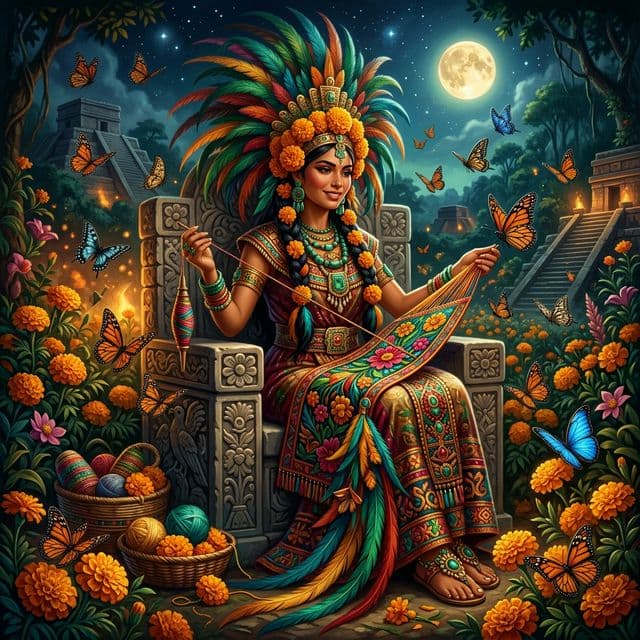
- beauty
- flowers
- love
- fertility
- weaving
- arts
The goddess of beauty, love, flowers, and female sexuality. Xochiquetzal was patron of artisans, weavers, and pregnant women, and dwelt in the paradise of Tamoanchan.
About Xochiquetzal
Precious Feather Flower
Xochiquetzal ("Precious Feather Flower") was the Aztec goddess of beauty, love, pleasure, flowers, and female sexuality. Unlike many Aztec deities associated with darkness or sacrifice, she represented joy, youth, and the pleasures of life. She was eternally young and beautiful, dwelling in Tamoanchan, the paradise above the heavens.
Patron of Artisans
Xochiquetzal was the divine patron of weavers, embroiderers, painters, sculptors, and silversmiths. All decorative arts fell under her protection. Women who excelled at weaving were considered blessed by her, and fine textiles were offerings worthy of the gods.
The First Woman
In some traditions, Xochiquetzal was the first woman created by the gods, companion to the first man Piltzintecuhtli. She later became consort of Tlaloc before being abducted by Tezcatlipoca, after which she became associated with illicit love.
The Festival of Flowers
The festival Toxcatl included ceremonies honoring Xochiquetzal with offerings of flowers, particularly marigolds (cempoalxochitl). Celebrants wore flower garlands and masks of her image.
Sexuality and Transgression
Xochiquetzal was also associated with prostitutes and courtesans (ahuianime), who accompanied warriors and were considered under her protection. She embodied both legitimate fertility and transgressive desire.
Origin story
Xochiquetzal was created in the paradise of Tamoanchan. She was initially consort of the rain god Tlaloc, but Tezcatlipoca abducted her to be his own. Her abduction introduced desire and longing into the world.
Across traditions
Parallel figures
Figures who play a role like Xochiquetzal's in other traditions.
 GreekAphroditeIllustration
Both are goddesses of love, beauty, and sexuality
Compare Xochiquetzal and Aphrodite side by side NorseFreyjaIllustration
Both combine aspects of love, beauty, and fertility with patronage of arts and crafts
Compare Xochiquetzal and Freyja side by side
Worship and cult
Temples, festivals, and practices recorded for Xochiquetzal
Marigolds, sexual love, and the work of the loom. Young women and artisans kept her. Not a war cult: a soft, expensive one.
Sacred sites
- Flower and weaver precincts in Tenochtitlan
Festivals
- Huey Tozoztli flower offerings
- Linked days in the xiuhpohualli
Family
 TezcatlipocaXochiquetzal
Questions about Xochiquetzal's family
- Who were Xochiquetzal's spouses and consorts?
- Spouses and consorts of Xochiquetzal recorded in the atlas: Tezcatlipoca.
- Who are Xochiquetzal's siblings?
- Siblings of Xochiquetzal recorded in the atlas: Xochipilli.
In the atlas
Where Xochiquetzal appears
Sources and further reading
Source notes
These references are recorded in the catalog. Their passage wording and translation have not been checked, so quotations are not displayed here.
- Florentine Codex
About this entry
By Elizabeth Stein for Mythos Atlas. About the author. Editorial notes are grounded in the site's cited sources and can be challenged through the contact page.
Parallels are editorial comparisons across traditions: a shared role does not, by itself, establish a shared origin.
Family relationships come from the atlas's kinship records. Ancient sources often disagree on divine genealogy.
Keep exploring
One myth a week, with its sources in a short email. The sign-up form is just below.
Genealogy
Family tree
Xochiquetzal's parents, consorts, children and rivals, as recorded in the atlas.