Greek Pantheon
Aphrodite
Also known as Venus, Kypris
- love
- beauty
- desire
- sexuality
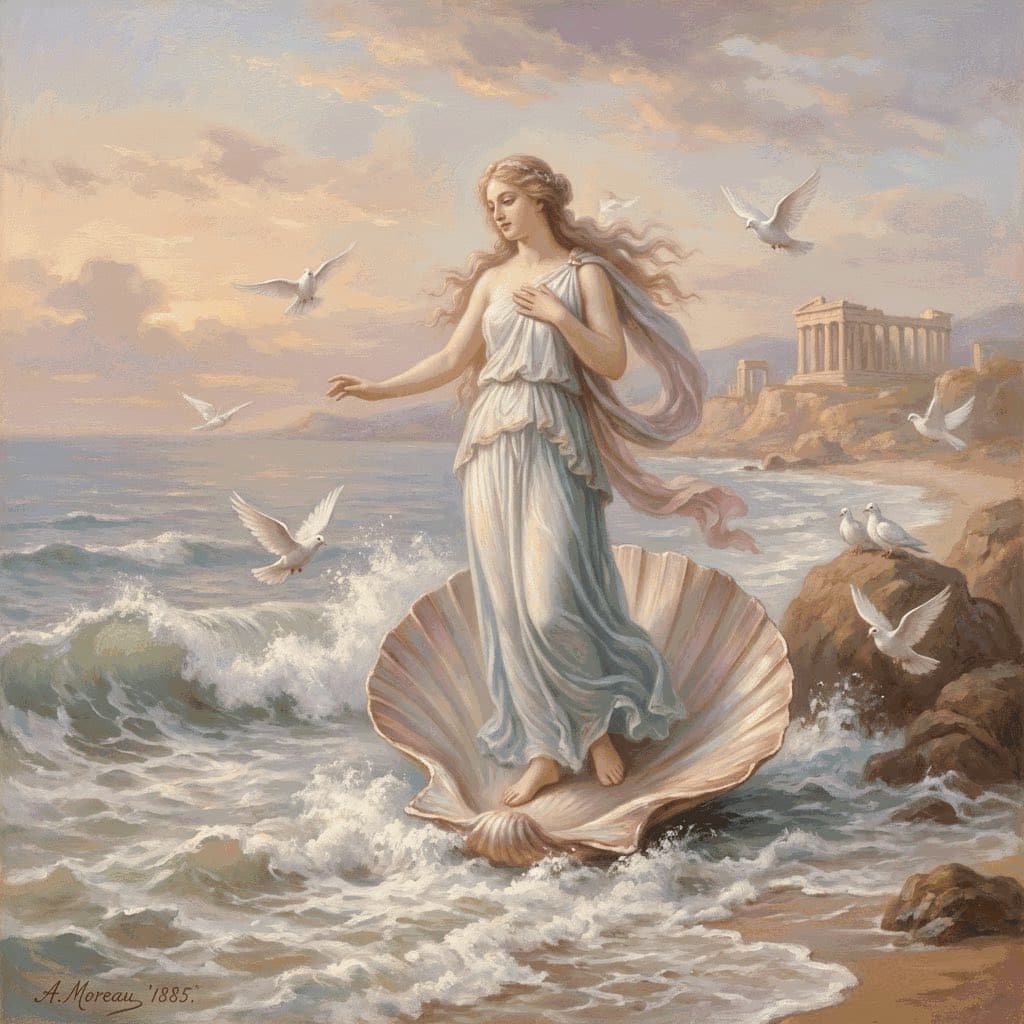
Goddess of love, beauty, and desire. Born from the sea foam after Cronus castrated Uranus and threw his genitals into the sea.
About Aphrodite
The Cyprian
Aphrodite is the irresistible goddess of love and beauty. Though married to Hephaestus, she had many lovers, most notably Ares. She has the power to make anyone fall in love, a power that even Zeus cannot resist.
Birth from Foam
She was born from the white foam (aphros) produced by the severed genitals of Uranus when they were thrown into the sea. She washed ashore on Cyprus (or Cythera), where she was attended by the Seasons.
Desire As Social Force
Greek myth uses Aphrodite to explain far more than romance. She drives political alliances, humiliations, marriages, rivalries, and catastrophic choices, which is why she stands near the center of stories like the Judgment of Paris and the Trojan cycle. Her sphere is desire as a civilizing and destabilizing power at the same time.
Across traditions
Parallel figures
Figures who play a role like Aphrodite's in other traditions.
 RomanVenusIllustration
Venus is the direct Roman equivalent, though in Rome she gained additional importance as divine ancestor of the Julian family
Compare Aphrodite and Venus side by side NorseFreyjaIllustration
Both are goddesses of love and beauty, though Freyja also has domains of war, death, and magic that Aphrodite lacks
Compare Aphrodite and Freyja side by side
Worship and cult
Temples, festivals, and practices recorded for Aphrodite
Cyprus is her oldest ground. Corinth mixed sailors, courtesans, and a high temple. Athens split Ourania from Pandemos: heavenly and of the whole people. Roses, doves, and the sea-foam story sit on top of a civic sex-and-luck cult.
Sacred sites
- Sanctuaries at Paphos and Amathus on Cyprus
- Temple of Aphrodite on Acrocorinth
- Aphrodite Pandemos at Athens
Festivals
- Aphrodisia
- Adonia
Family


Relationship sources
Theogony — Aphrodite lover of Ares
Hesiod · Hugh G. Evelyn-White, Hesiod, the Homeric Hymns and Homerica (1914), Project Gutenberg #348 · Theogony 933–937
Questions about Aphrodite's family
- Who were Aphrodite's spouses and consorts?
- Spouses and consorts of Aphrodite recorded in the atlas: Hephaestus and Ares.
In the atlas
Where Aphrodite appears
Play the myth
Branching retellings featuring Aphrodite: your choices decide the ending.
In the museums
Aphrodite in art
Real objects in public collections, released into the public domain by the museums that hold them. Dates refer to when each object was made. Objects made within the tradition come first, later depictions after.
 (opens the museum record)
Ancient object
Marble statuette of Aphrodite (opens the museum record)
A Hellenistic Greek marble statuette the museum catalogs as Aphrodite. Small-scale marble statuettes of the goddess were popular for private display in the Hellenistic period.
 (opens the museum record)
Ancient object
Marble statue of a crouching Aphrodite (opens the museum record)
A Roman marble statue the museum identifies as a crouching Aphrodite, a popular type derived from a lost Hellenistic original showing the goddess bathing. The crouching pose was copied widely across the Roman world.
Sources and further reading
Source notes
These references are recorded in the catalog. Their passage wording and translation have not been checked, so quotations are not displayed here.
- Homeric Hymn V, To Aphrodite (trans. Evelyn-White)
Appears in
Ancient and classical works featuring this figure.
born from the sea foam after Cronus castrates Uranus (the early cosmogony)
Goddess of love who sheds irresistible grace and heartbreaking desire upon Pandora's head (Lines 65-67)
Goddess of love compelled by Zeus to desire the mortal Trojan shepherd Anchises, conceiving Aeneas (Hymn 5)
About this entry
By Elizabeth Stein for Mythos Atlas. About the author. Editorial notes are grounded in the site's cited sources and can be challenged through the contact page.
Parallels are editorial comparisons across traditions: a shared role does not, by itself, establish a shared origin.
Family relationships come from the atlas's kinship records. Ancient sources often disagree on divine genealogy.
Keep exploring
One myth a week, with its sources in a short email. The sign-up form is just below.
Genealogy
Family tree
Aphrodite's parents, consorts, children and rivals, as recorded in the atlas.