Greek Pantheon
Ares
Also known as Mars
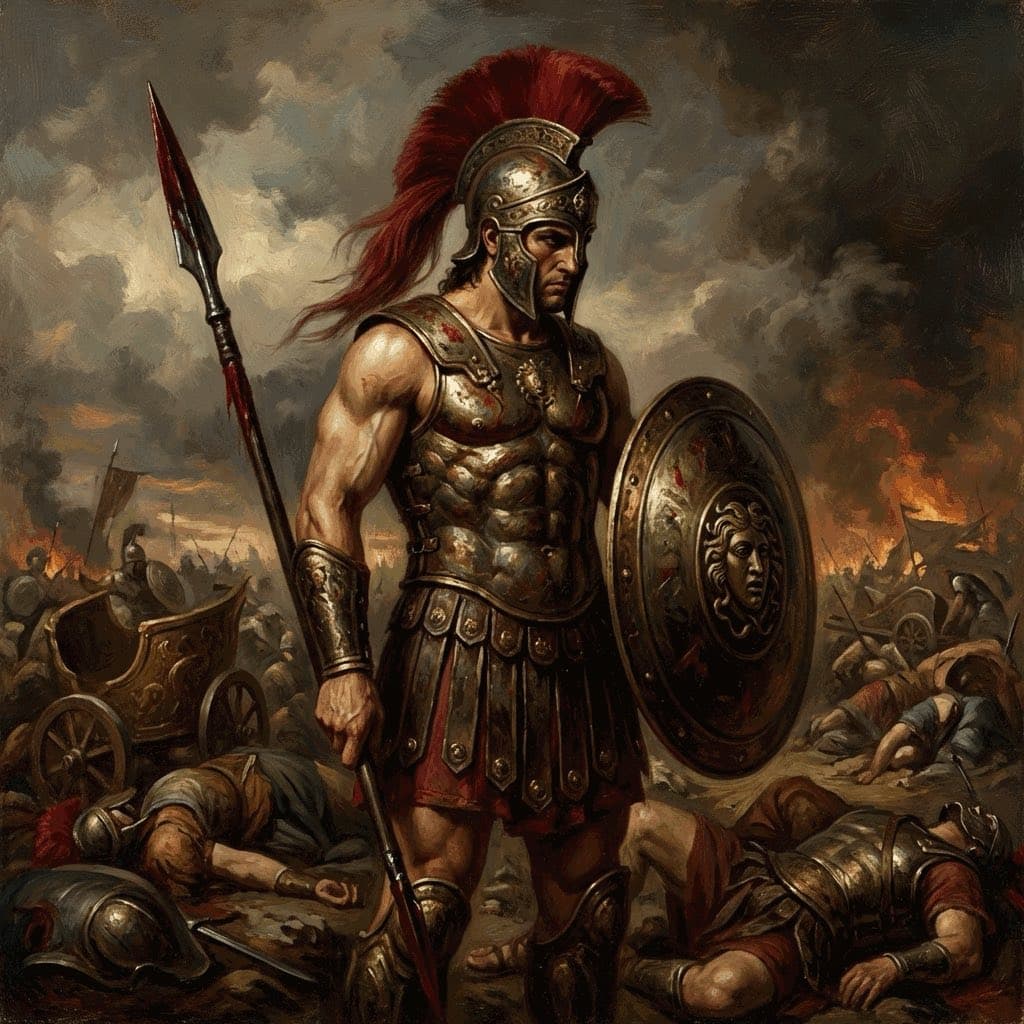
- war
- violence
- bloodshed
God of war, violence, and bloodshed. Son of Zeus and Hera, representing the brutal and chaotic aspects of warfare.
About Ares
The God of War
Ares embodies the physical valor and untamed violence of war. While Athena represents strategy, Ares is the chaotic frenzy of battle. He was not well-liked by the Greeks, who found him dangerous and overwhelming.
Affair with Aphrodite
His most famous myth involves his affair with Aphrodite. Her husband, Hephaestus, crafted an unbreakable golden net and trapped the lovers in bed, inviting all the other gods to laugh at them.
A Greek Contrast To Roman Mars
Ares matters partly because Greek myth often uses him as a warning about war without restraint. He appears powerful, but not admirable. That contrast becomes especially clear beside Roman Mars, who absorbs military honor, civic order, and ancestral prestige in a way Ares rarely does in Greek storytelling.
Across traditions
Parallel figures
Figures who play a role like Ares's in other traditions.
 RomanMarsIllustration
Mars is the Roman equivalent, though far more honored in Rome as father of Romulus and guardian of the state
Compare Ares and Mars side by side NorseTyrIllustration
Both are war gods, though Tyr represents the legal and honorable aspects of war while Ares embodies its violence
Compare Ares and Tyr side by side
Worship and cult
Temples, festivals, and practices recorded for Ares
Athens gave him little love and less architecture. Sparta and Thebes treated the war god as a fact. Dogs and night sacrifices appear in some rites. He is battlefield panic, not a patriotic mascot.
Sacred sites
- Temple of Ares in the Athenian Agora (moved stone, late)
- Theban and Spartan cults of the war god
Festivals
- Areia
- Gymnopaidiai (Spartan war festivals, adjacent)
Family


Relationship sources
Theogony — Zeus parent of Ares
Hesiod · Hugh G. Evelyn-White, Hesiod, the Homeric Hymns and Homerica (1914), Project Gutenberg #348 · Theogony 921–923
Theogony — Hera parent of Ares
Hesiod · Hugh G. Evelyn-White, Hesiod, the Homeric Hymns and Homerica (1914), Project Gutenberg #348 · Theogony 921–923
Theogony — Aphrodite lover of Ares
Hesiod · Hugh G. Evelyn-White, Hesiod, the Homeric Hymns and Homerica (1914), Project Gutenberg #348 · Theogony 933–937
In the atlas
Where Ares appears
Play the myth
Branching retellings featuring Ares: your choices decide the ending.
The Judgment of Paris
Step into the sandals of Paris, prince of Troy. Three goddesses stand before you, each offering a gift beyond mortal dreams. But every choice carries consequences that will echo through eternity.
5-8 min3 endingsThor's Journey to Jotunheim
Accompany Thor, god of thunder, on a perilous journey to the realm of giants. Will you rely on Mjolnir's might, or discover that sometimes wisdom serves better than strength?
8-12 min8 endings
Sources and further reading
Source notes
These references are recorded in the catalog. Their passage wording and translation have not been checked, so quotations are not displayed here.
- Homeric Hymn VIII, To Ares (trans. Evelyn-White)
About this entry
By Elizabeth Stein for Mythos Atlas. About the author. Editorial notes are grounded in the site's cited sources and can be challenged through the contact page.
Parallels are editorial comparisons across traditions: a shared role does not, by itself, establish a shared origin.
Family relationships come from the atlas's kinship records. Ancient sources often disagree on divine genealogy.
Keep exploring
One myth a week, with its sources in a short email. The sign-up form is just below.
Genealogy
Family tree
Ares's parents, consorts, children and rivals, as recorded in the atlas.