Greek Pantheon
Poseidon
Ποσειδῶν(Poseidon)
Also known as Neptune
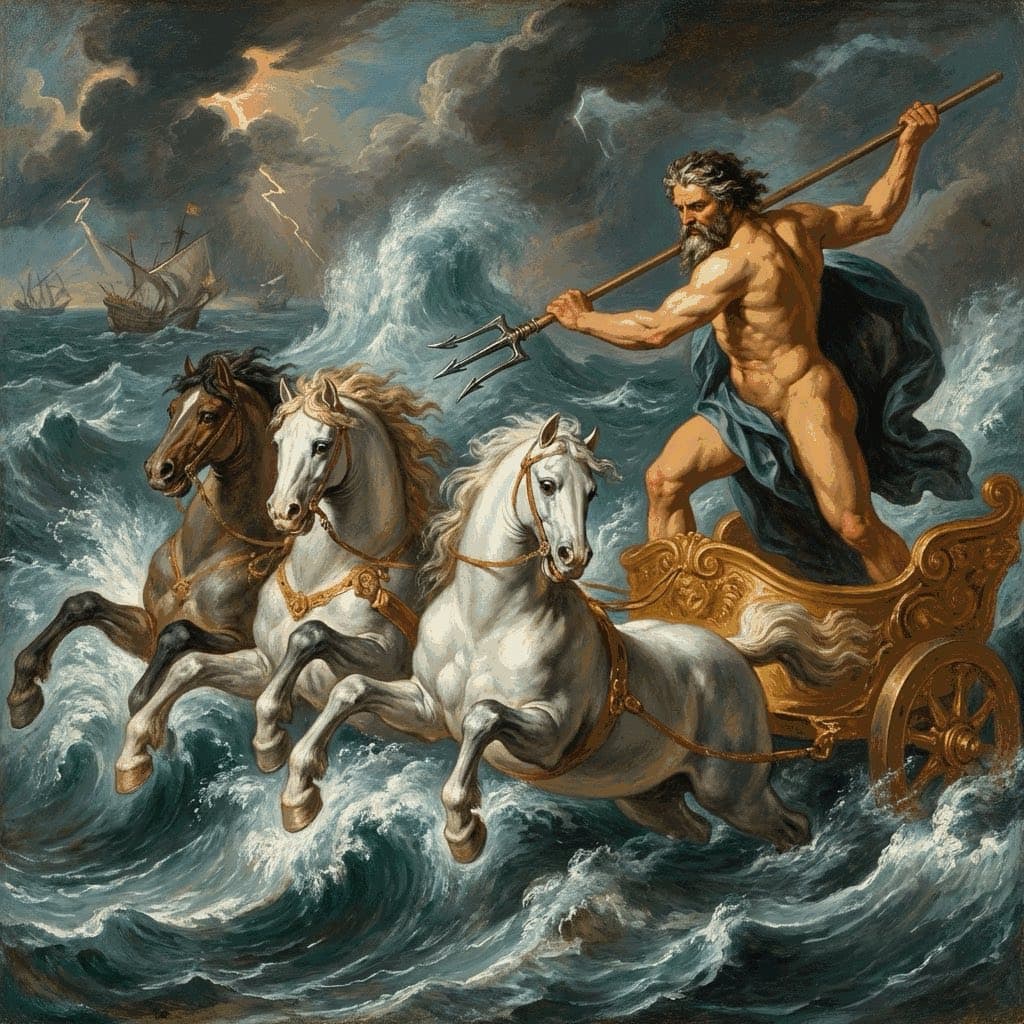
- sea
- earthquakes
- horses
- storms
God of the sea, earthquakes, and horses. Brother of Zeus and Hades, ruler of the oceans and all waters.
About Poseidon
Lord of the Seas
Poseidon rules the vast oceans, earthquakes ("Earth-Shaker"), and horses. He is a moody and tempestuous god, much like the sea itself. Sailors prayed to him for safe passage, often sacrificing horses or bulls to appease his wrath.
Contest for Athens
Poseidon competed with Athena for the patronage of Athens. He struck the Acropolis with his trident, creating a salt spring. Athena planted an olive tree. The people chose the olive tree, and Poseidon, enraged, flooded the Thriasian plain.
A God Of Boundaries And Storms
Greek myth uses Poseidon whenever a story crosses unstable ground or dangerous water. He breaks ships, sends monsters, fathers island dynasties, and reminds mortals that civilization depends on forces it cannot fully control. That wider role makes him more than a sea god: he is a divine power behind coastal trade, colonization, horses, and sudden catastrophe.
Across traditions
Parallel figures
Figures who play a role like Poseidon's in other traditions.
 RomanNeptuneIllustration
Neptune is the direct Roman equivalent, ruling the seas with the same trident and temperament
Compare Poseidon and Neptune side by side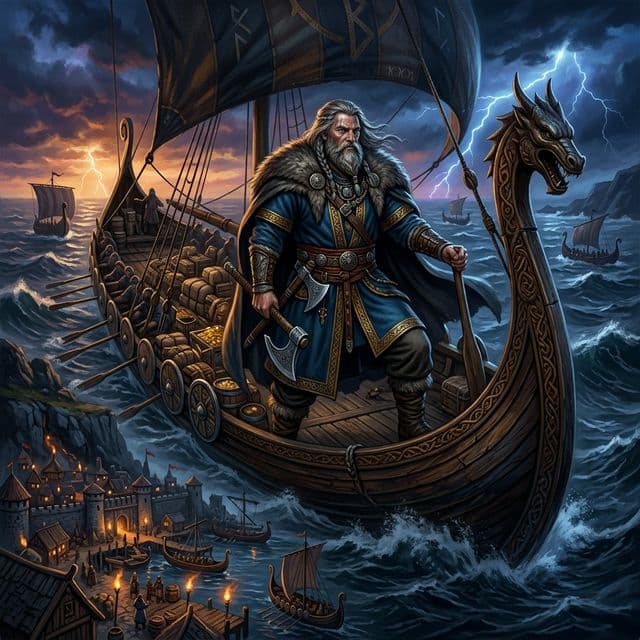 NorseNjordIllustration
Both are sea gods, though Njord is a Vanir deity associated more with wealth from the sea and calm waters
Compare Poseidon and Njord side by side
Worship and cult
Temples, festivals, and practices recorded for Poseidon
Horses, earthquakes, and the drowned coast are his working signs. Isthmia held games under his name. A bull often went to the sea. Inland Boeotia kept him as a horse god, not only a sailor's patron.
Sacred sites
- Sanctuary of Poseidon at Isthmia
- Temple of Poseidon at Sounion
- Onchestos in Boeotia
Festivals
- Isthmian Games
- Posideia
Family
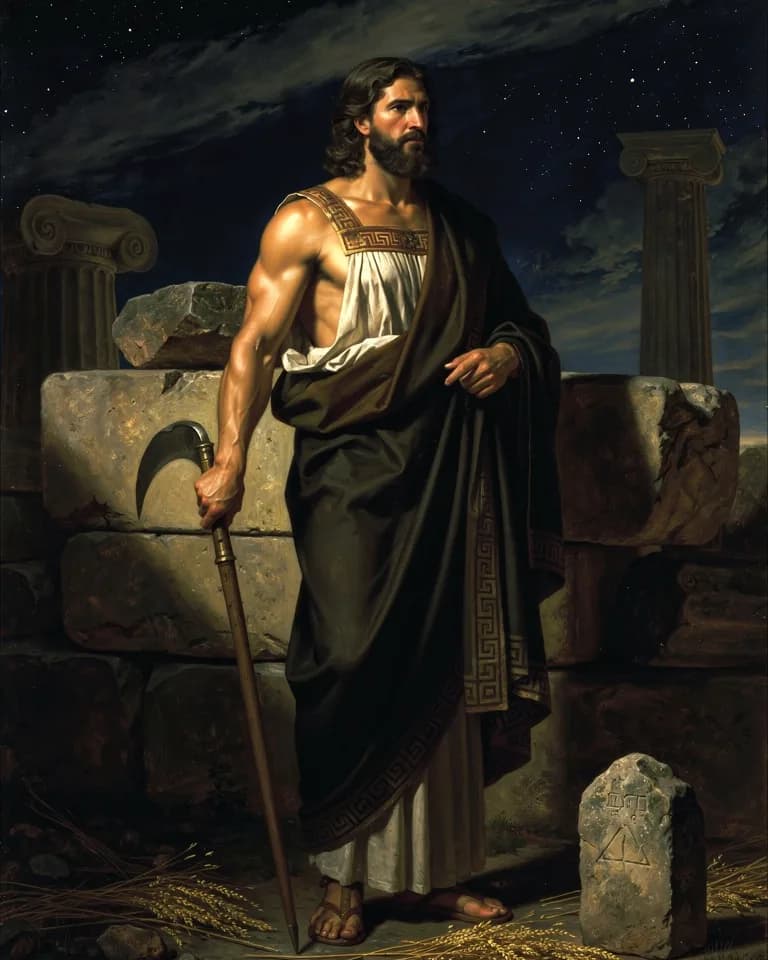
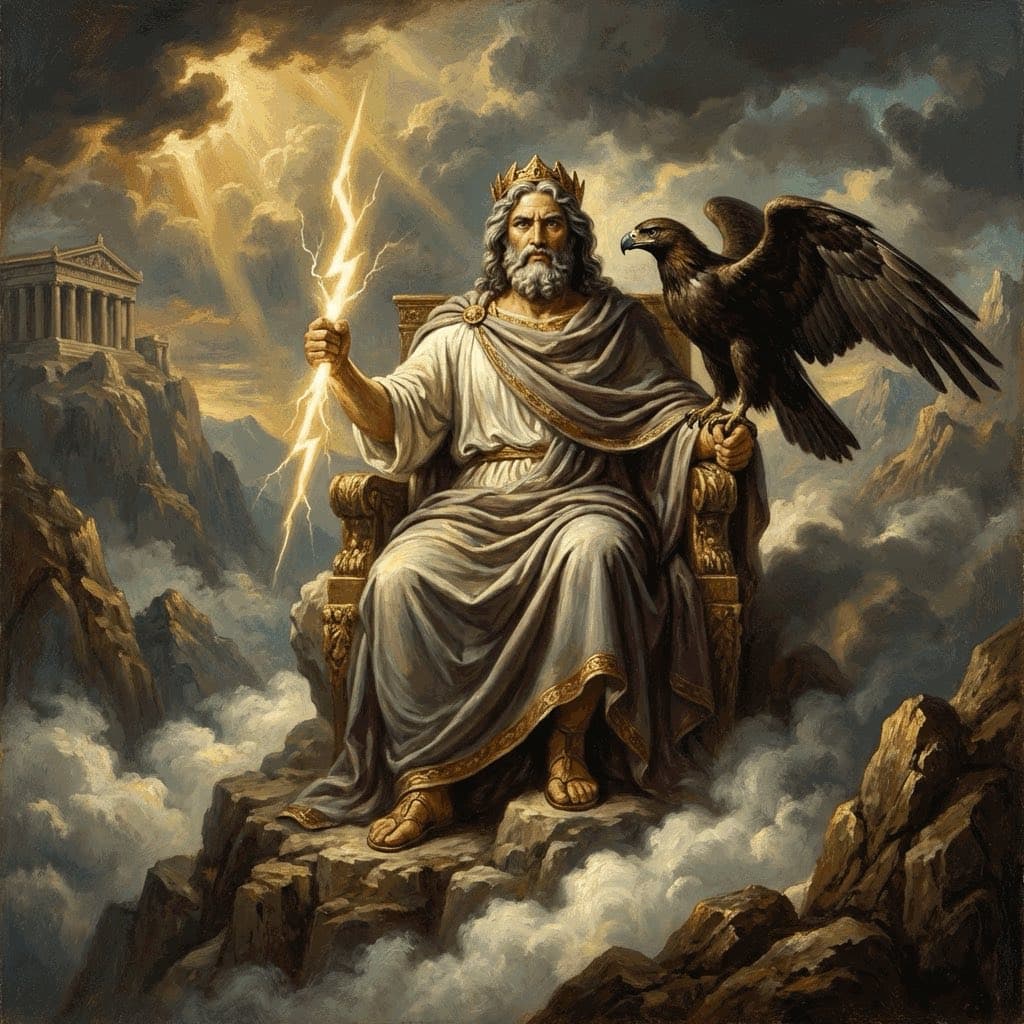
Relationship sources
Theogony — Zeus sibling of Poseidon
Hesiod · H. G. Evelyn-White, Hesiod, the Homeric Hymns and Homerica (1914), Loeb Classical Library 57; Theoi transcription · Theogony 453–458
Theogony — Cronus parent of Poseidon
Hesiod · Hugh G. Evelyn-White, Hesiod, the Homeric Hymns and Homerica (1914), Project Gutenberg #348 · Theogony 453–491
Theogony — Rhea parent of Poseidon
Hesiod · Hugh G. Evelyn-White, Hesiod, the Homeric Hymns and Homerica (1914), Project Gutenberg #348 · Theogony 453–491
In the atlas
Where Poseidon appears
Stories
Artifacts
Journeys
In the museums
Poseidon in art
Real objects in public collections, released into the public domain by the museums that hold them. Dates refer to when each object was made. Objects made within the tradition come first, later depictions after.
 (opens the museum record)
Ancient object
Bronze statuette of a god, possibly Poseidon (opens the museum record)
A Hellenistic bronze statuette the museum identifies as possibly depicting Poseidon, shown in a striding pose that would originally have held an attribute such as a trident. The tentative identification reflects how sea deities and river gods shared similar iconography.
 (opens the museum record)
Ancient object
Terracotta hydria: kalpis (water jar) (opens the museum record)
An Attic water jar painted with a scene the museum tags as showing Poseidon among seahorses. The imagery reflects his domain over the sea on a vessel shape used for carrying water.
 (opens the museum record)
Ancient object
Terracotta kylix (drinking cup) (opens the museum record)
An Archaic Attic drinking cup painted with a battle scene the museum tags as including Poseidon among warriors, horses, and an Iliad-related subject. Poseidon's involvement in the Trojan War appears throughout the Iliad.
Sources and further reading
Ancient sources
Quotations, paraphrases and verification notes. Each passage states what has been checked.
“Forthwith then he went down from the rugged mount, striding forth with swift footsteps, and the high mountains trembled and the woodland beneath the immortal feet of Poseidon as he went.”
Homer, Iliad · 13.17–19
Translation: A. T. Murray
1924; Theoi transcription. English transcription checked 2026-09-23. Replaces prior unverified wording; no original-language text is supplied or certified.
Read sourceSource notes
These references are recorded in the catalog. Their passage wording and translation have not been checked, so quotations are not displayed here.
- Homer, Odyssey
Appears in
Ancient and classical works featuring this figure.
pursues Odysseus in anger over the blinding of his son Polyphemus (Books 1-13)
About this entry
By Elizabeth Stein for Mythos Atlas. About the author. Editorial notes are grounded in the site's cited sources and can be challenged through the contact page.
Parallels are editorial comparisons across traditions: a shared role does not, by itself, establish a shared origin.
Family relationships come from the atlas's kinship records. Ancient sources often disagree on divine genealogy.
Keep exploring
One myth a week, with its sources in a short email. The sign-up form is just below.
Genealogy
Family tree
Poseidon's parents, consorts, children and rivals, as recorded in the atlas.