Roman Pantheon
Venus
Also known as Venus Genetrix, Venus Victrix

- love
- beauty
- desire
- fertility
- victory
Goddess of love, beauty, desire, sex, and fertility. Mother of the Roman people through her son Aeneas, ancestor of Romulus. Patron goddess of the Julian family.
About Venus
Venus Genetrix
Venus is love, charm, and winning, but in Rome she is also a mother of a people. Through Aeneas, her son by Anchises, the Julian house claimed her blood. Julius Caesar dedicated a temple to Venus Genetrix in his forum; the political point was not subtle. What Greek myth tells as Aphrodite's dangerous sweetness, Rome also tells as ancestry.
Cults of the city
She had many epithets: Erycina from the Sicilian mountain, Verticordia who turns hearts toward chastity, Victrix who grants victory. The Vinalia festivals mixed her with wine and with Jupiter in ways that refuse a single job description. Desire, luck in war, and the right to rule could occupy the same altar.
Love with consequences
Poets kept the Greek love-affairs, including her link with Mars. Virgil then used her as Aeneas's advocate before Jupiter, a goddess who argues for Rome's future rather than for a private passion. That double life, erotic and dynastic, is the Roman Venus.
Origin story
Venus corresponds to Greek Aphrodite. In Roman tradition, she was mother of Aeneas by the Trojan prince Anchises. Through Aeneas, she became the divine ancestress of the Roman people.
Across traditions
Parallel figures
Figures who play a role like Venus's in other traditions.
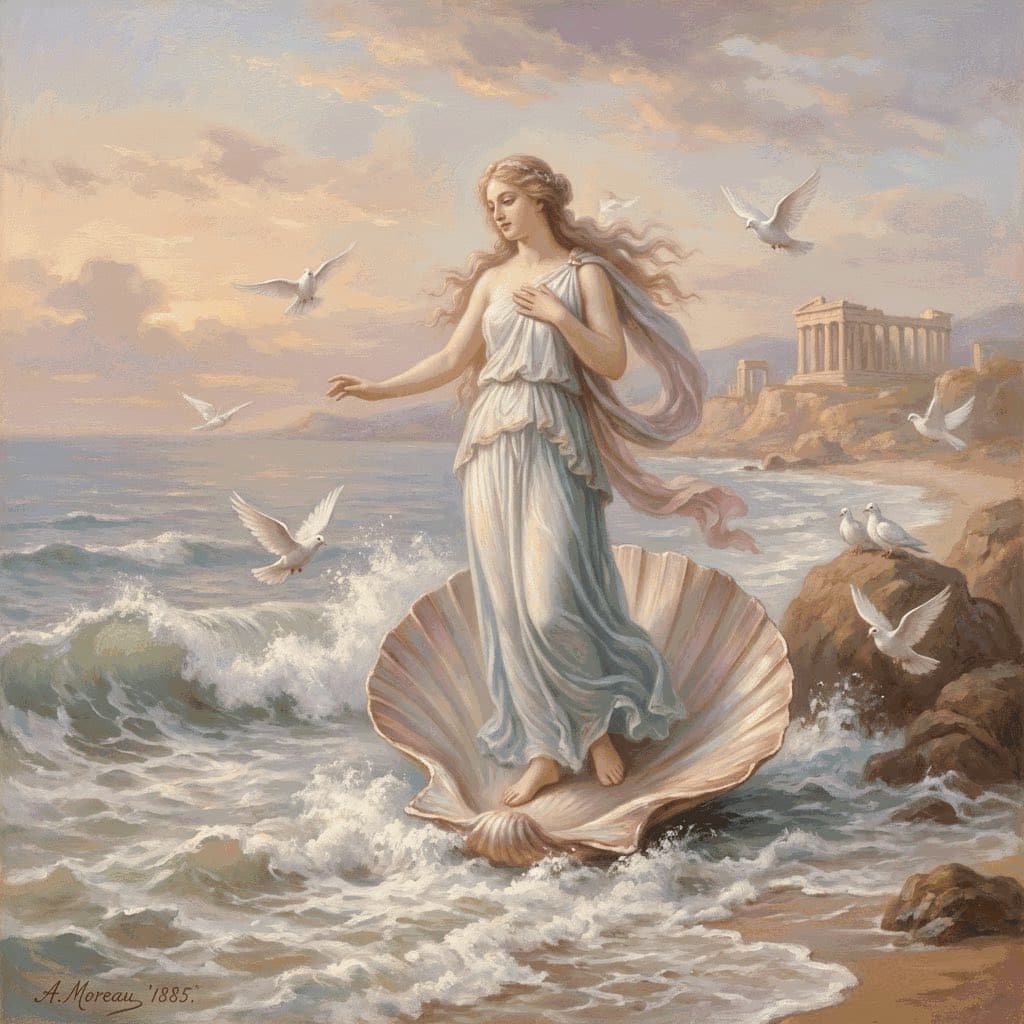 GreekAphroditeIllustration
Aphrodite is the direct Greek equivalent, goddess of love and beauty
Compare Venus and Aphrodite side by side
Worship and cult
Temples, festivals, and practices recorded for Venus
Myrtle and roses are hers. The Veneralia was a women's washing of her image. Augustus made Venus Genetrix a family ancestor, so state cult and Julian politics share a temple. She is luck in war as well as desire; generals vowed temples after victories.
Sacred sites
- Temple of Venus Genetrix in the Forum of Caesar
- Temple of Venus Erycina on the Capitoline and later the Colline Gate
- Temple of Venus Obsequens and Venus Verticordia
Festivals
- Veneralia (1 April)
- Vinalia Rustica (19 August)
Family


In the atlas
Where Venus appears
In the museums
Venus in art
Real objects in public collections, released into the public domain by the museums that hold them. Dates refer to when each object was made. Objects made within the tradition come first, later depictions after.
 (opens the museum record)
Ancient object
Marble statue of Aphrodite, the so-called Venus Genetrix (opens the museum record)
A Roman marble statue of the so-called Venus Genetrix type, named by the museum in its own title. The type descends from a cult statue associated with Venus as ancestress of the Julian imperial line.
Sources and further reading
Source notes
These references are recorded in the catalog. Their passage wording and translation have not been checked, so quotations are not displayed here.
- Virgil, Aeneid, Book I (trans. Dryden)
Appears in
Ancient and classical works featuring this figure.
Aeneas divine mother and guardian guide through his journey (Books 1-12)
About this entry
By Elizabeth Stein for Mythos Atlas. About the author. Editorial notes are grounded in the site's cited sources and can be challenged through the contact page.
Parallels are editorial comparisons across traditions: a shared role does not, by itself, establish a shared origin.
Family relationships come from the atlas's kinship records. Ancient sources often disagree on divine genealogy.
Keep exploring
One myth a week, with its sources in a short email. The sign-up form is just below.
Genealogy
Family tree
Venus's parents, consorts, children and rivals, as recorded in the atlas.