Roman Pantheon
Juno
Also known as Juno Regina

- marriage
- women
- childbirth
- family
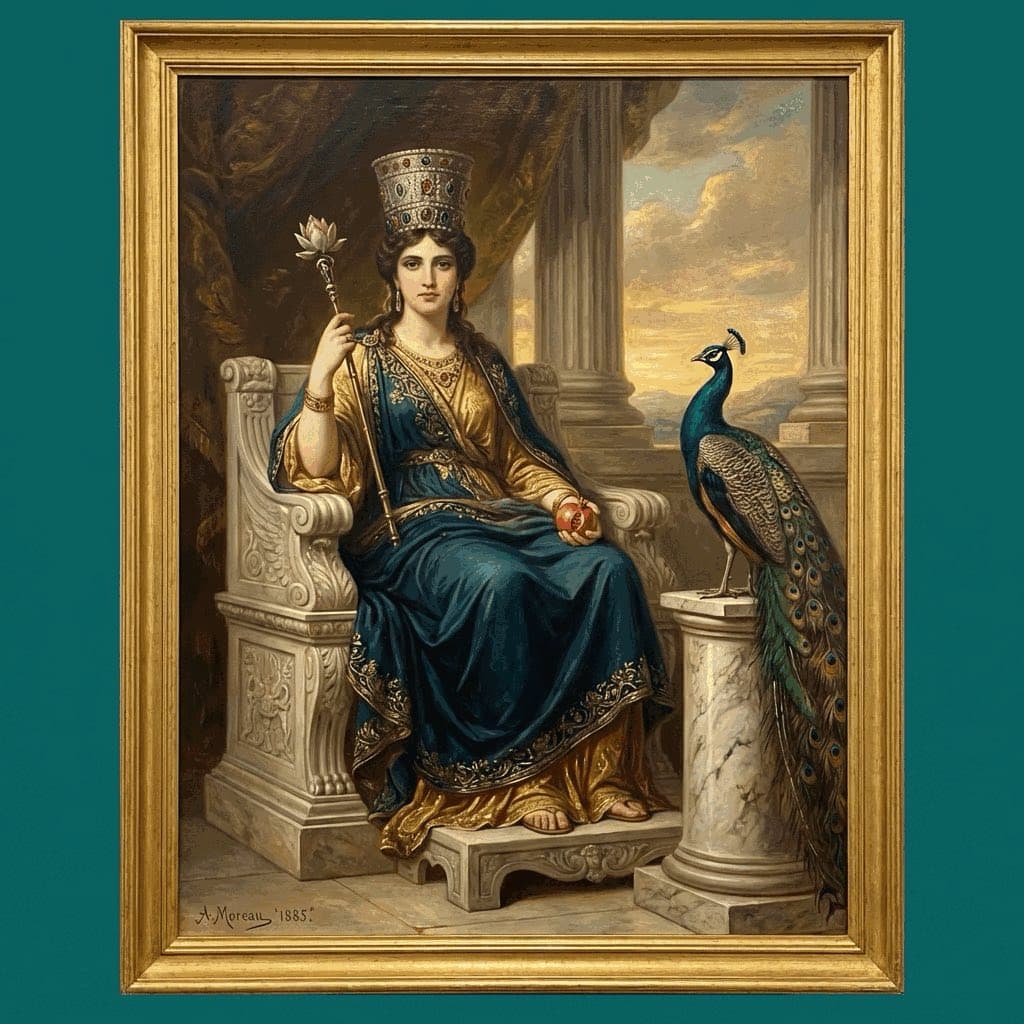
Queen of the gods and protector of the Roman state. Goddess of marriage, women, and childbirth. Wife and sister of Jupiter, patron of married women and the Roman matrons.
About Juno
Juno Regina
Juno is queen of the Roman gods and the protector of married women, but she is also a civic goddess. As Juno Regina she sat on the Capitol with Jupiter and Minerva. As Juno Moneta she kept a temple on the Arx whose name still sits inside the word "money," because the mint later worked nearby. As Juno Sospita she came from Lanuvium in goatskin and armed, a savior as much as a wife.
Marriage and the state
The Matronalia on March 1 honored her as guardian of Roman wives. Myth makes her sister and spouse of Jupiter, jealous in the Greek manner when poets want that color. Cult practice is cooler and more public: women, colonies, and the city's own well-being all fall inside her brief.
Not Hera in Latin
She shares myths with Hera, including the difficult marriage to the sky king. She also has Latin faces Hera never wore. Lucina at childbirth, Curitis with the spear, the warning geese of her temple during the Gallic sack: these are Roman stories attached to Juno, not footnotes to Olympus.
Origin story
Juno is the Roman equivalent of Hera, daughter of Saturn and Ops. She became Jupiter's consort and queen of heaven, fiercely protective of marriage and legitimate children.
Across traditions
Parallel figures
Figures who play a role like Juno's in other traditions.
 GreekHeraIllustration
Both are queen of the gods and goddess of marriage
Compare Juno and Hera side by side NorseFriggIllustration
Both are the wife of the chief sky god and preside over marriage and the domestic sphere
Compare Juno and Frigg side by side
Worship and cult
Temples, festivals, and practices recorded for Juno
Juno is the Kalends as Jupiter is the Ides. Matrons offered at the Matronalia. The geese of Juno on the Capitol were remembered as having saved the hill from the Gauls. The flaminica Dialis served her beside the flamen of Jupiter.
Sacred sites
- Temple of Juno Moneta on the Arx of the Capitoline
- Temple of Juno Regina on the Aventine (evocatio from Veii)
- Capitoline triad cella beside Jupiter and Minerva
Festivals
- Matronalia (1 March)
- Nonae Caprotinae
- Kalends (monthly)
Family



In the atlas
Where Juno appears
Sources and further reading
Source notes
These references are recorded in the catalog. Their passage wording and translation have not been checked, so quotations are not displayed here.
- Virgil, Aeneid, Book I (trans. Dryden)
Appears in
Ancient and classical works featuring this figure.
implacable adversary of the Trojans stirring Carthage and Turnus (Books 1-12)
About this entry
By Elizabeth Stein for Mythos Atlas. About the author. Editorial notes are grounded in the site's cited sources and can be challenged through the contact page.
Parallels are editorial comparisons across traditions: a shared role does not, by itself, establish a shared origin.
Family relationships come from the atlas's kinship records. Ancient sources often disagree on divine genealogy.
Keep exploring
One myth a week, with its sources in a short email. The sign-up form is just below.
Genealogy
Family tree
Juno's parents, consorts, children and rivals, as recorded in the atlas.