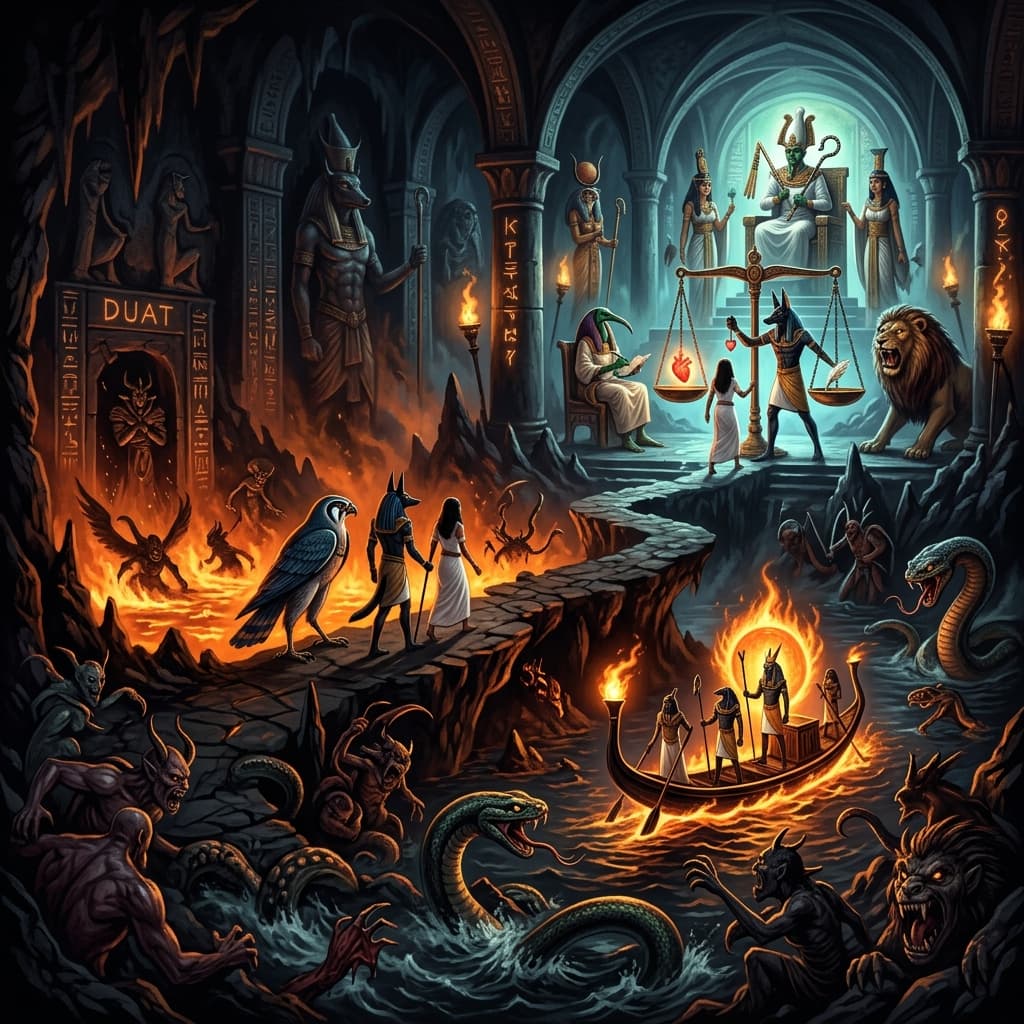
The Descent into Darkness
When an Egyptian died, their journey had only begun. The ka and the ba, the two aspects of the soul, departed from the body and entered the Duat, the vast and terrifying underworld through which the sun traveled each night. The spells inscribed on papyrus scrolls and painted on tomb walls, collectively known as the Book of the Dead or "The Book of Coming Forth by Day," served as a guide through this realm of shadows.
The newly dead soul, called the akh, found itself in darkness. Before it stretched a path fraught with danger: lakes of fire, serpents with knives for teeth, demons whose names had to be known to pass, gates guarded by creatures of nightmare. Without the proper knowledge, the soul would be devoured or lost forever in the darkness.
I know the names of the forty-two judges. I know the words of power. I have not done evil. My heart is pure, lighter than the feather of Ma'at.
The Trials of the Duat
The soul passed through twelve regions, each corresponding to an hour of the night. It encountered the serpent Apep, the embodiment of chaos, who sought to swallow the sun-bark of Ra and plunge all existence into eternal darkness. The justified dead might join Ra's crew in the nightly battle against Apep, helping to ensure that dawn would come again.
At each gate, guardians demanded passwords and proof of worth. The soul had to recite the correct formulae, speak the true names of the demons, and demonstrate knowledge of the divine mysteries. Those who failed were seized by the Am-mit, the Devourer, a monster with the head of a crocodile, the body of a lion, and the hindquarters of a hippopotamus.
The Hall of Two Truths
If the soul survived the Duat's perils, it arrived at last at the Hall of Two Truths, also called the Hall of Ma'at. Here sat Osiris, Lord of the Dead, upon his throne, attended by Isis and Nephthys. Before him stood a great scale, and around the hall sat the forty-two assessor gods, each representing a different sin.
The soul stood before this divine tribunal and recited the Negative Confession, declaring each sin they had not committed: "I have not done wrong. I have not robbed. I have not stolen. I have not killed. I have not told lies. I have not caused pain. I have not committed adultery." The declaration went on, covering every aspect of moral conduct.
The Weighing of the Heart
Anubis, the jackal-headed god of mummification and the guide of souls, took the deceased's heart and placed it upon one side of the scale. On the other side rested the feather of Ma'at, the symbol of cosmic truth and justice, lighter than breath.
If the heart was heavy with sin, if the weight of wrongdoing tipped the scale, the Am-mit waited eagerly to devour it. The soul would cease to exist, denied the afterlife, erased from eternity. This was the second death, the true death from which there was no return.
But if the heart balanced against the feather, or better still, if it proved lighter, the soul was declared "true of voice" and worthy to enter the presence of Osiris. Thoth, the ibis-headed god of wisdom and writing, recorded the verdict on his scroll.
The heart of the deceased has been weighed in the scale of the Balance, and it has been found true. He has not sinned against any god or goddess. Admit him to the Kingdom of Osiris.
The Field of Reeds
The justified soul was led by Horus into the presence of Osiris, where they received eternal life and a place in the Field of Reeds, the Egyptian paradise. Here, the afterlife mirrored the best of Egypt itself: eternal harvests, cool breezes, and reunion with loved ones who had gone before. The soul would live forever in peace, journeying with Ra across the sky by day and through the Duat by night, part of the eternal cycle of death and rebirth that governed all existence.