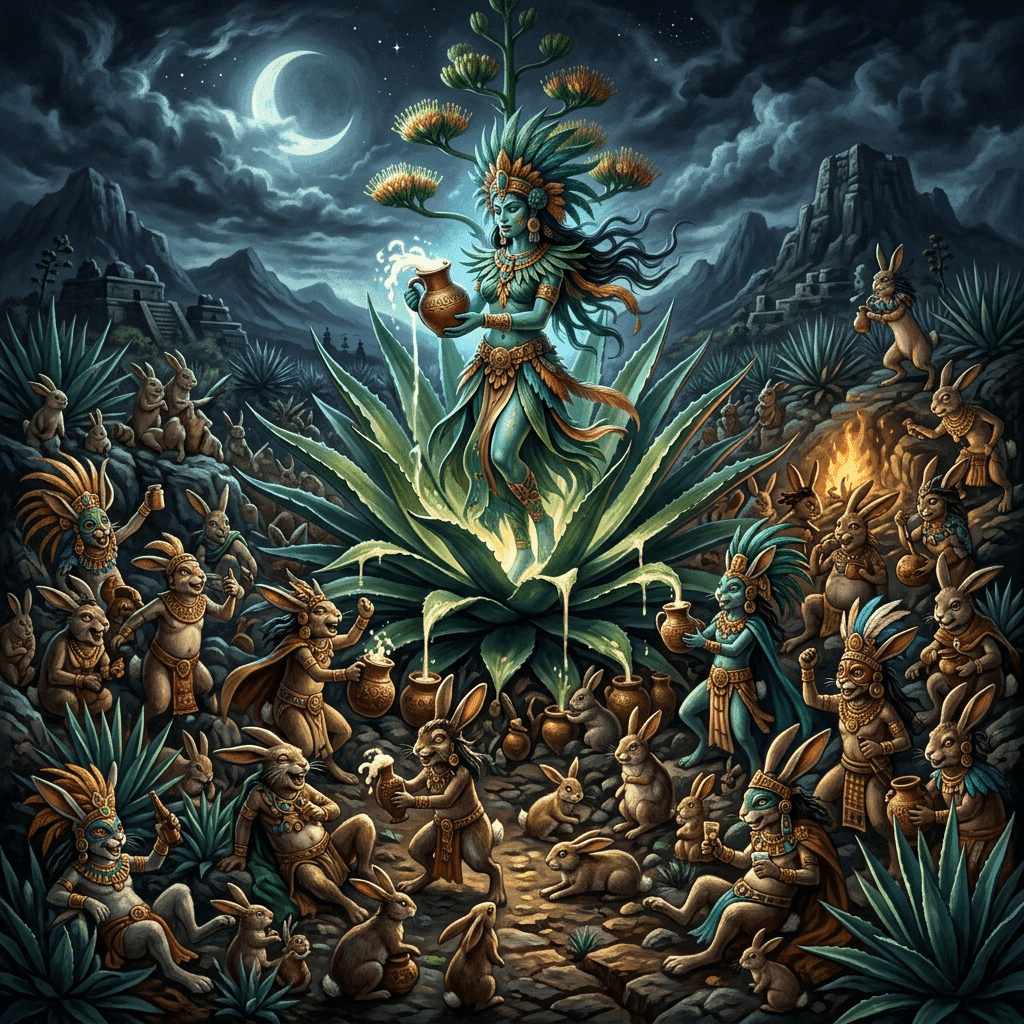
The Discovery of Maguey
Mayahuel was a young goddess kept captive in the sky by her grandmother Tzitzimitl, one of the fearsome star demons who threatened the sun during eclipses. Quetzalcoatl, ever seeking to bring good things to humanity, discovered that Mayahuel knew the secret of a miraculous plant.
He stole her away from her grandmother's watchful eye, and together they descended to earth. There they transformed themselves into branches of a single tree, intertwined with love. But Tzitzimitl awoke and found her granddaughter missing. With an army of star demons, she descended in wrath.
The demons tore the tree apart. Quetzalcoatl escaped, but Mayahuel was devoured. From her scattered remains, where her bones met the earth, the first maguey plant grew—the source of the sacred drink called pulque.
The Birth of Pulque
Pulque, the fermented sap of the maguey, was discovered when the goddess Mayahuel's essence entered the plant. When properly prepared, it produced a milky, mildly intoxicating beverage that the Aztecs considered sacred. It was the drink of priests, of the elderly, of nursing mothers, and of those participating in certain rituals.
Four hundred breasts has Mayahuel, they said, to nurse her four hundred children—for the maguey plant has many shoots, and each produces the sacred drink.
But who would govern the effects of this powerful drink? The gods saw that humans who consumed too much pulque behaved in strange ways—some becoming brave, some foolish, some violent, some merely sleepy.
The Four Hundred Rabbit Gods
Mayahuel gave birth to four hundred children, the Centzon Totochtin or "Four Hundred Rabbits." Each represented a different aspect or degree of intoxication. The number four hundred was symbolic—it meant "innumerable," representing the infinite varieties of drunkenness.
The most important of the rabbit gods included:
- Ome Tochtli (Two Rabbit): The chief of the rabbit gods, representing the moment when intoxication becomes obvious.
- Tepoztecatl: Patron of Tepoztlan, associated with wind and with the sudden rush of drunkenness.
- Texcatzonatl: "Straw Mirror," representing the loss of self-awareness.
- Colhuatzincatl: Associated with ancestral spirits and respectful ritual drinking.
Each rabbit god presided over a different manifestation of pulque's effects, from gentle euphoria to violent madness.
The Regulation of Drinking
The Aztecs took drunkenness very seriously. Public intoxication was forbidden except for specific individuals and occasions: the elderly (who had earned the privilege), priests during certain rituals, warriors after battle, and all people during designated festivals.
Violating these rules carried severe punishment—public shaming for first offenses, execution for repeated violations. The Four Hundred Rabbits served as a warning: any degree of drunkenness had a divine patron, but losing control entirely was to fall under the sway of the more dangerous rabbit gods.
The Sacred Number
The number four hundred appeared throughout Aztec mythology: the Four Hundred Mimixcoa (cloud serpents who became stars), the Four Hundred Huitznahua (southern stars defeated by Huitzilopochtli). It represented multiplicity beyond counting, the infinite variations that emerge from a single source. Just as one maguey plant could produce countless cups of pulque, one sip could lead to four hundred different outcomes.