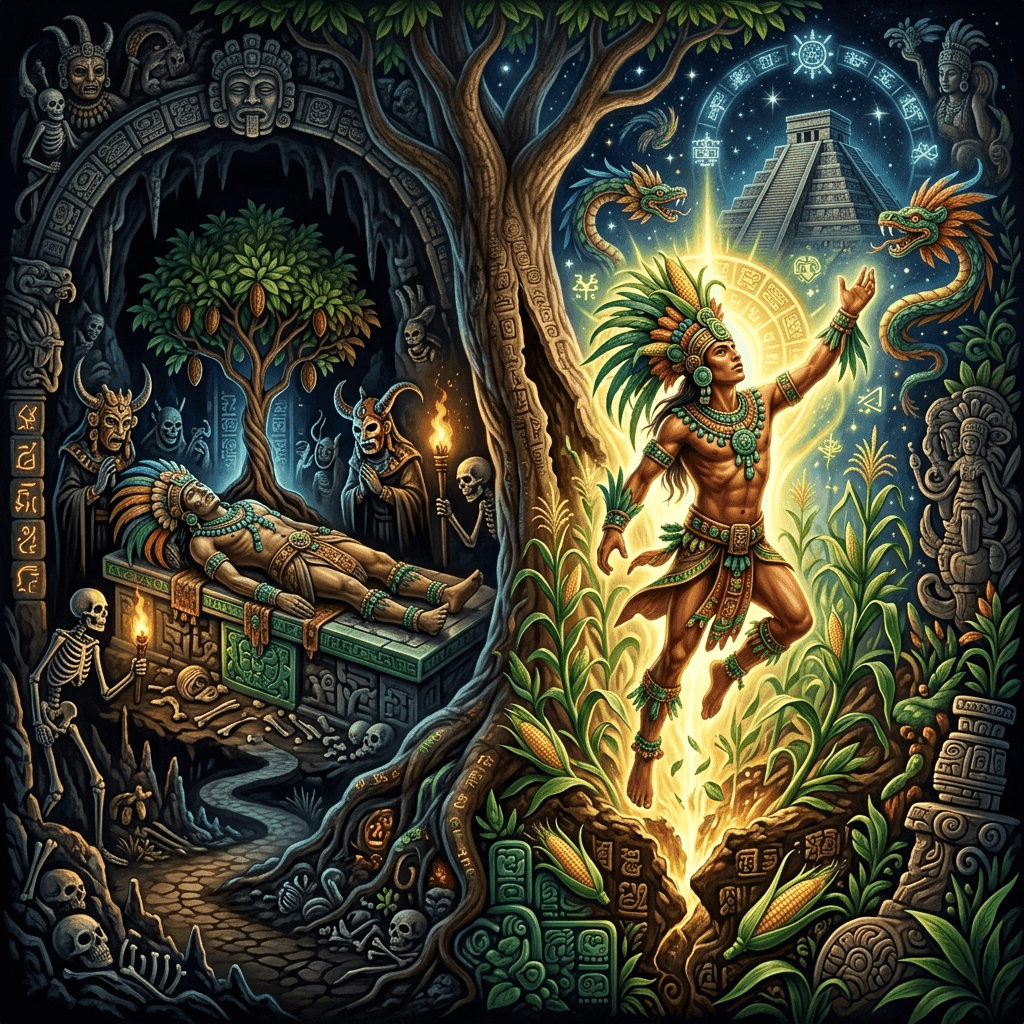
The Cycle of Maize
For the ancient Maya, maize (corn) was not merely a crop but the very substance of humanity. The Popol Vuh tells that after the gods' failed attempts to create people from mud and wood, they finally succeeded using maize dough. Humans are literally made of corn.
At the center of Maya agricultural religion stood the Maize God, known in different forms as Hun Hunahpu, God E, or simply the Young Maize God. His story is the story of the agricultural cycle: planting, death in the earth, and glorious rebirth.
The Death
The Maize God was beautiful, forever young, with an elongated head shaped like a corn cob and hair like silk tassels. He was a ballplayer, and his playing on the ball court above Xibalba attracted the attention of the death lords.
Summoned to the underworld, the Maize God failed the tests of Xibalba. He was sacrificed, his body buried beneath the ball court like a seed planted in the earth. His head was hung in a calabash tree, where it would impregnate the maiden Xquic with the Hero Twins.
The Maize God descends into the earth as the seed descends into the soil. Both must die to be reborn.
The Realm of Death
In the darkness of Xibalba, beneath the earth, the Maize God remained. He was not destroyed but transformed, waiting for the conditions of his rebirth. This period corresponds to the time between planting and germination, when the seed lies in the soil.
The lords of death believed they had triumphed. But death is not the end in Maya cosmology - it is transformation, the necessary passage to new life.
The Hero Twins' Descent
The Maize God's sons, Hunahpu and Xbalanque, grew to maturity and discovered their destiny. They descended to Xibalba to avenge their father and retrieve him from death.
Through cleverness, sacrifice, and resurrection, the Hero Twins defeated the lords of death. They found where their father was buried, beneath the cracked surface of the ball court.
The Resurrection
The twins spoke the words of resurrection. The earth split open, and the Maize God rose from the crack, reborn as the young green maize plant emerges from the soil.
In Maya art, this moment is depicted as the Maize God rising from a turtle shell (representing the earth) or emerging from a cracked glyph representing the earth's surface. He rises beautiful and young, often attended by two figures (his sons) who pour water on him - the rain that enables germination.
From death comes life. From the buried seed comes the sprout. From sacrifice comes sustenance.
The Agricultural Meaning
This myth is not merely story but agricultural instruction encoded in sacred narrative:
- Death/Planting: The seed (the Maize God) must be buried in the earth (the underworld)
- Waiting/Germination: The seed lies in darkness, transformed but not destroyed
- Water/Rain: The twins (rain gods or their helpers) pour water to enable growth
- Resurrection/Sprouting: The Maize God rises as the plant emerges
- Harvest/Sacrifice: The cycle continues as the mature plant is cut down
Human Sacrifice and Agriculture
The Maya understood human sacrifice in agricultural terms. Just as the maize must die to provide sustenance, just as the Maize God was sacrificed and reborn, so human sacrifice sustained the cosmic cycle.
Bloodletting rituals allowed rulers to communicate with the Maize God and ensure successful harvests. Human sacrifice fed the gods who sent rain. The ballgame itself was a ritual drama reenacting the Maize God's contest with death.
Living Tradition
For modern Maya communities, the Maize God remains important. The planting and harvesting of maize is accompanied by prayers and rituals honoring the sacred nature of the crop. The story of death and rebirth encoded in the ancient myths continues to shape understanding of the relationship between humans, plants, and the divine.