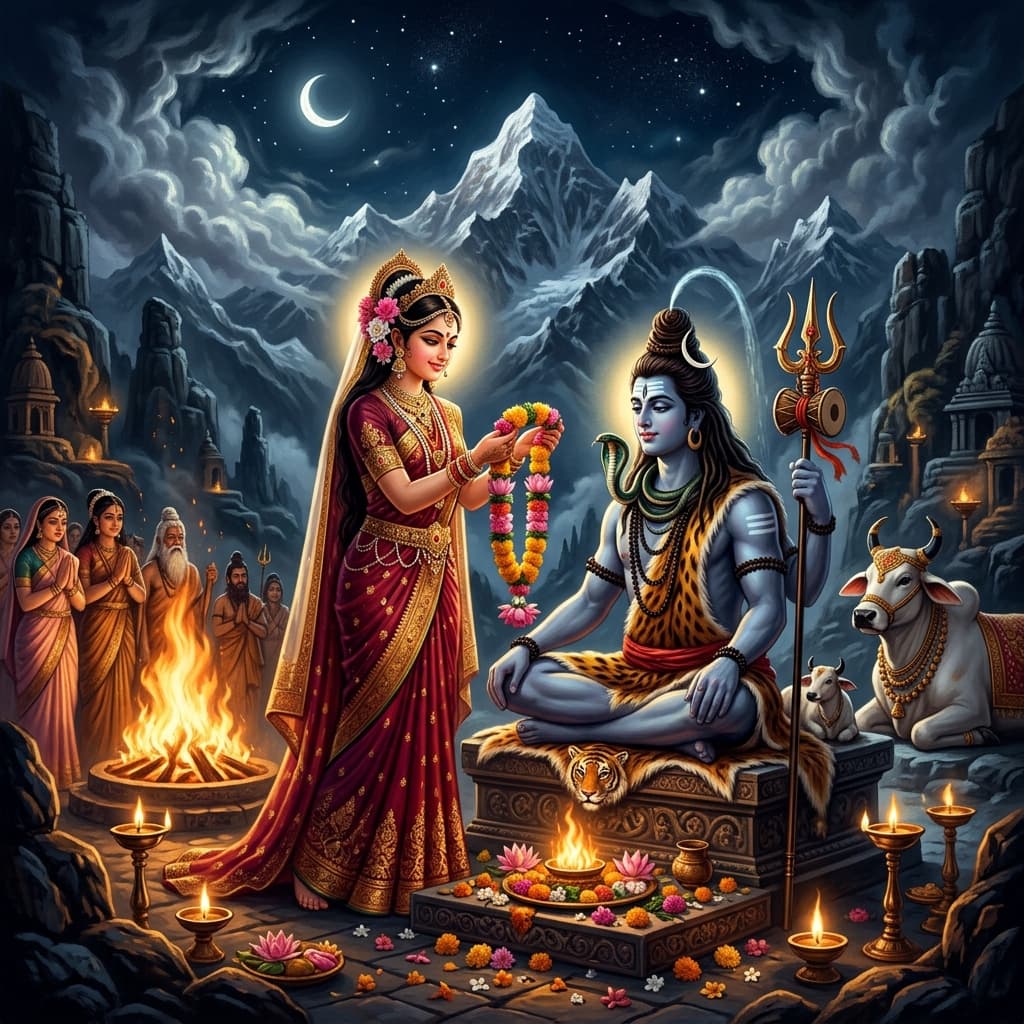
The Death of Sati
In the previous age, Shiva was married to Sati, daughter of the great lord Daksha. But Daksha despised his son-in-law, the ash-smeared hermit who haunted cremation grounds. When Daksha held a great sacrifice and deliberately excluded Shiva, Sati was consumed with shame. She immolated herself in the sacrificial fire.
Shiva's grief knew no bounds. He carried Sati's body across the universe in his terrible tandava dance of destruction, and the other gods feared he would unmake creation entirely. Vishnu cut the body into pieces with his discus so that Shiva would eventually release it. Where the pieces fell, sacred sites arose.
But Shiva's heart was broken. He withdrew to Mount Kailash and sank into meditation so deep that the cosmos held its breath. He had become the eternal ascetic, beyond all attachment.
The Rebirth of the Goddess
Sati was reborn as Parvati, daughter of Himavat, lord of the Himalayas. From childhood, she was devoted to Shiva. She would bring him flowers and sit beside him in meditation, hoping to rouse some response. But the god noticed nothing.
The other gods grew worried. They needed a son of Shiva and Parvati to defeat a demon named Taraka, who could only be killed by such a child. They sent Kamadeva, the god of love, to awaken desire in Shiva.
Kamadeva drew his bow and struck Shiva with a flower-arrow just as Parvati approached with offerings. But instead of awakening love, Shiva opened his third eye in fury and reduced Kamadeva to ash.
The Goddess's Penance
Parvati refused to give up. She retreated to the forest and began her own severe austerities. For years she sat in meditation, standing on one foot, surrounding herself with fires in summer and ice in winter, eating nothing, drinking nothing, pushing her body to the edge of death.
She became "Aparna," the One Who Takes No Leaves, not even the smallest sustenance.
Her tapas (spiritual heat) grew so powerful that it disturbed the cosmic order. The gods begged Shiva to pay attention before Parvati burned up the universe with her asceticism.
The Test
Shiva came to test her, disguised as an old brahmin. He spoke ill of himself, calling Shiva a mad beggar, an outcast, a dweller among corpses. Surely Parvati could do better than this frightening, ash-covered madman?
Parvati's anger blazed. She defended Shiva passionately, declaring that only those blind to truth could fail to see his greatness. The brahmin dropped his disguise, and Shiva stood before her, smiling.
"You have conquered me," he admitted. "Your devotion exceeds my detachment."
The Divine Wedding
Their wedding was the greatest celebration the cosmos had ever seen. The gods descended from heaven, the sages emerged from their hermitages, the gandharvas provided music, and the apsaras danced. Vishnu served as the priest. Even the ghosts and goblins of Shiva's retinue came, making the wedding party a wild mixture of the sacred and the strange.
From their union came Kartikeya (also called Skanda or Murugan), the war god who would defeat the demon Taraka, and later Ganesha, the elephant-headed remover of obstacles. Shiva and Parvati became the divine couple, embodying the balance between asceticism and engagement, withdrawal and participation, the masculine and feminine principles of the cosmos.
Their marriage proved that even the most resolute detachment can be dissolved by devoted love, and that the universe itself depends on the union of apparently opposite forces.