The Reign of Cronus
In the age before the Olympians, the Titan Cronus ruled supreme over the cosmos. He had seized power from his own father, Ouranos, castrating him with an adamantine sickle at the urging of his mother Gaia. But power won through violence carries with it a terrible curse: the prophecy that Cronus himself would be overthrown by his own offspring.
Consumed by this fear, Cronus devoured each of his children the moment they were born. One by one, the gods who would become the great Olympians vanished into the darkness of their father's belly: Hestia, Demeter, Hera, Hades, and Poseidon. The Titaness Rhea, their mother, watched in horror as child after child disappeared.
The Birth of Zeus
When Rhea was pregnant with her sixth child, she could bear no more grief. She sought counsel from Gaia and Ouranos, and together they devised a plan. Rhea traveled to Crete, to the hidden cave of Dicte on Mount Ida, where she gave birth to Zeus in secret. In place of the infant, she wrapped a great stone in swaddling clothes and presented it to Cronus, who swallowed it without suspicion.
The young Zeus grew in hiding, nourished by the goat Amaltheia and guarded by the Kouretes, warrior spirits who clashed their shields and spears to drown out the baby's cries. In the shadow of the mountain, the future king of the gods grew strong.
The Liberation
When Zeus reached maturity, he returned to challenge his father. With the aid of the Titaness Metis, who prepared an emetic potion, Zeus forced Cronus to disgorge his siblings. First came the great stone, which Zeus later set at Delphi as an eternal monument. Then, one by one, his brothers and sisters emerged: Poseidon, Hades, Hera, Demeter, and Hestia, fully grown and burning with righteous anger.
The six children of Cronus stood united for the first time, and the cosmos trembled at what was to come.
The Ten-Year War
The war that followed was unlike anything the universe had ever witnessed. The Olympians established their stronghold on Mount Olympus, while the Titans rallied under Cronus on Mount Othrys. For ten years the two sides clashed, their battles shaking the very foundations of the earth.
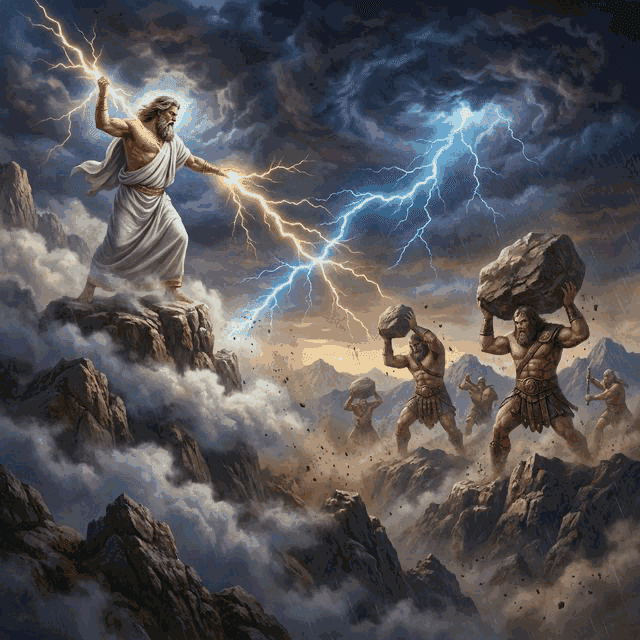
Neither side could gain the advantage until Zeus descended to Tartarus and freed the Hecatonchires, the Hundred-Handed Ones, and the Cyclopes, all of whom had been imprisoned by Cronus. The Cyclopes forged terrible weapons for the Olympians: the thunderbolt for Zeus, the trident for Poseidon, and the helm of invisibility for Hades. The Hecatonchires, with their three hundred hands, hurled volleys of boulders that darkened the sky.
The boundless sea roared terribly around, the great earth rumbled, and broad heaven groaned, shaken. Tall Olympus trembled from its roots under the immortal feet of the lord.
The final battle was cataclysmic. Zeus unleashed his thunderbolts in an endless barrage, Poseidon shook the earth and sea, and Hades struck terror into the hearts of the Titans with his unseen presence. The Hecatonchires buried the Titans under mountains of stone.
The New Order
Victorious, the three brothers divided the cosmos by lot. Zeus received the sky, Poseidon the sea, and Hades the underworld. The earth and Mount Olympus remained common ground. The defeated Titans were cast into Tartarus, guarded eternally by the Hecatonchires. Atlas, who had led the Titans in battle, was condemned to hold up the sky for all eternity.
A new age had begun. Zeus took his place as king of gods and men, establishing the order that would govern the cosmos for all time. Yet the cycle of violence that began with Ouranos cast a long shadow, and the question lingered: would Zeus, too, one day fall to his own children?