Side by sideParent and child

Haumea vs Pele

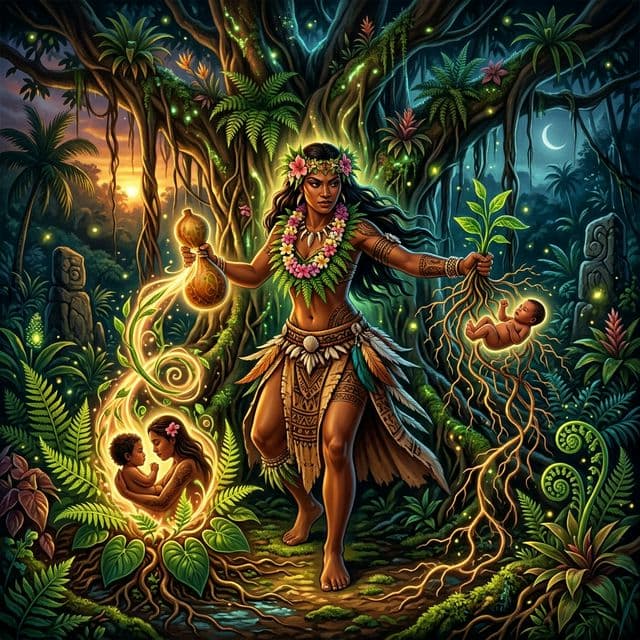
Haumea
HaumeaPolynesian
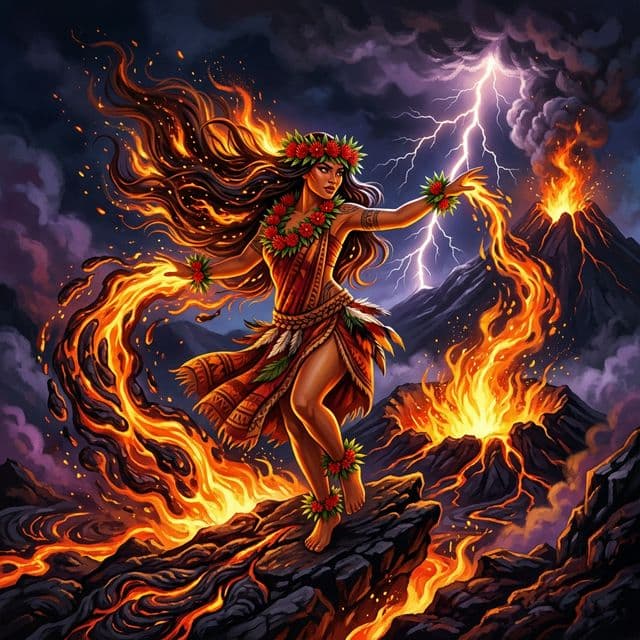
Pele
PelePolynesian

Haumea and Pele are recorded as parent and child in the Polynesian Pantheon.

At a glance

Haumea and Pele compared
HaumeaPele
TraditionPolynesian PantheonPolynesian Pantheon
Domainsfertility, childbirth, wild foods, regenerationvolcanoes, fire, lightning, dance, creation
Symbolsfern roots, gourd, childbirth, transformationvolcanic fire, ohia lehua flower, pahoehoe lava, lava rock
Also calledHaumia (Maori harvest god)Pelehonuamea (She who shapes the sacred land), Ka wahine ai honua (The woman who devours the land)

Where they meet

The atlas records no domain or symbol that Haumea and Pele share.

They are compared because of how the myths connect them, not because of what they rule.

Where they part

Only Haumea

Associated with fertility, childbirth, wild foods, and regeneration.

Only Pele

Associated with volcanoes, fire, lightning, dance, and creation.

How each was worshipped

Haumea

Cult sites
Hawaiian traditions of fertility and childbirth

Mother of islands and of Pele's line in some tellings. Cult is reproductive and local. Do not flatten her into a generic earth mother.

Pele

Cult sites
Halemaumau crater at Kilauea, her living house; Other volcanic sites on Hawai'i Island
Festivals
Offerings of gin, berries, and ohelo; hula for Pele

The volcano is the temple. People still stack ho'okupu at the crater. She is jealousy, fire, and new land. Christian centuries did not empty the pit. Treat living practice as practice, not as folklore leftover.

The two figures

Polynesian Pantheon

Haumea

A powerful fertility goddess with the ability to regenerate herself and transform her age. In Hawaiian tradition, Haumea is the mother of Pele and many other deities, and taught humans the secrets of childbirth.

Haumea's exact origins are mysterious, befitting a goddess of transformation. In some Hawaiian traditions, she emerged in Kahiki (Tahiti) in the earliest times. Her ability to shed her form and regenerate suggests she may be as old as creation itself, a primal force of fertility that takes different shapes across the ages.

Haumea is a complex goddess figure, particularly prominent in Hawaiian mythology, where she is among the most powerful of female deities. She embodies fertility, regeneration, and the mysterious powers of women.

Read the full Haumea entry

Polynesian Pantheon

Pele

The Hawaiian goddess of volcanoes, fire, and lightning. Pele is a fierce and passionate deity who creates new land through volcanic eruptions and whose temper is as volatile as the lava she commands.

Pele was born in Kahiki (Tahiti) to Haumea and Ku-waha-ilo. Her fiery nature and affairs angered her sister Namaka, the sea goddess, who drove her from her homeland. Pele traveled across the Pacific, seeking a home for her fires, finally settling in Kilauea volcano on Hawaii, where she remains the living goddess of volcanic creation.

Pele is the most revered deity in Hawaiian mythology, an akua (goddess) whose power is visible in every eruption of Kilauea. She embodies both creation and destruction, as her lava destroys what exists while simultaneously creating new land. She represents the untameable forces of nature and the passionate spirit of Hawaii itself.

Read the full Pele entry
About this comparison

Comparisons pair figures that play a similar role across traditions, or that the myths connect within one. A shared role does not, by itself, establish a shared origin.