A dwarf-bodied, lion-maned household protector god who warded off evil spirits, nightmares, and dangers to mothers and children. Unlike most Egyptian deities, Bes was typically shown facing forward rather than in profile, and his cult was overwhelmingly domestic rather than centered on formal state temples.
Bes was among the most widely beloved deities in everyday Egyptian life, despite never receiving the grand state temples built for gods like Amun or Ra. Depicted as a bow-legged dwarf with a lion's mane and tail, a protruding tongue, and a fierce, often almost comic grimace, Bes was believed to frighten away evil spirits, snakes, and other dangers through sheer grotesque ferocity.
An Unusual Iconography
Egyptian art overwhelmingly depicted gods and people in profile. Bes is a striking exception, shown facing directly outward toward the viewer, a composition that emphasized his role as a protective, apotropaic presence meant to confront threats head-on. He is frequently shown brandishing knives, snakes, or other weapons, dancing, or playing musical instruments such as the tambourine.
Guardian of Childbirth
Bes was especially associated with protecting women in childbirth and watching over young children. His image appears on household furniture, cosmetic items, amulets, and on the walls of "birth houses" (mammisi) attached to major temples, such as those at Dendera, where reliefs of Bes accompany scenes of divine birth. Mothers and children wore amulets bearing his image for protection, and his boisterous, dancing depiction was thought to entertain and soothe infants while warding off harmful forces.
A God of the People
Unlike the great state gods with elaborate priesthoods, Bes belonged primarily to ordinary household religion. He required no formal temple or organized clergy to be effective; his presence was invoked directly in the home, worn on the body, or painted on domestic walls, making him one of the most consistently popular deities across all social classes throughout much of Egyptian history.
Origin Story
Bes's precise origins are unclear, though his distinctive dwarf-and-lion form appears from the Middle Kingdom onward and became increasingly popular through the New Kingdom and Late Period. Rather than emerging from a single cosmogonic myth, Bes developed as a household protector whose role expanded over time to cover childbirth, music, and the warding off of evil.
Source Notes
These records lack edition and translator details. Their wording has not been verified as a direct quotation.
[Bes appears repeatedly in domestic and apotropaic contexts rather than in a single canonical mythic narrative; his role is attested primarily through iconography and amulet inscriptions rather than an extended literary text.]
Academic References
Gods and Pharaohs from Egyptian Mythology by Geraldine Harris
1982·English
Covers Bes's household and protective role
References & further reading
Editorial notes for deeper study (not a full bibliography).
Wilkinson, Richard H. *The Complete Gods and Goddesses of Ancient Egypt* (Thames & Hudson, 2003).
Meeks, Dimitri and Favard-Meeks, Christine (trans. G. M. Goshgarian). *Daily Life of the Egyptian Gods* (Cornell University Press, 1996) — on household and apotropaic deities including Bes.
Browse representative texts and policies on the Sources page.
Worship & Cult
How Bes was venerated in ancient times
Sacred Temples
•No major dedicated state temple; shrines and 'Bes chambers' at sites such as Saqqara and Deir el-Medina
•Depicted in birth-house (mammisi) reliefs at temples including Dendera
Worship Practices
Bes's worship was overwhelmingly domestic: amulets, painted bedroom and birth-room walls, cosmetic containers, and furniture carried his image throughout Egyptian homes. He required no formal priesthood, making him one of the most consistently accessible deities to ordinary Egyptians across the social scale.
Domains
protection of the household
childbirth
music and dance
warding off evil
Symbols
lion mane and tail
protruding tongue
dwarf stature
knives or serpents brandished defensively
In the museums
Bes in art
Real objects in public collections, released into the public domain by the museums that hold them. Dates refer to when each object was made. Objects made within the tradition come first, later depictions after.
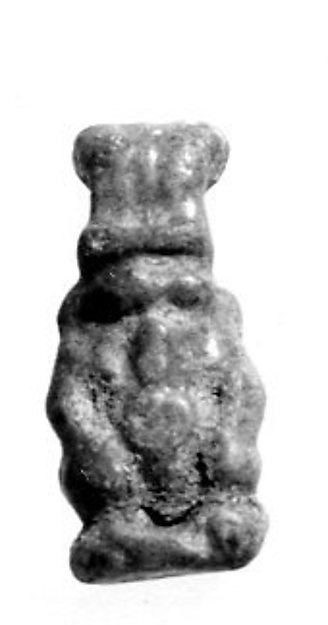
A faience amulet of the dwarf god Bes, tagged by the museum with his name. Bes amulets were worn for protection, especially of households, women in childbirth, and children.
Egyptian, Late Period · 360–343 BCE · Metagraywacke
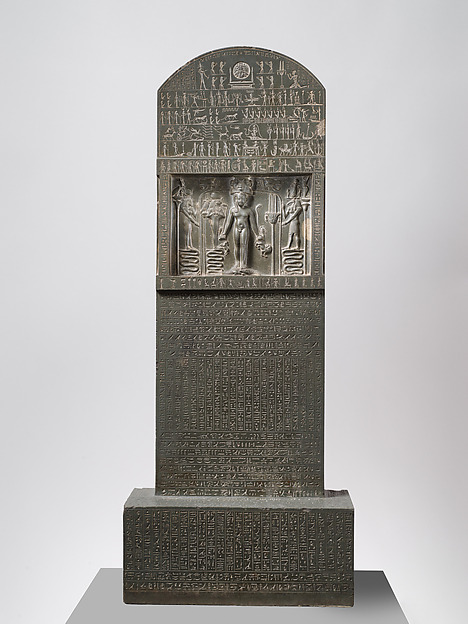
The Metternich Stela, a magical healing stela carved with spells against venomous bites; the museum tags it with figures including Bes and Horus the Child, whose image dominates the front. Owners would pour water over the inscribed surface and drink the water as a cure.