Aztec Pantheon
Coatlicue
Also known as She of the Serpent Skirt, Teteoh Innan
- earth
- fertility
- life
- death
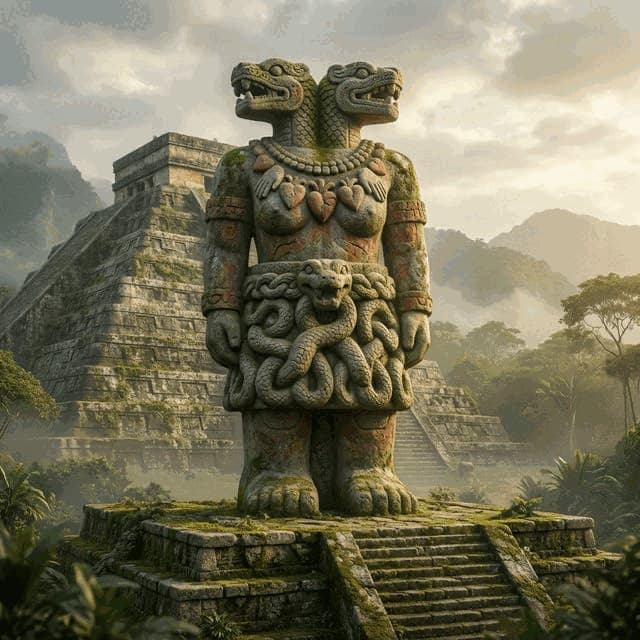
Earth mother goddess who gave birth to the moon, stars, and Huitzilopochtli. Depicted wearing a skirt of writhing serpents and a necklace of human hearts and hands.
About Coatlicue
She of the Serpent Skirt
Coatlicue, meaning "She of the Serpent Skirt," was the primordial earth mother goddess of the Aztecs, embodying both the terror and the nurturing power of the earth itself. Her famous statue in the National Museum of Anthropology in Mexico City depicts her with a skirt of writhing serpents, a necklace of human hearts, hands, and skulls, clawed feet, and two serpent heads forming her face - representing the duality of life and death.
Mother of Gods
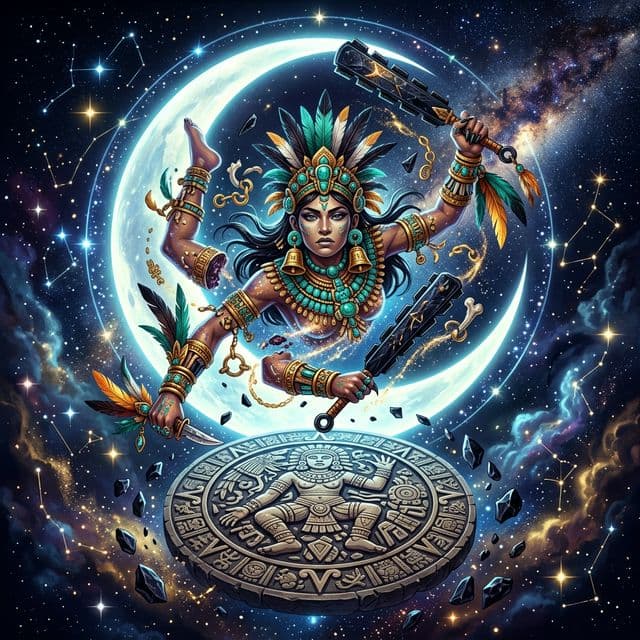
Coatlicue was mother to the Centzon Huitznahua (the 400 stars of the southern sky), Coyolxauhqui (the moon goddess), and most importantly, Huitzilopochtli (the sun god). Her children represented the celestial bodies locked in eternal conflict, playing out the daily drama of sunrise as Huitzilopochtli defeated his siblings.
The Birth at Coatepec
The central myth of Coatlicue tells of her miraculous pregnancy on the sacred mountain Coatepec (Serpent Hill). While sweeping the temple as a penitent, a ball of feathers descended from the heavens and she became pregnant. Her 400 sons, led by Coyolxauhqui, viewed this as a disgrace and marched to kill her. At the moment of her death, Huitzilopochtli sprang fully armed from her womb and slaughtered his siblings.
Earth and Sacrifice
As an earth deity, Coatlicue required nourishment through sacrifice to remain fertile. The Aztecs believed the earth literally consumed the dead, recycling them into new life - hence her terrifying imagery of devoured hearts and severed limbs.
Origin story
While sweeping a temple on Coatepec, a ball of feathers fell on her and she became miraculously pregnant with Huitzilopochtli. Her other children plotted to kill her, but Huitzilopochtli was born fully armed and defended her.
Across traditions
Parallel figures
Figures who play a role like Coatlicue's in other traditions.
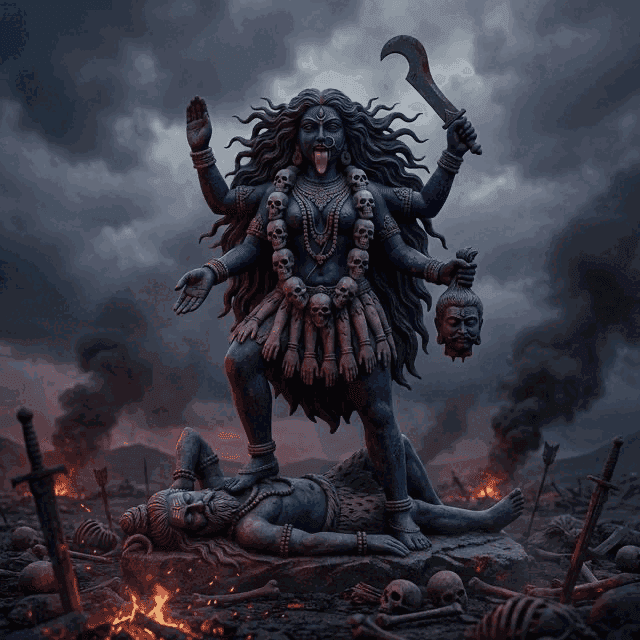 HinduKaliIllustration
Both are 'terrible mother' goddesses adorned with symbols of death (a skirt of serpents and necklace of hands/hearts vs. a skull necklace) who embody destruction and rebirth
Compare Coatlicue and Kali side by side
Worship and cult
Temples, festivals, and practices recorded for Coatlicue
The serpent-skirt statue is a temple object, not a parlour icon. Her cult is the earth that eats and feeds, tied to Coatepec and the war god's birth.
Sacred sites
- Templo Mayor as mother of Huitzilopochtli
- Teteoinnan shrines in the Mexica calendar
Festivals
- Linked to mother-goddess days rather than a feast in her name alone
Family
Coatlicue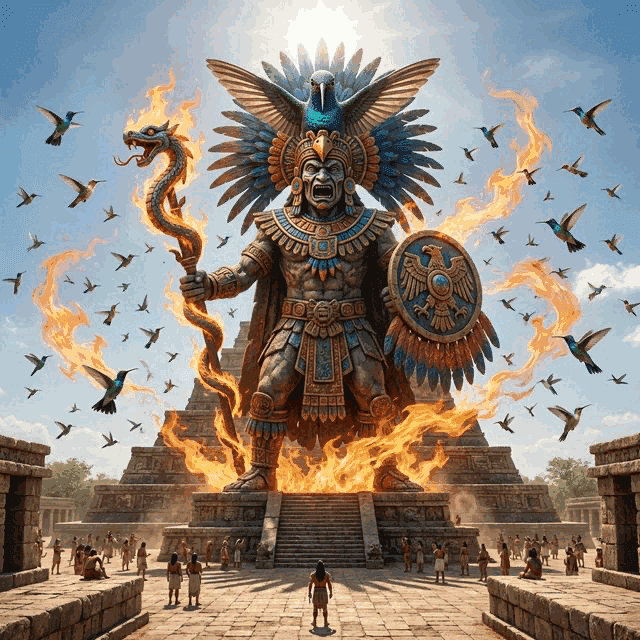
Questions about Coatlicue's family
- Who are Coatlicue's children?
- Children of Coatlicue recorded in the atlas: Huitzilopochtli and Coyolxauhqui.
In the atlas
Where Coatlicue appears
Sources and further reading
Source notes
These references are recorded in the catalog. Their passage wording and translation have not been checked, so quotations are not displayed here.
- Lewis Spence, The Myths of Mexico and Peru (1913)
About this entry
By Elizabeth Stein for Mythos Atlas. About the author. Editorial notes are grounded in the site's cited sources and can be challenged through the contact page.
Parallels are editorial comparisons across traditions: a shared role does not, by itself, establish a shared origin.
Family relationships come from the atlas's kinship records. Ancient sources often disagree on divine genealogy.
Keep exploring
One myth a week, with its sources in a short email. The sign-up form is just below.
Genealogy
Family tree
Coatlicue's parents, consorts, children and rivals, as recorded in the atlas.