Yoruba Tradition
Shopona
Also known as Sopona, Sakpata, Omolu, Obaluaye
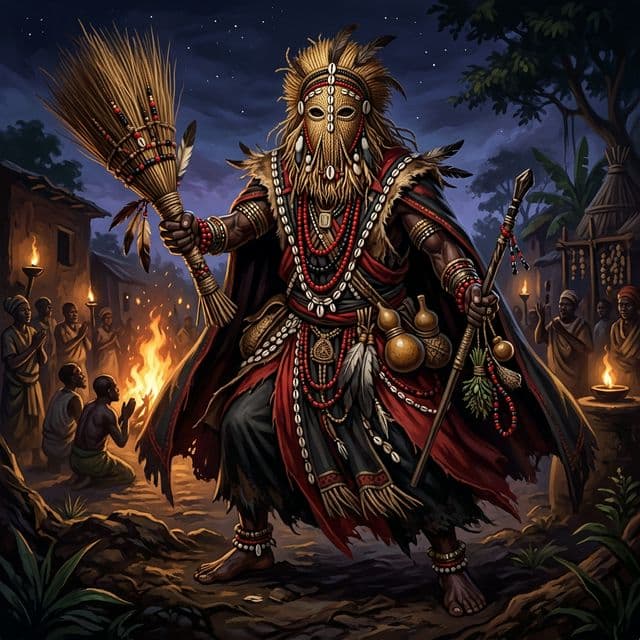
- disease
- healing
- earth
- smallpox
- justice
The feared Orisha of disease, particularly smallpox. Shopona punishes wrongdoers with illness but also heals those who honor him.
About Shopona
The Lord of Infectious Disease
Shopona is the Orisha of disease, particularly smallpox, which was once the most feared killer in West Africa. He is both the bringer of epidemics and the healer of the sick.
The Hidden Face
Shopona is always depicted with his face covered, usually with straw or raffia. This represents both the disfiguring effects of smallpox and the belief that to see his true face would bring immediate death.
Divine Justice
Shopona does not strike randomly. He is an agent of divine justice, punishing thieves, liars, and those who violate sacred laws with disease.
The Healer
Paradoxically, Shopona is also a healer. His priests were among the first to practice a form of variolation (primitive vaccination).
The End of Smallpox
With the eradication of smallpox in 1980, Shopona's domain has shifted to include all infectious diseases.
Origin story
Shopona emerged from the earth itself, embodying the power of disease that lives in the soil and spreads through communities.
Across traditions
Parallel figures
Figures who play a role like Shopona's in other traditions.
 GreekApolloIllustration
Both can bring plague and also healing, representing divine justice
Compare Shopona and Apollo side by side
Worship and cult
Temples, festivals, and practices recorded for Shopona
Disease god. People do not advertise the cult. In some towns even the name is careful. Do not turn a pox orisha into a wellness brand.
Sacred sites
- Avoidant shrines; smallpox as the old dossier
Family
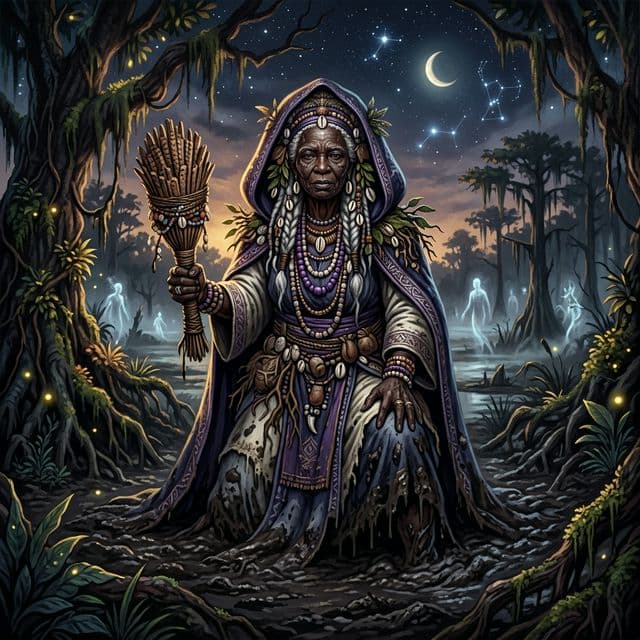 Shopona
Questions about Shopona's family
- Who are Shopona's parents?
- The atlas's kinship records name one parent of Shopona: Nana Buruku. Ancient accounts do not always agree on divine parentage.
Sources and further reading
Source notes
These references are recorded in the catalog. Their passage wording and translation have not been checked, so quotations are not displayed here.
- Oriki Shopona
About this entry
By Elizabeth Stein for Mythos Atlas. About the author. Editorial notes are grounded in the site's cited sources and can be challenged through the contact page.
Parallels are editorial comparisons across traditions: a shared role does not, by itself, establish a shared origin.
Family relationships come from the atlas's kinship records. Ancient sources often disagree on divine genealogy.
Keep exploring
One myth a week, with its sources in a short email. The sign-up form is just below.
Genealogy
Family tree
Shopona's parents, consorts, children and rivals, as recorded in the atlas.