Slavic Pantheon
Stribog
Стрибогъ(Stribogŭ)
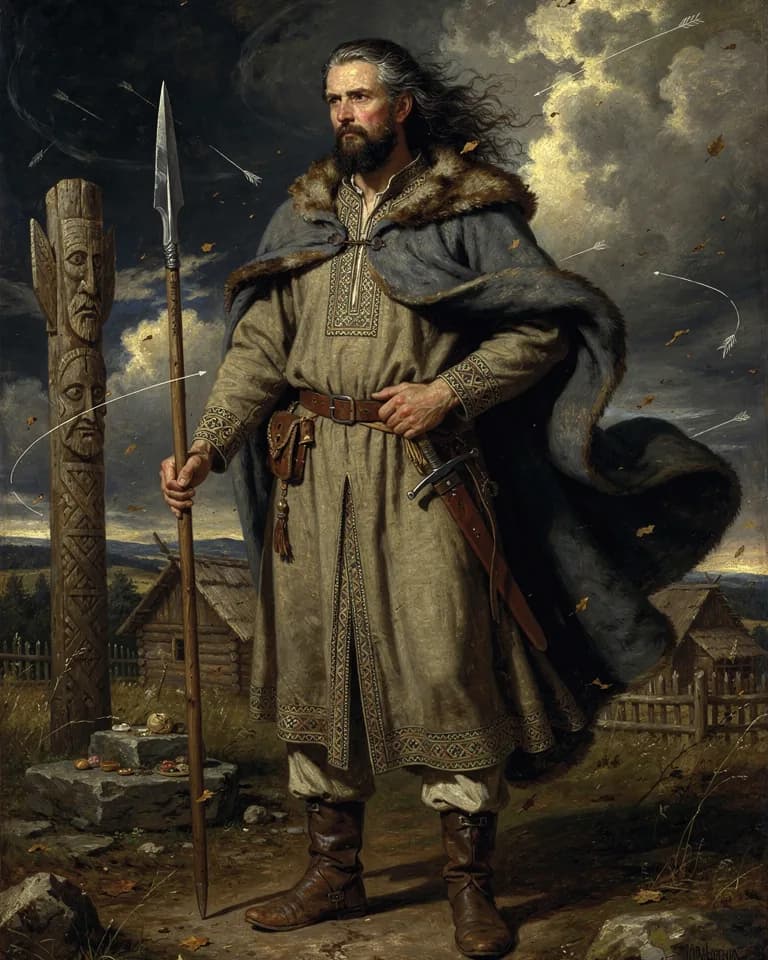
- wind
A wind god among Vladimir's 980 idols, remembered in the Tale of Igor's Campaign as the ancestor of the winds that blow arrows against the poem's defeated Rus' army.
About Stribog
Attestation
Stribog is named fourth–fifth among Vladimir's six idols in the Russian Primary Chronicle's entry for 980. His function as a wind god rests almost entirely on one striking line in the Tale of Igor's Campaign, which calls the winds "Stribog's grandsons," blowing arrows from the sea against Prince Igor's host. Beyond his name in the idol list and that one poetic image, nothing about his myth, temple, or worship survives.
An inference, held with appropriate caution
The wind association is widely accepted by Slavicists precisely because of how specific and vivid the Tale's image is, but it remains an inference from a single later literary reference rather than a chronicle statement of his domain; the Primary Chronicle itself never says what Stribog governed.
Worship and cult
Temples, festivals, and practices recorded for Stribog
No medieval source records a rite, temple, or festival for Stribog; he is known only from his place in the 980 idol list and from a single poetic image in the Tale of Igor's Campaign describing the winds as his descendants.
In the atlas
Where Stribog appears
Sources and further reading
Source notes
These references are recorded in the catalog. Their passage wording and translation have not been checked, so quotations are not displayed here.
- Russian Primary Chronicle, s.a. 980 (paraphrase)
- Tale of Igor's Campaign (Slovo o polku Igoreve), paraphrase
Cite this page
No publication date is recorded for this page, so each citation uses n.d. and today's date as the access date.
About this entry
By Elizabeth Stein for Mythos Atlas. About the author. Editorial notes are grounded in the site's cited sources and can be challenged through the contact page.
Parallels are editorial comparisons across traditions: a shared role does not, by itself, establish a shared origin.
Keep exploring
One myth a week, with its sources in a short email. The sign-up form is at the foot of the page.