Polynesian Pantheon
Tangaroa
Also known as Kanaloa (Hawaiian), Ta'aroa (Tahitian), Tagaloa (Samoan)
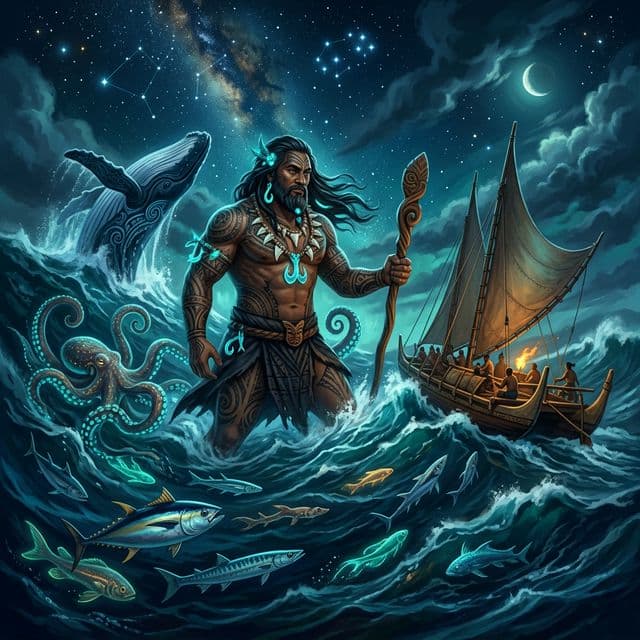
- sea
- ocean
- fish
- marine life
- navigation
The great god of the sea and all that dwells within it. In some traditions, particularly Tahitian and Samoan, Tangaroa/Tagaloa is the supreme creator god who brought forth the world from primordial darkness.
About Tangaroa
Lord of the Ocean
Tangaroa is one of the great gods of Polynesia, revered across the Pacific as the deity of the ocean and all marine life. For peoples who lived by the sea and traveled across vast ocean distances, Tangaroa was one of the most important gods, protector of fishermen and navigators.
Regional Variations
Tangaroa's role varies significantly across Polynesia:
Tahitian Tradition: As Ta'aroa, he is the supreme creator god who existed alone in darkness within an egg-like shell. Breaking free, he created the world from his own body, using his spine for mountains, his feathers for trees, and his tears for rain.
Samoan Tradition: Tagaloa is the supreme god who dwelt in the expanse of space when there was no land. He created the islands and sent down his daughter to populate them.
Maori Tradition: Tangaroa is one of the sons of Rangi and Papa, brother to Tane and Tu. He is the god of the sea and father of all fish and sea creatures. He is in eternal conflict with Tane, whose forests provide the wood for canoes that conquer Tangaroa's realm.
Hawaiian Tradition: As Kanaloa, he is associated with the ocean and often paired with Kane (Tane). In later Hawaiian tradition, influenced by Christian missionaries, Kanaloa became associated with evil, but originally he was a beneficent god of the deep ocean.
The Primal Sea
In most Polynesian traditions, the ocean is primary, the original element from which all else emerged. Tangaroa thus represents both the physical ocean and the primordial chaos from which creation sprang. Fishermen prayed to him for good catches and safe returns.
Conflict with Tane
In Maori tradition, Tangaroa is perpetually at war with his brother Tane. When Tane's trees provide canoes that sail upon and fish from Tangaroa's ocean, the sea god sends storms and waves in revenge. When Tangaroa's creatures wash ashore, Tane's forests claim them. This conflict explains the eternal tension between land and sea.
Origin story
In Maori tradition, Tangaroa was born from the union of Rangi (Sky Father) and Papa (Earth Mother), emerging when his brothers separated their parents. In Tahitian tradition, he existed eternally in primordial darkness within a cosmic shell, eventually breaking free to create the universe from his own body.
Across traditions
Parallel figures
Figures who play a role like Tangaroa's in other traditions.
 GreekPoseidonIllustration
Both are gods of the sea and its creatures
Compare Tangaroa and Poseidon side by side NorseNjordIllustration
Both are sea gods important to seafaring peoples
Compare Tangaroa and Njord side by side
Worship and cult
Temples, festivals, and practices recorded for Tangaroa
Ocean, fish, and the law of the reef. Offerings differ from Aotearoa to Tahiti. Treat local tapu as the liturgy; there is no single cathedral.
Sacred sites
- Sea tapu; coastal shrines vary by island
Family

In the atlas
Where Tangaroa appears
Sources and further reading
Source notes
These references are recorded in the catalog. Their passage wording and translation have not been checked, so quotations are not displayed here.
- Tahitian Creation Chant
Cite this page
No publication date is recorded for this page, so each citation uses n.d. and today's date as the access date.
About this entry
By Elizabeth Stein for Mythos Atlas. About the author. Editorial notes are grounded in the site's cited sources and can be challenged through the contact page.
Parallels are editorial comparisons across traditions: a shared role does not, by itself, establish a shared origin.
Family relationships come from the atlas's kinship records. Ancient sources often disagree on divine genealogy.
Keep exploring
One myth a week, with its sources in a short email. The sign-up form is just below.
Genealogy
Family tree
Tangaroa's parents, consorts, children and rivals, as recorded in the atlas.