Death answers
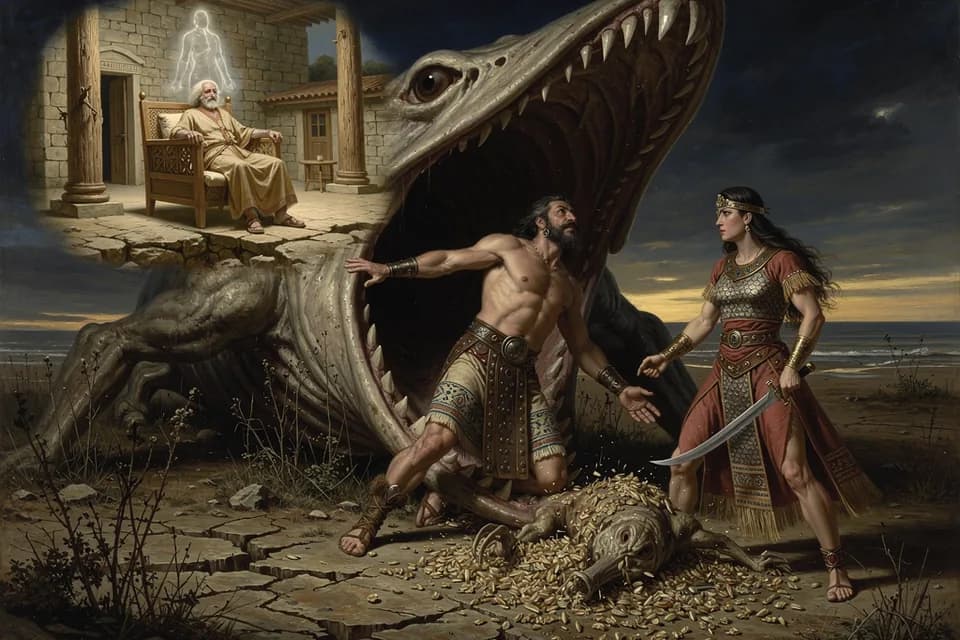
The last two tablets of the Baal Cycle (KTU 1.5-1.6) tell the story of Baal and Mot. When Baal, newly enthroned in his palace, sends messengers to Mot claiming kingship, Death replies with a threat. He reminds Baal that he struck down Litan, the fleeing serpent, the twisting serpent with seven heads, and says that because of it Baal must now come down into his throat (KTU 1.5 I). Mot describes his appetite: one lip to the earth, one lip to the heavens, a tongue reaching the stars (KTU 1.5 II).
Submission
Baal is afraid. He sends back word that he is Mot's servant forever. Before going down he is told to take with him his clouds, his winds, his rain, and his attendants, and he couples with a heifer, which bears a son; the purpose of that episode is debated. Then Baal goes down to the underworld, and the text reports that he is dead (KTU 1.5 V-VI).
Mourning
Messengers find El and report that they have found Baal fallen on the ground. El comes down from his throne, sits in the dust, pours dirt on his head, gashes his cheeks and arms, and cries out that Baal is dead: what will become of the people? (KTU 1.5 VI). Anat, too, roams every mountain looking for him, and finds his body. With the help of the sun-goddess Shapash she carries it to Zaphon, buries it, and offers sacrifices (KTU 1.6 I).
A replacement king
El asks Athirat to name one of her sons as king, and she proposes Athtar. He climbs onto Baal's throne, but his feet do not reach the footstool and his head does not reach the top; he comes down and rules instead over the earth (KTU 1.6 I).
Anat destroys Mot
Days and months pass. Anat longs for Baal like a cow for her calf. At last she seizes Mot. With a blade she splits him; with a sieve she winnows him; with fire she burns him; with millstones she grinds him; in the field she sows him, and the birds eat his flesh (KTU 1.6 II).
El's dream
El then dreams: the heavens rain oil, the wadis run with honey. He laughs, puts his feet on the footstool, and declares that Mightiest Baal is alive (KTU 1.6 III). But the furrows are still dry, and Shapash is sent to find him.
The last battle
In the seventh year, Mot comes back to complain of what he has suffered. He and Baal meet on Zaphon and fight. They gore like wild oxen, bite like serpents, kick like stallions; both fall. Then Shapash calls to Mot: how can he fight Baal? If El hears of it he will overturn Mot's throne and break his sceptre. Mot is afraid, and yields, acknowledging Baal's kingship (KTU 1.6 VI). The cycle ends with a hymn to Shapash and a colophon naming the scribe Ilimilku.
Interpretation
The story links Baal's absence with drought and his return with rain, and many scholars have read it as a myth of the agricultural year. Others stress that it tells of a single cosmic crisis, and that the text never describes an annual cycle. Either way, its central claim is stark: even the king of the gods can be swallowed by Death, and he returns only through the loyalty of others.