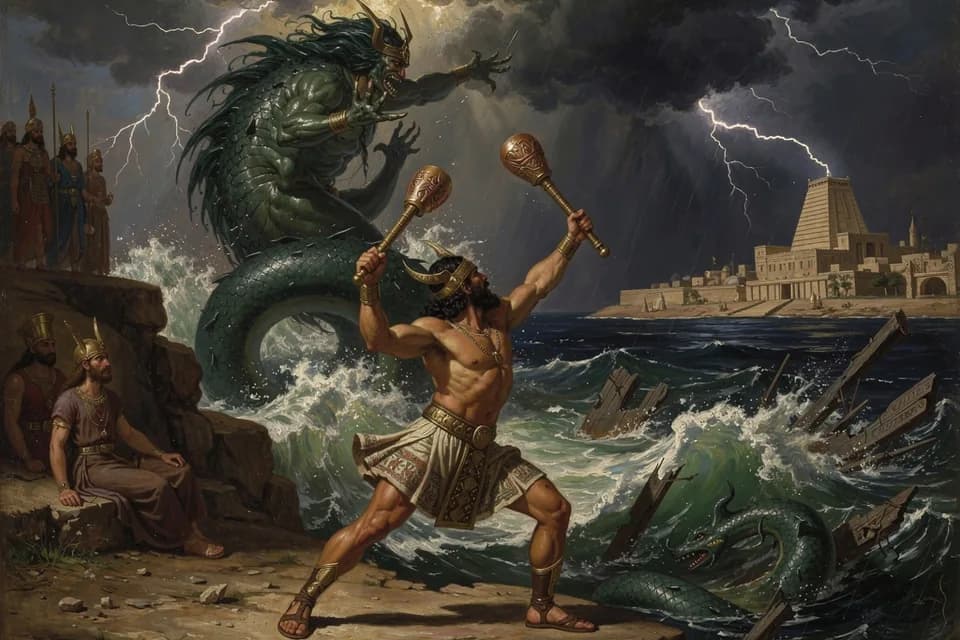
The first tablets
This episode comes from the first two tablets of the Baal Cycle (KTU 1.1-1.2), which are badly damaged; scholars disagree about the order of some columns, and much of KTU 1.1 is too broken to translate continuously. The outline below follows the reconstruction in Mark S. Smith's translation.
El favours the Sea
In the broken opening, El proclaims the name and status of Yam, Prince Sea and Judge River, whom he calls beloved, and the craftsman god Kothar-wa-Khasis is summoned to build Yam a house. Athtar seems to object that he, too, lacks a palace, and is told by the sun-goddess Shapash that El has chosen Yam (KTU 1.2 III). The balance of power among the gods is shifting toward the Sea.
The messengers
Yam then sends two messengers to the assembly of the gods, which is feasting on El's mountain. They are told not to bow, and to deliver the message standing: the gods must give up Baal and his followers, so that Yam may take his gold (KTU 1.2 I). When the messengers arrive, the gods lower their heads onto their knees in fear. Baal, standing by El, rebukes them for cowering. But El agrees to the demand: Baal is to be Yam's slave, and will bring him tribute.
Baal is furious. He seizes a weapon to attack the messengers, and two goddesses hold him back: Anat seizes his right hand and Athtart his left, reminding him that messengers must not be harmed.
Two clubs
The central scene is in KTU 1.2 IV. Kothar-wa-Khasis encourages Baal: now is the time to strike his enemy and take his eternal kingship. He fashions two clubs and gives each a name with a spell over it. The first is Yagrush, "Driver", told to drive Yam from his throne. It leaps from Baal's hand like an eagle and strikes Yam on the shoulders and chest, but Yam does not fall. The second is Ayyamur, "Expeller", told to expel Yam from his seat. It strikes Yam on the head, between the eyes, and Prince Sea collapses to the ground, his joints shaking, his body slumping. Baal drags him down and sets about finishing him.
Athtart's cry
Athtart then calls out to Baal. The lines are damaged and translators differ: she either rebukes Baal or urges him to "scatter" the defeated Sea, because Yam is now their captive. The episode ends with a declaration that Yam is dead and Baal shall be king.
What the story means
The battle of a storm-god with the sea is one of the oldest and most widespread myths of the ancient Near East. At Ugarit, a harbour city dependent on the sea but vulnerable to it, the story makes Baal the guarantor of order: the waters that can drown are subdued by the god who sends rain. The same pattern appears in Babylon, where Marduk defeats Tiamat, and in biblical poetry, where God rebukes the sea and crushes the dragon. Scholars disagree about whether the Ugaritic story was recited at a particular festival; the texts themselves do not say.
Anat's claim
A different tablet (KTU 1.3 III) has Anat boast that she herself destroyed Yam, El's beloved, and the dragon Tunnan and the twisting serpent. Ugaritic tradition could credit more than one god with the victory over the Sea.