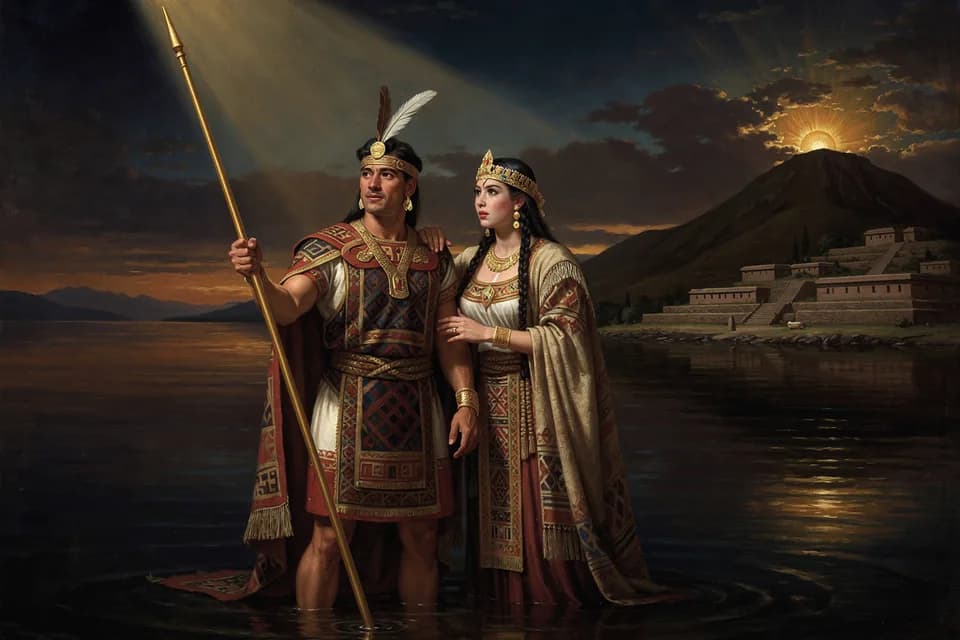
Garcilaso's version: the golden rod
The Inca Garcilaso de la Vega, writing in Spain in 1609, says he heard this account as a boy in Cusco from an elderly Inca relative of his mother. In the beginning, people lived like wild animals, without farming, houses, or clothing. Our father the Sun, taking pity on them, sent a son and a daughter of his down to earth, placing them in Lake Titicaca. He gave them a rod of gold, half a yard long and two fingers thick, and told them to travel wherever they wished, and at every place they stopped to eat or sleep to try to push the rod into the ground. Where it sank in at a single thrust, there they were to stay and found their court.
The pair traveled north from the lake. At every resting place the rod refused the ground, until they came to the hill of Huanacauri above the valley of Cusco. There the rod sank into the earth and disappeared. Manco Cápac said to his sister-wife that this was the place their father meant them to settle. They separated to gather the people: Manco to the north of the valley and Mama Ocllo to the south. The people, amazed at their clothing and ornaments and trusting their words, followed them, and Cusco was founded. Manco taught the men to farm and to bring water in channels; Mama Ocllo taught the women to spin, weave, and make clothing.
The Pacaritambo version: brothers from a cave
Juan de Betanzos (1551) and Pedro Sarmiento de Gamboa (1572), drawing on other Inca informants, tell a different story. At Pacaritambo, south of Cusco, four brothers and four sisters emerged from the central window of a cave called Tambo Toco: Ayar Manco, Ayar Cachi, Ayar Uchu, and Ayar Auca, with Mama Ocllo, Mama Huaco, and two other sisters. They set out with the people of that place to find good land.
Ayar Cachi was so strong that with his sling he could split hills and raise ravines, and his siblings feared him. They sent him back to the cave to fetch sacred objects they claimed to have left behind, and when he went in, their companion sealed the entrance with stone, trapping him forever. At Huanacauri another brother, Ayar Uchu, turned to stone and became the huaca of that hill, charging his siblings to honor him. A third, Ayar Auca, became a stone marking possession of the site of Cusco. Manco, the survivor, founded the city with his sisters, and Mama Ocllo bore his son Sinchi Roca, the next ruler.
Two stories, two purposes
The two versions are not simply right and wrong. The cave story ties the dynasty to a specific place of emergence, the pacarina that every Andean lineage had, and gives Huanacauri its status as a huaca. Garcilaso's story ties the dynasty directly to the Sun and presents the Incas as bringers of civilization, which suited his argument that the Incas prepared the Andes for Christianity. Sarmiento, commissioned by a viceroy who wanted to deny the Incas' legitimacy, lingers on episodes of violence against the valley's earlier people.