The beggar and the maiden
In the most ancient times, the Huarochirí stories say, Cuniraya Viracocha wandered the land looking like a miserably poor man in rags, and people who did not know him called him a lousy wretch. Yet he made terraces rise on the sides of ravines at a word and sent irrigation channels flowing by throwing a hollow cane.
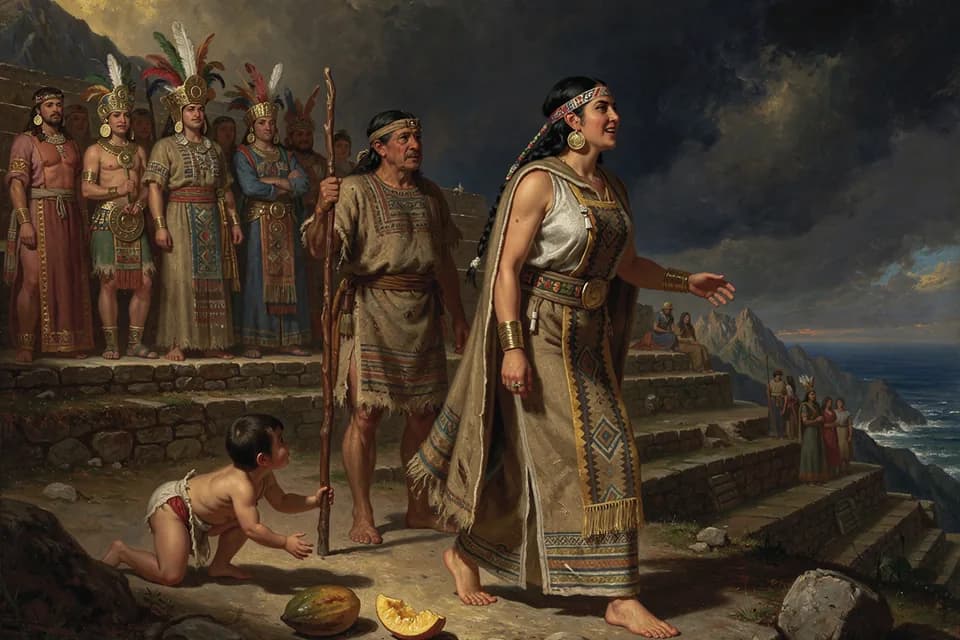
There lived then a huaca named Cavillaca, a beautiful virgin whom all the huacas desired, but who would have none of them. One day, as she sat weaving beneath a lúcuma tree, Cuniraya turned himself into a bird, placed his seed in a ripe lúcuma, and let the fruit fall beside her. She ate it gladly, and from it she conceived. After nine months she bore a son, and nursed him for a year without knowing who his father was.
The child chooses
When the child was a year old and crawling, Cavillaca called all the huacas together at Anchicocha, a cold place high in the mountains, to learn who had fathered him. Each came in his finest clothes, hoping to be chosen as her husband. Cuniraya sat in his rags in the lowest place, and she hardly looked at him. When no one would confess, she set the child down, saying that he would crawl to his father. The child passed by all the others and went straight to the beggar, laughing and settling at his feet.
Cavillaca was mortified that a creature so filthy had made her pregnant. Snatching up her child, she fled toward the sea. Cuniraya put on golden clothing that lit up the whole country and ran after her, calling on her to turn and see how handsome he was, but she would not look back.
Blessings and curses
As he ran, Cuniraya asked every animal he met whether it had seen her. The condor said she was close, and Cuniraya blessed it: it would live long, fly where it pleased, and eat whatever dead animals it found, and whoever killed it would die. A skunk said he would never catch her, and he cursed it to go out only at night and stink. The puma gave hopeful news and was granted honor, so that people would dance at festivals wearing its skin with the head still on. The fox, with bad news, was condemned to be hunted and despised; the falcon, with good news, was honored; the parrots, with bad news, were doomed to be betrayed by their own shrieks.
At Pachacamac
Cavillaca reached the coast at Pachacamac and walked into the sea with her child, and both became rocks, which people still pointed out in the seventeenth century. On the shore Cuniraya found the two daughters of Pachacamac guarding a serpent while their mother, Urpay Huachac, was away visiting Cavillaca in the sea. He slept with the elder; the younger escaped by turning into a dove. In anger that their mother was absent, he emptied the fish she kept in a pond into the sea, and so the ocean has been full of fish ever since. Urpay Huachac chased him and tried to trick him over a cliff while pretending to pick lice from his hair, but he saw through her and escaped, and went on wandering and playing tricks on towns and people.
Why it mattered
The priest Francisco de Ávila, who retold this story in 1608 in order to refute it, complained that people in his parishes still refused to kill condors, hunted foxes on sight, and wore puma skins at festivals exactly as Cuniraya had decreed.