The son who longed for the world
Iryeon's Samguk Yusa, compiled in the late thirteenth century, opens its history of Korea with a story taken from an older 'Old Record'. In ancient times Hwanin, the Lord of Heaven, had a son by a secondary wife named Hwanung, who often longed for the world below heaven and desired to live among humans. His father knew his heart. Looking down on the mountains, he saw that Mount Taebaek was a place where his son could widely benefit humanity, and he gave Hwanung three heavenly seals and sent him down to rule.
The City of God
Hwanung descended with three thousand followers to the summit of Mount Taebaek, beneath the sacred altar tree, and called the place Sinsi, the City of God. He was called the Heavenly King. With him came the Wind Earl, the Rain Master, and the Cloud Master, and he took charge of grain, life, sickness, punishment, and good and evil, some three hundred and sixty affairs of human life, ruling the world and bringing it to order.
The bear and the tiger
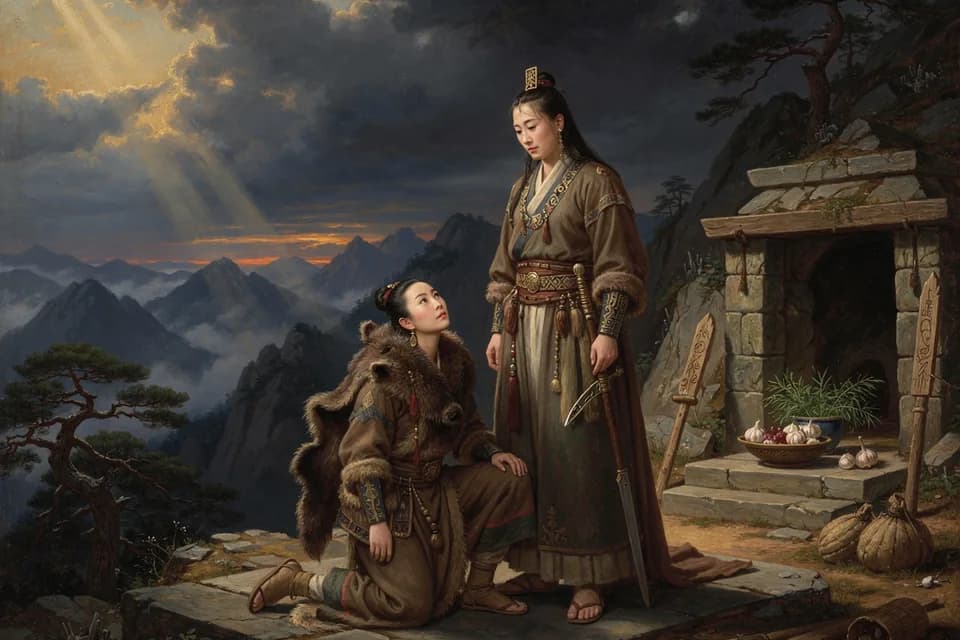
In a cave nearby lived a bear and a tiger, and both prayed constantly to Hwanung that they might become human. The god gave them a bundle of sacred mugwort and twenty cloves of garlic and said: eat these, and do not look upon the sunlight for a hundred days, and you will gain human form. The bear and the tiger took them and withdrew into the dark. The bear kept the taboo, and after twenty-one days she became a woman. The tiger could not endure it, and remained a tiger.
The birth of Dangun
The bear-woman, Ungnyeo, had no one to marry, and she went every day to pray beneath the altar tree for a child. Hwanung took on human form for a while and married her, and she bore a son. He was called Dangun Wanggeom.
The kingdom of Joseon
In the fiftieth year of the sage-emperor Yao, Dangun set his capital at Pyongyang and first called his kingdom Joseon. Later he moved the capital to Asadal on Mount Baegak, and he ruled for fifteen hundred years. When King Wu of Zhou granted Joseon to Gija, Dangun moved away; afterward he returned to Asadal, withdrew into the mountains, and became a mountain god. He lived to the age of one thousand nine hundred and eight.
What the text says and what came later
Iryeon adds small notes of his own: that Hwanin means Jeseok, the Buddhist Indra; that Taebaek is the present Myohyangsan; and that the year given for the founding does not match Yao's reign. The famous date of 2333 BCE for Dangun's founding was calculated by later historians, and the modern ideals attached to the story, the nation's descent from a single ancestor and the principle of 'widely benefiting humanity', took shape in the twentieth century, especially under Japanese colonial rule, when Dangun became a symbol of Korean independence.