Stranded in Pohjola
On his way to woo a bride in the North, Väinämöinen is shot from his horse by the vengeful Joukahainen and falls into the sea. He drifts for days until an eagle carries him to the coast of Pohjola, where Louhi, its mistress, takes him in. He longs for home. Louhi agrees to send him back, and to give her daughter too, to whoever can forge the Sampo from the tip of a swan's feather, the milk of a barren cow, a grain of barley, and the wool of a summer lamb. Väinämöinen says he cannot, but that his brother Ilmarinen, the smith who hammered out the sky, can. Louhi sends him home in a sledge, warning him not to look up on the way.
The trick
Väinämöinen does look up, and meets the Maiden of Pohjola sitting on a rainbow, weaving; she sets him impossible tasks, and he wounds himself with his own axe. Healed, he reaches home and tells Ilmarinen of the maiden. When Ilmarinen refuses to go north, Väinämöinen sings a great fir tree to grow with the moon and the Great Bear in its branches, and when Ilmarinen climbs it to fetch them, Väinämöinen raises a wind that blows him, tree-top and all, to Pohjola.
Four days at the forge
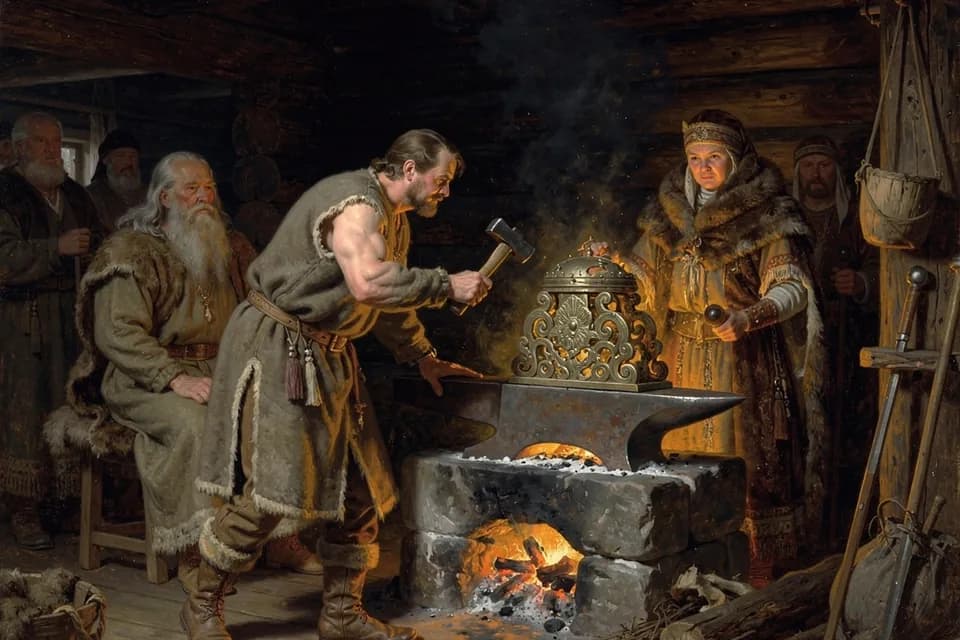
Ilmarinen sets up his forge, and slaves work the bellows. On the first day a golden crossbow rises from the fire, beautiful but evil, demanding a life every day; he breaks it and throws it back. On the second day comes a red boat that sails only to war; on the third, a heifer with golden horns that spills her milk; on the fourth, a golden plough that ploughs the neighbors' fields. Each he destroys. Then he sends away the slaves and calls on the winds to work the bellows, east wind and west, south and north, for three days. When he looks into the fire, the Sampo is rising. In Crawford's translation: 'Forges skilfully the Sampo; / On one side the flour is grinding, / On another salt is making, / On a third is money forging, / And the lid is many-colored.'
Locked in the mountain
Louhi is overjoyed. She carries the Sampo into the rock-mountain of Pohjola and locks it behind nine locks, and it puts down roots nine fathoms deep, into the earth, the shore, and the home-mountain. The Sampo grinds a measure for eating, a measure for selling, and a measure for storing each day, and Pohjola grows rich. But the Maiden of Pohjola refuses Ilmarinen, and he sails home alone.
What was the Sampo?
The runo-songs never describe the Sampo clearly, and its nature has been debated for two centuries. Scholars have read it as a mill, a treasure chest, a shield, a ship's mast, a world pillar supporting the sky, or the starry vault itself, among other things. The Kalevala's 'many-colored lid' (kirjokansi) is also used in folk poetry of the sky. Lönnrot's version gives it the three grinding faces of a mill, but the mystery is part of the tradition.