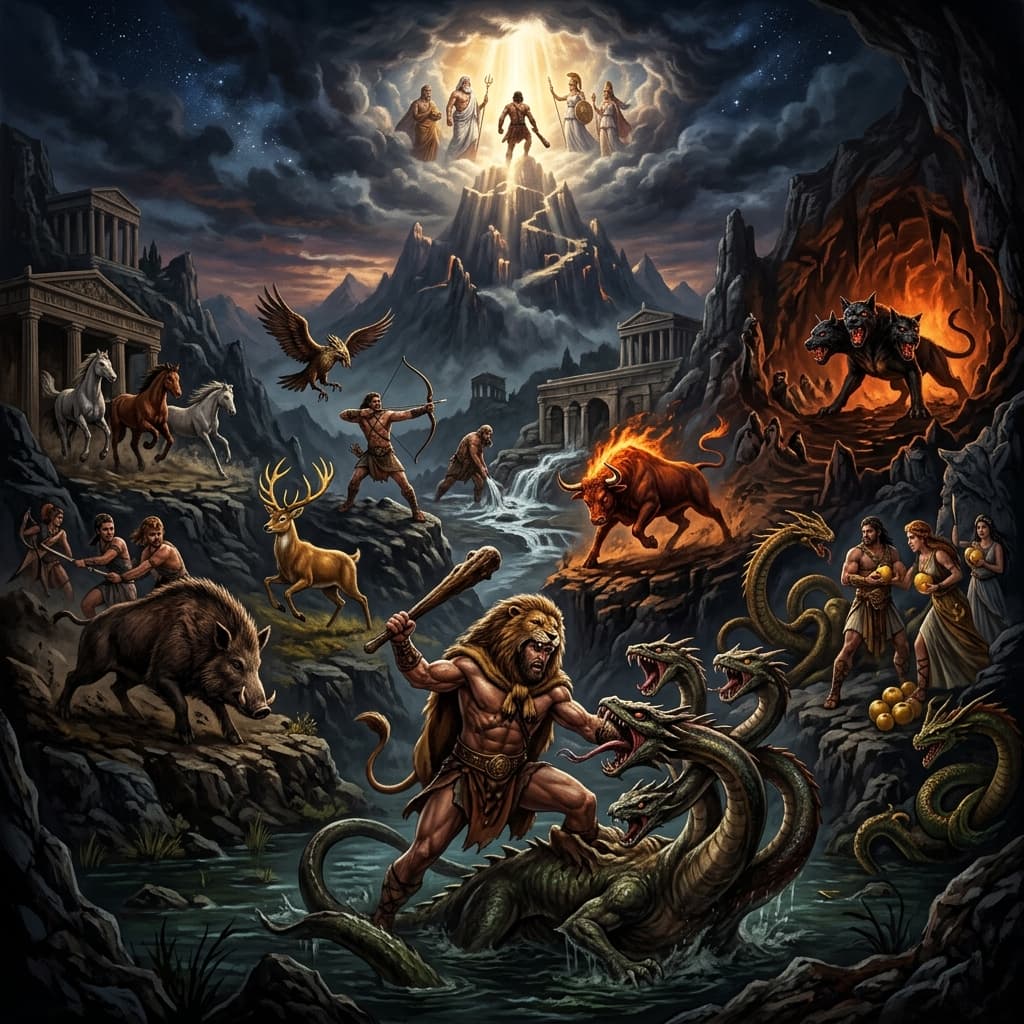
The Crime and the Penance
Hercules, son of Jupiter by the mortal Alcmena, was the mightiest hero the world had ever seen. But Juno, queen of the gods, despised him as living proof of her husband's infidelity. She sent a madness upon him, and in his frenzy, Hercules killed his children by Megara. This account places the catastrophe before the labors, following the chronology in Pseudo-Apollodorus; Euripides presents a different sequence.
When sanity returned and Hercules saw what he had done, he was consumed by grief. He consulted the Oracle at Delphi, which commanded him to serve his cousin King Eurystheus of Tiryns for twelve years. Whatever tasks Eurystheus set, Hercules must complete. Only then would he find absolution.
The First Six Labors
The Nemean Lion: This beast's hide was impervious to weapons. Hercules tracked it to its cave, blocked one entrance, and strangled it with his bare hands. He wore its skin as armor thereafter.
The Lernaean Hydra: A serpent with nine heads, one immortal. Each time Hercules cut off a head, two grew back. His nephew Iolaus cauterized each stump while Hercules severed the heads, until only the immortal head remained. This he buried under a great rock.
The Ceryneian Hind: A golden-antlered deer sacred to Diana. Hercules tracked it for a full year before capturing it alive, then explained to the goddess that he acted under divine command.
The Erymanthian Boar: A monstrous beast terrorizing the mountainside. Hercules chased it through deep snow until it was exhausted, then bound it and carried it to Eurystheus, who hid in a bronze jar from terror.
The Augean Stables: King Augeas kept vast herds whose stables had not been cleaned in thirty years. Hercules diverted two rivers to wash the filth away in a single day.
The Stymphalian Birds: Man-eating birds with bronze beaks and metallic feathers. Hercules startled them into flight with a rattle forged by Vulcan, then shot them down with arrows dipped in the Hydra's venom.
The Final Six Labors
Eurystheus devised ever more dangerous tasks, hoping Hercules would perish. But with each labor, the hero's fame only grew.
The Cretan Bull: The father of the Minotaur, a beast of immense power. Hercules wrestled it into submission and brought it back alive.
The Mares of Diomedes: Horses that ate human flesh. Hercules fed their cruel master to them, which calmed their bloodlust, then led them away.
The Belt of Hippolyta: Queen of the Amazons, who was willing to give Hercules her belt freely. But Juno spread a rumor that Hercules meant to kidnap the queen, and battle ensued. Hercules killed Hippolyta and took the belt.
The Cattle of Geryon: A three-bodied giant dwelling on the western edge of the world. Hercules killed Geryon and his two-headed dog Orthrus, then drove the cattle back to Greece through countless perils.
The Apples of the Hesperides: Golden apples guarded by a dragon that never slept. Hercules held up the sky while Atlas fetched the apples, then tricked the Titan into resuming his burden.
The Capture of Cerberus: The three-headed hound guarding the underworld. Hercules descended to Pluto's realm, obtained permission to borrow Cerberus if he could subdue it without weapons, and carried the beast to the terrified Eurystheus.
Apotheosis
With the labors complete, Hercules was free. Though more trials awaited him, his ultimate destiny was assured. After death, he ascended to Olympus, reconciled at last with Juno, and married the goddess Hebe. He became the divine patron of heroes, proof that even the most terrible sins could be redeemed through courage and perseverance.