A house destroyed
The Epic of Kirta survives on three tablets (KTU 1.14-1.16); a fourth may have existed. It begins with the ruin of King Kirta's house. His family is destroyed one by one: a wife lost, children dead of disease, carried off by flood, struck by the sword, until the king has no heir. Kirta goes into his chamber and weeps, his tears falling like shekels to the ground, until he falls asleep (KTU 1.14 I).
El's dream
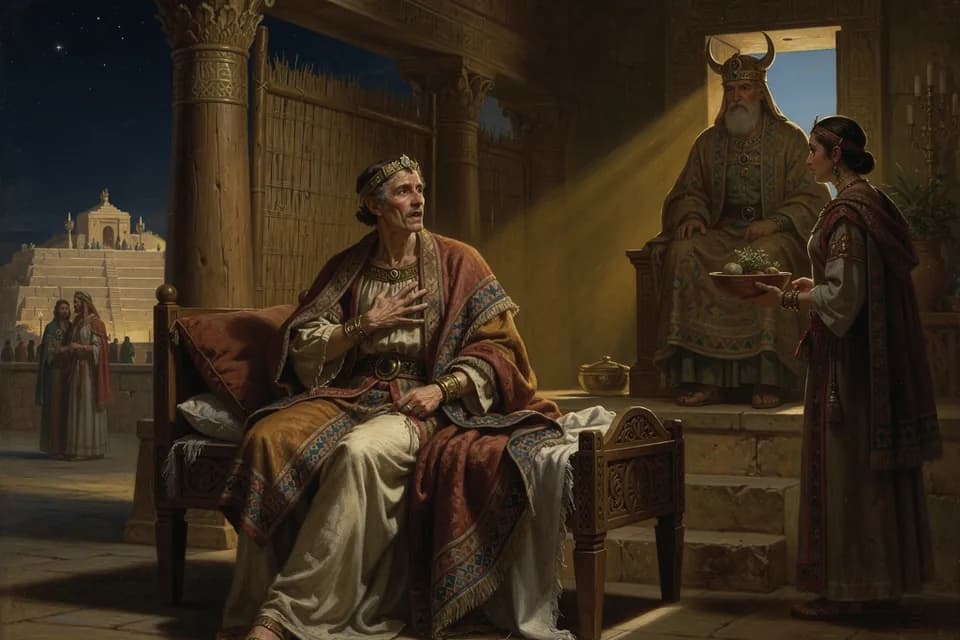
El, his divine father, comes down to him in a dream and asks why he weeps: does he want silver, gold, horses, kingship? Kirta answers that he wants only sons. El then gives detailed instructions. Kirta is to wash, make an offering on the tower, and gather an army so large that it will cover the fields like locusts; even the newly married man must leave his bride. He is to march for seven days to Udm the Great, the city of King Pabil, besiege it without attacking, refuse Pabil's offers of silver, gold, slaves, horses, and chariots, and ask only for Pabil's daughter, Hurriya, whose beauty is like Anat's and Athtart's (KTU 1.14 II-III).
The vow
Kirta wakes and does exactly as El said, with one addition. On the third day of the march he stops at the shrine of Athirat of Tyre, goddess of Sidon, and makes a vow: if he brings Hurriya into his house, he will give twice her weight in silver and three times in gold (KTU 1.14 IV). Everything happens as foretold: Pabil offers riches, Kirta refuses, and Hurriya is given to him.
Blessing, and a debt forgotten
At the wedding feast the gods come, and El blesses Kirta: Hurriya will bear him seven or eight sons, and a daughter, and one son will be nursed by the goddesses Athirat and Anat (KTU 1.15 II). The children are born. But Kirta has not paid his vow, and Athirat remembers: she asks whether Kirta has changed his vow, and says she will break her own promise (KTU 1.15 III).
Sickness
Kirta falls ill. His son Ilhu weeps and asks how a son of El can die; his daughter Thitmanat mourns. The land suffers; the text describes the fields waiting for rain (KTU 1.16 I-III). El asks the gods seven times who will drive out the illness, and none answers. So El himself takes clay and makes a healing being, Shaʿtaqat, a female figure who flies over the towns to Kirta's bed and drives away the sickness. Kirta recovers, eats, and returns to his throne (KTU 1.16 V-VI).
The challenge of Yassib
But his eldest son Yassib, thinking his father still weak, confronts him: Kirta has let his hand fall slack; he has not judged the widow's case or the orphan's; he should step down and let Yassib rule. Kirta answers with a curse, calling on the god Horon and on Athtart, Name of Baal, to break his son's head. The tablet ends with the curse.
Themes
The poem asks what makes a king legitimate. Kirta is called a son of El and is saved by El's direct action, yet he is mortal, he fails in piety, and his son's challenge uses the standard language of royal duty to the weak. It is one of the earliest works of literature to examine the gap between sacred kingship and human failing.