The warning of the brush
Lemminkäinen, the reckless and handsome adventurer, sets out for Pohjola to woo Louhi's daughter, against his mother's pleading. As he leaves, he throws his hairbrush against the wall and tells her that if blood ever flows from it, harm has come to him.
Louhi's three tasks
In Pohjola he sings the men of the house out of doors, sparing only a blind old herdsman, whom he insults. Louhi sets him three tasks for her daughter's hand. First he must ski down the elk of Hiisi, a creature built by the demon's folk from willow and rushes; he breaks his skis in the chase, but after praying to Tapio and Mielikki, the lord and mistress of the forest, he captures it. Next he must bridle Hiisi's fire-breathing gelding, which he does with Ukko's help, calling down iron hail. Last, Louhi tells him to shoot, with a single arrow, the swan that swims on the black river of Tuonela, the river of the dead.
Death at the river
At the river of Tuonela the blind herdsman he had mocked is waiting. He draws a water-serpent from the waves and thrusts it through Lemminkäinen's heart. The hero dies calling for his mother, and the herdsman throws him into the black river. There the son of Tuoni, the lord of death, hacks his body into pieces with his sword and scatters them in the water.
The search
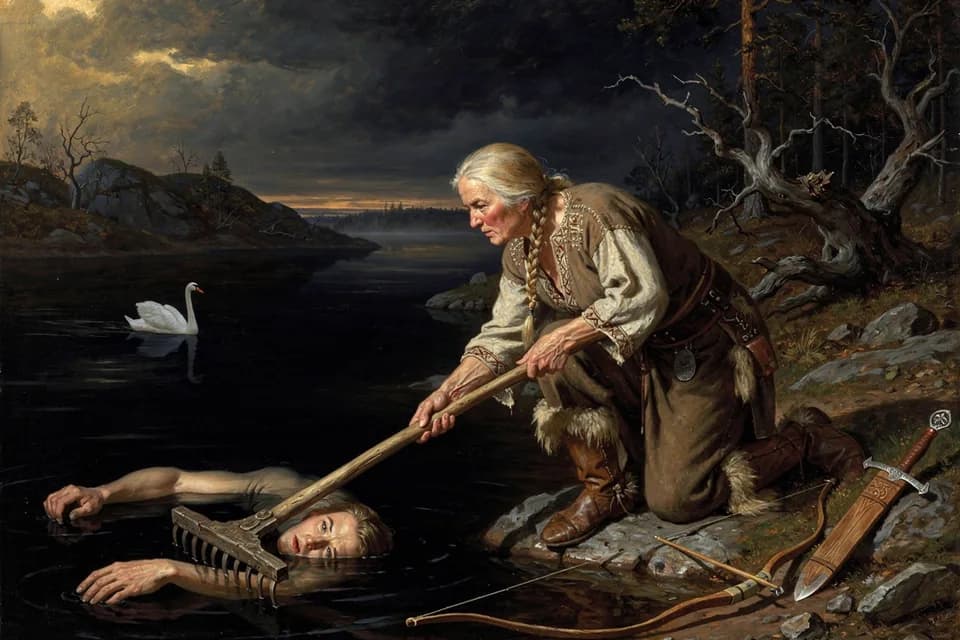
At home, blood runs from the hairbrush. Lemminkäinen's mother sets out at once. She forces Louhi to tell her where her son was sent, then asks the trees, the road, and the moon, who cannot help her; at last the sun tells her he lies in the river of Tuonela. She goes to Ilmarinen and asks him to forge a rake of copper with a very long handle. With it, standing in the river up to her waist, she rakes the depths, finding first his shirt, then his hat and stockings, and then, raking again and again, his body and the scattered pieces. She joins them together, flesh to flesh and bone to bone, with charms that name each part and the goddess of veins who knits them.
The bee's honey
Still he does not speak. She sends the bee to fetch balm, first from the meadows, then from beyond the moon and sun, and finally from above the ninth heaven, where the Creator keeps his honey. With that ointment she anoints her son, and he wakes as if from sleep, saying he had slept long. She tells him it was not sleep, and takes him home. He never shoots the swan of Tuonela.
Afterlife of the story
The episode, assembled by Lönnrot from songs about a hero's death and a mother's search, became one of the most beloved in the Kalevala. Akseli Gallen-Kallela's painting Lemminkäinen's Mother (1897) shows her at the black river with her son's body and the rake, a bee overhead, and Sibelius's The Swan of Tuonela sets the dark river to music.