Victory without a house
After his victory over Yam, Baal laments that he has no house like the other gods: El has a dwelling, Athirat has one, but Baal and his daughters live without a palace (KTU 1.3 V; 1.4 I). In Ugaritic thinking a king needs a house; the story of the palace is the story of Baal's kingship being made permanent. It fills tablets KTU 1.3 and 1.4, with gaps.
Anat's feast and fury
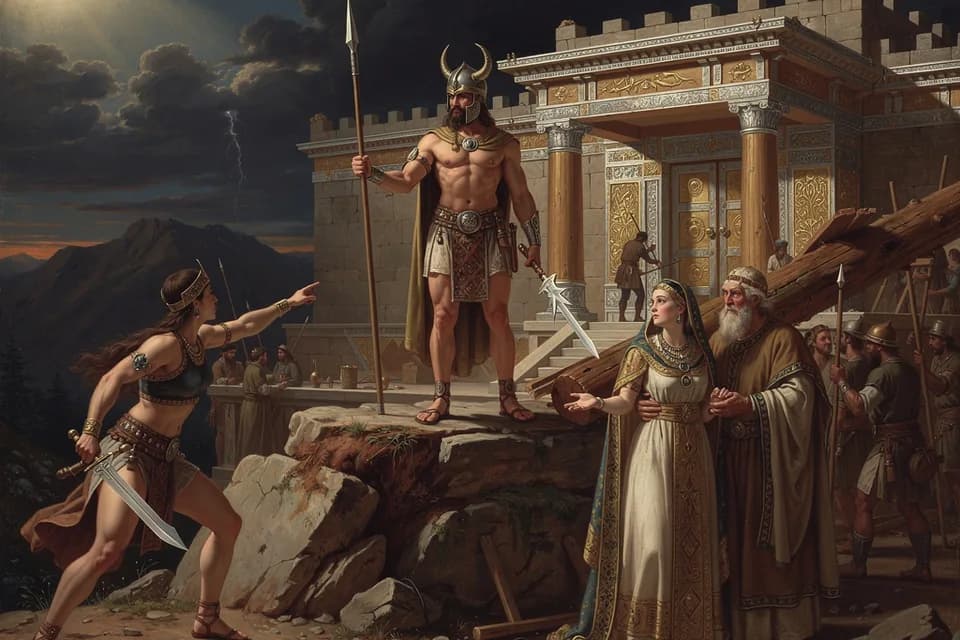
The episode opens with Anat. In one of the most violent passages in ancient literature, she fights in the valley between two towns, cutting down warriors until heads fly like balls and hands like locusts, and she wades in blood up to her knees and then her neck, before cleansing herself with dew and rain (KTU 1.3 II). Baal sends messengers to her asking her to set aside war and come to him, promising to reveal the secret of the lightning. She comes, and agrees to go to El on his behalf.
At El's dwelling at the source of the two rivers, Anat threatens the old god: she will drag him down like a lamb and make his grey hair run with blood unless he grants Baal a house (KTU 1.3 V). El answers mildly but does not give in.
Athirat's intercession
A different approach is needed. Baal and Anat have Kothar-wa-Khasis make splendid gifts, furniture, a footstool, a table, and a bowl, of gold and silver, and take them to Athirat (KTU 1.4 I-II). She is by the sea, spinning, when she sees them coming, and at first she is afraid; when she sees the gifts she rejoices. She saddles a donkey and rides to El. El greets her with pleasure, laughing, and asks whether she is hungry or thirsty. She praises his wisdom and asks for Baal's house. El consents: let a house be built for Baal (KTU 1.4 IV-V).
Cedar, silver, and gold
Kothar-wa-Khasis is summoned from far-off Kaphtor. Timber is brought from Lebanon and Sirion, and the house is built on Zaphon; for seven days fire burns inside it, and the silver becomes plates and the gold becomes bricks (KTU 1.4 VI).
The window
During the building, Kothar twice proposes to put a window in the palace, and Baal twice refuses; the reason he gives is lost or unclear in the text. Kothar tells him calmly that he will come back to his words. After the palace is finished and Baal has held a great feast for the gods, his seventy brothers, he returns and agrees. A window is opened, a rift in the clouds, and Baal gives his holy voice: the earth shakes and the mountains tremble, and his enemies flee to the forests (KTU 1.4 VII).
Kingship declared, and Death answers
Baal declares that he alone will rule over the gods and sends messengers to Mot, Death, with his claim. That message opens the final and darkest part of the cycle.
Reading the story
The palace episode shows how Ugaritic poets imagined divine politics: a young god wins by force, but needs the consent of the old king and the persuasion of the queen mother to make his victory lasting. Baal's temple on the acropolis of Ugarit, facing toward Mount Zaphon, was the earthly counterpart of this mythical palace, though the texts do not explicitly identify the two.