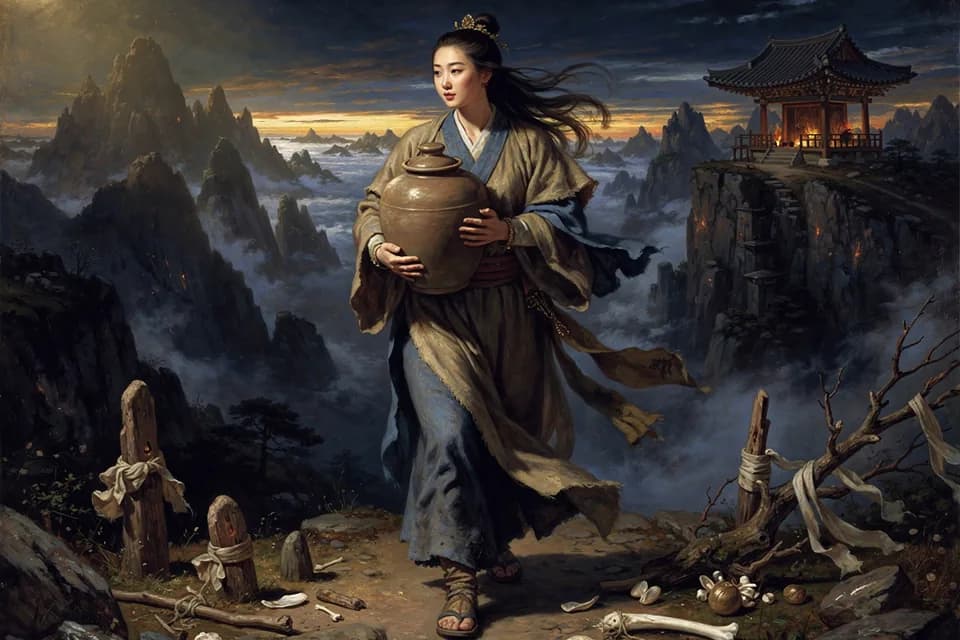
A song sung for the dead
This story is not a written text but a song, performed by Korean shamans in rituals that send the dead to the other world. It exists in many versions; this retelling follows the main line common to the Seoul-region versions.
The seventh daughter
King Ogu married Queen Gildae, though a fortune-teller had warned that the year was unlucky and that if they married then they would have only daughters. So it was: one daughter was born, then another, until there were six. When the queen bore a seventh daughter, the king, who longed for a son, ordered her thrown away. The baby was put in a jade box and cast into the water. She was named Bari, 'the thrown-away one'. But the box did not sink. In some versions a golden turtle carried it to shore; in others the Buddha saw it; and an old childless couple took the baby home and raised her.
The illness
Years later the king and queen fell ill with a sickness no doctor could cure. In a dream or through a diviner they learned that they had been punished for abandoning their child, and that only the medicinal water of the Western Heaven, at the end of the world, could save them. They asked each of their six daughters to go. Each refused, with an excuse. At last the king sent for the child he had thrown away. When Bari was brought before her parents, she agreed to go: she had received nothing from them in her upbringing, she said, but she owed them her birth.
The journey
Disguised as a man, Bari set out. She crossed mountains and rivers and passed through the hells where the dead are punished, sometimes helped by the Buddha, who gave her a flower or a staff that parted the waters. At the source of the medicine water she found its guardian, a huge and fearsome being. He would give her the water only if she paid for it with labor: she drew water for three years, cut firewood for three years, and tended the fire for three years. In many versions he then asked her to marry him, and she bore him seven sons.
The return
At last she filled her vessel with the water of life, gathered the flowers that restore bone, flesh, and breath, and hurried home with her husband and sons. As she reached her parents' country she met a funeral procession: her parents had already died. She stopped the biers, laid the flowers on their bodies, and poured the water of life into their mouths, and the king and queen came back to life.
The goddess of the dead
The grateful king offered her half his kingdom, wealth, anything she wished. She refused. Instead she asked to become the one who leads the souls of the dead to the other world, and so she became the goddess of the passage of the dead and the ancestor of shamans; in some versions her seven sons became the seven stars of the Big Dipper. When a shaman sings her story at a funeral rite, the shaman walks Bari's road to guide the soul of the dead.