A night in Samangan
One day, hunting near the border of Turan, Rostam fell asleep and his horse Rakhsh was stolen by Turanian riders. Following the tracks, he came to the city of Samangan, whose king received him as a guest. That night Tahmineh, the king's daughter, came to his room; she had long heard of his deeds and wished to bear his child. Rostam asked for her hand, and they were married. In the morning, when Rakhsh had been found, he gave her an onyx armband and told her to tie it to the child's arm if it were a son. Then he rode back to Iran.
The young champion
Tahmineh bore a son, Sohrab, who grew with astonishing speed: at a month he was like a child of a year, at ten no one could stand against him. When his mother told him his father was Rostam, Sohrab resolved to march on Iran, overthrow its king Kay Kavus, and set his father on the throne, and then to overthrow Afrasiyab of Turan as well. Afrasiyab, learning of this, secretly sent an army with him, with orders that father and son must never recognize each other, so that one might kill the other.
Unrecognized
Sohrab's advance brought him to the White Fortress on Iran's frontier, where he fought the woman warrior Gordafarid. Kay Kavus summoned Rostam, who delayed, drinking for days, and was rebuked by the angry king before he took the field. Sohrab, looking down on the Iranian camp, asked a captured Iranian, Hujir, to point out the famous heroes, and above all Rostam. Hujir, afraid that the young man would kill Rostam, lied and said Rostam was not there.
The combat
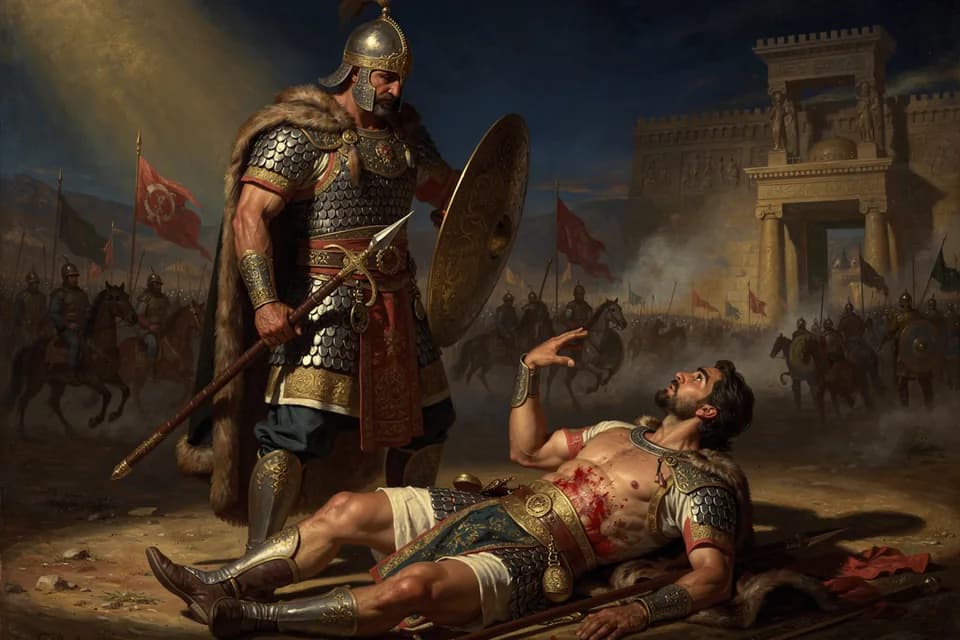
Father and son met in single combat between the armies. On the first day they fought with spears, swords, and maces until their weapons broke, and parted exhausted. Sohrab felt drawn to the older man and asked whether he was Rostam; Rostam denied it. On the second day Sohrab threw Rostam to the ground and could have killed him, but Rostam claimed that custom required a wrestler to throw his opponent twice before killing him, and Sohrab let him go. That night Rostam prayed for the full strength he had once asked God to diminish. On the third day he threw Sohrab down and drove his dagger into the young man's side.
The token
Dying, Sohrab told him that his father Rostam would avenge him. Rostam, stricken, demanded proof, and Sohrab showed him the armband on his arm. Rostam tore his clothes and wept. He sent to Kay Kavus for the healing potion that the king kept, but Kavus, fearing that Rostam and a son like this together would be too powerful, delayed. Before the potion could come, Sohrab died. Rostam carried his body home to Zabulistan, and Tahmineh mourned him until her own death.
Why the story endures
Ferdowsi frames the tragedy with reflections on fate and the limits of human understanding. The father who kills his unrecognized son is a motif known in other traditions, from the Irish Cú Chulainn and Connla to the German Hildebrand; in the Shahnameh it becomes the defining grief of Iran's greatest hero. Matthew Arnold's poem Sohrab and Rustum (1853) made it famous in English.