The longest Hurrian song
The Song of Ullikummi (CTH 345) is the best preserved song of the Hurrian Kumarbi cycle, known from several Hittite copies found at Hattusa. It continues the conflict of the Song of Kumarbi: the storm-god Teššub now rules in heaven, and the deposed Kumarbi wants his kingship back. The ending of the song is lost.
A rival made of stone
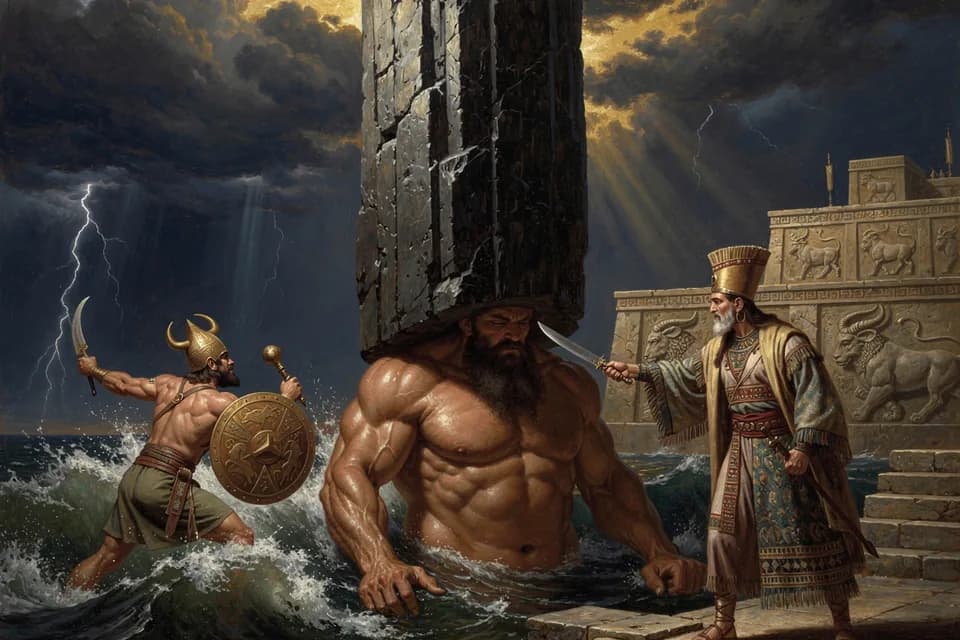
Kumarbi takes wisdom into his mind and plans an enemy for Teššub. He leaves his city of Urkeš and goes to a place where a huge rock lies, and he sleeps with the rock as with a woman. The rock gives birth to a son made of basalt, and Kumarbi names him Ullikummi, a name that announces his purpose: he is to destroy Kummiya, Teššub's city. To keep the child hidden from the gods until he is grown, Kumarbi has him taken down to the Dark Earth and placed on the right shoulder of Upelluri, the giant who stands in the sea and carries heaven and earth. There the stone child grows, a great distance each day and each month, until he stands out of the sea and his head reaches the sky.
The gods see him
The Sun-god is the first to notice the giant rising from the sea and goes to warn Teššub. Teššub, with his brother Tašmišu and his sister Šauška, climbs Mount Hazzi to look, and when he sees the monster he sits down and weeps. Šauška tries her own weapon: she adorns herself and sings to Ullikummi on the shore. But a great wave rises from the sea and tells her that there is no point singing to him, because he is deaf and cannot hear, and blind and cannot see, and has no compassion.
Defeat
Teššub prepares for war, harnessing his bulls Šeri and Hurri to his chariot and calling out his storms and lightning. He attacks, with seventy gods beside him, but the battle goes badly. Ullikummi keeps growing and pushes all the way up to the gates of Kummiya, forcing Teššub's wife Hebat out of her temple so that she can no longer get news of her husband. Tašmišu brings Teššub the bad news and advises him to go to the wise god Ea.
The copper cutter
Ea goes first to Enlil and then to Upelluri, and asks the giant whether he knows what is standing on his shoulder. Upelluri says that he felt nothing when heaven and earth were built on him, nothing when they were cut apart, and now only a slight pain in his shoulder, though he does not know which god causes it. Ea then goes to the Former Gods and asks them to open the ancient storehouses and bring out the copper cutting tool with which heaven and earth were once separated. With it he cuts Ullikummi's feet away from Upelluri's shoulder, and the stone giant loses his strength.
The lost ending
Ea tells the gods to fight again, and Teššub mounts his chariot for a second battle. The song clearly moved toward his victory, but the last part of the text is broken, and the final defeat of Ullikummi is not preserved. The Hittite translators copied the song in the thirteenth century BCE, at the height of Hurrian influence at the Hittite court.
Reading the song
The central image, a monster growing on the shoulder of a world-bearing giant, cut free by the tool that once divided heaven from earth, is a myth about the structure of the cosmos as much as about a single fight. Scholars have compared Upelluri to the Greek Atlas and Ullikummi to Typhon, the last monster Zeus defeats in Hesiod; these are parallels in type, and this site does not treat any of them as the source of the others.