A festival text from Nerik
The Illuyanka tales (CTH 321) are Anatolian, not Hurrian. They are preserved on a single composition that presents itself as the words of Kella, a priest of the Storm-god of Nerik, and explains the Purulli festival, a spring festival of the sacred city of Nerik in the north of the Hittite lands. The text gives two different versions of the storm-god's fight with the serpent, one after the other, noting that the first way of telling it is no longer used. Illuyanka itself simply means "serpent" or "dragon" in Hittite.
The first version: a feast and a rope
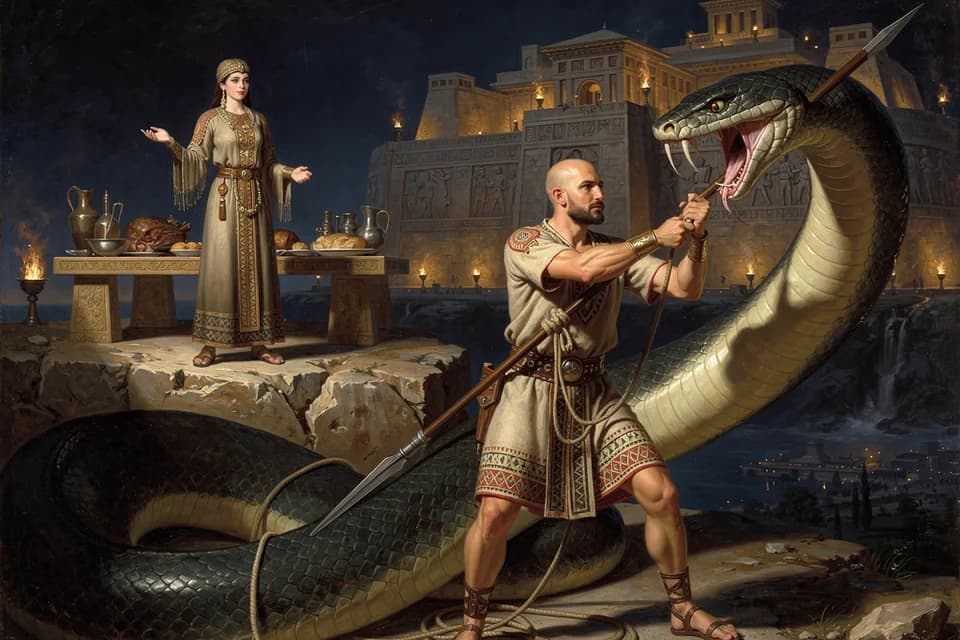
The Storm-god and the serpent fought at a place called Kiškilušša, and the serpent defeated the Storm-god. The Storm-god called on all the gods for help, and the goddess Inara prepared a feast, setting out vessels of wine and other drinks in abundance. Then she went to the town of Zigaratta and found a mortal man named Hupašiya. She asked for his help, and he agreed on one condition: that he might sleep with her. Inara agreed, took him to the feast, and hid him.
Inara adorned herself and called the serpent up from its hole. The serpent came up with its children, and they ate and drank until they had emptied every vessel. Then they could not fit back into their hole. Hupašiya came out of hiding and tied the serpent up with a rope, and the Storm-god came with the other gods and killed it.
Inara then built a house on a cliff in the land of Tarukka and settled Hupašiya in it, telling him not to look out of the window while she was away, or he would see his wife and children. After twenty days he opened the window, saw them, and when Inara returned he begged to go home. Here the tablet breaks. Most scholars assume Inara killed or punished him, but the surviving text does not say.
The second version: a stolen heart
In the second version, the serpent defeated the Storm-god and took his heart and his eyes. To get them back, the Storm-god married the daughter of a poor man and had a son. When the son grew up, he married the serpent's daughter. The Storm-god told his son to ask for his heart and eyes as a gift when he went to his wife's house, and the serpent gave them. Restored, the Storm-god went down to the sea to fight the serpent again, and this time he was winning. His son, who was with the serpent, called out that he belonged to the serpent's household now, and told his father not to spare him. So the Storm-god killed both the serpent and his own son.
Why two versions?
The text ties both stories to the Purulli festival and to the cult of Nerik, and it seems to preserve two local traditions side by side rather than choosing one. In neither version does the storm-god win by strength alone: he needs a goddess and a mortal in one, and a son whom he must sacrifice in the other. The victory is costly for everyone who helps.
Place in a wider pattern
The combat of a storm-god with a serpent or sea monster is one of the most widespread motifs in the ancient world, from Baal's fight with Yamm and Litan at Ugarit to Thor and Jörmungandr in Norse myth. The Illuyanka tales are among the oldest written examples, but their particular details, the feast, the rope, the stolen heart and eyes, and the mortal who pays for helping a god, are distinctively Anatolian.