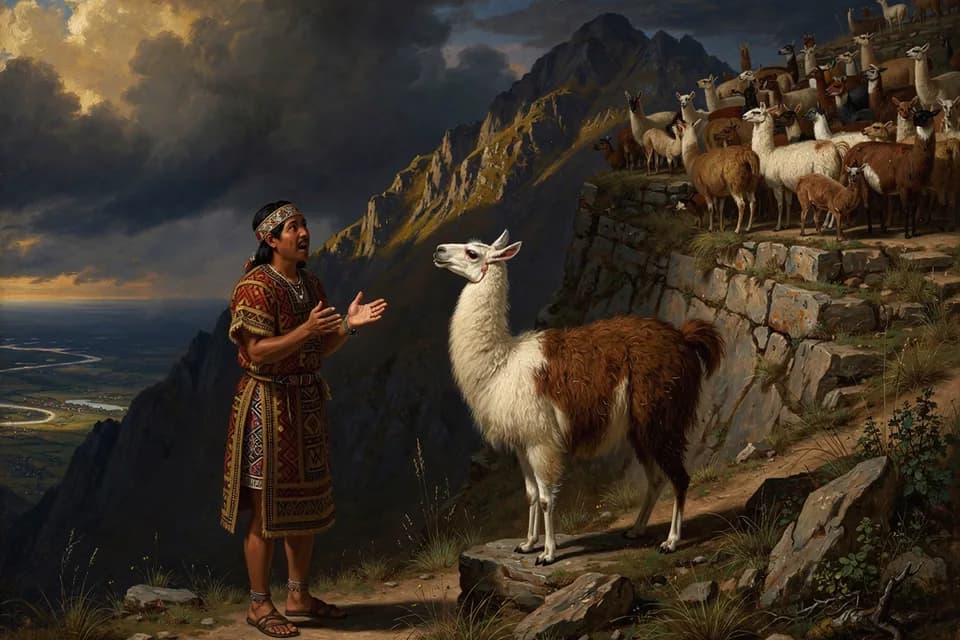
A llama that would not eat
The Huarochirí stories tell of a time when the world nearly came to an end. A man had tethered his llama in a place with good pasture, but the llama would not graze. It lay moaning and weeping in the way llamas do, crying yu yu. The man, who was eating maize, threw the cob at it in irritation. "Fool," he said, "why are you moaning and not eating? Haven't I put you where the grass is good?"
The llama answered him. It told him it was not sad without reason: within five days the sea would rise and cover the whole earth, destroying everything upon it.
Up the mountain
The man, astonished that his llama could speak, asked whether there was any way to escape. The llama told him to gather food for five days and follow it quickly to the top of a high mountain called Villcacoto, between the villages that later became San Damián and San Gerónimo de Surco. The man loaded the food on his back and led the llama up the mountain.
When they reached the summit they found every kind of bird and animal already gathered there. The sea began to rise. The water filled the valleys and covered the hilltops, all except the peak of Villcacoto, and the animals were crowded so tightly that some could hardly find footing. The fox's tail trailed in the water, and that is why the tips of foxes' tails are black to this day.
After five days
After five days the water began to fall and the sea went back to its place. The whole earth was empty of people except for that one man, and from him, the story says, all the people now living are descended.
The death of the sun
The manuscript follows this story with another world-ending memory. Long ago, it says, the sun disappeared and the world was dark for five days; stones knocked against each other, and the mortars and grinding stones rose up against their owners, as did the llamas. The Spanish priest who retold these stories suggested this might be a memory of the darkness at the crucifixion, then rejected the idea himself.
Reading the flood
Francisco de Ávila, who retold this story in Spanish in 1608, spent more words refuting it than telling it, insisting that no Andean could have remembered Noah's flood because the Americas were not yet peopled. Modern readers are more interested in the story's Andean features: the talking llama as a guide who understands the world better than its owner, the mountain as refuge, the five-day cycle that recurs throughout the Huarochirí stories, and the explanation of the fox's black-tipped tail.