The star and the arrow
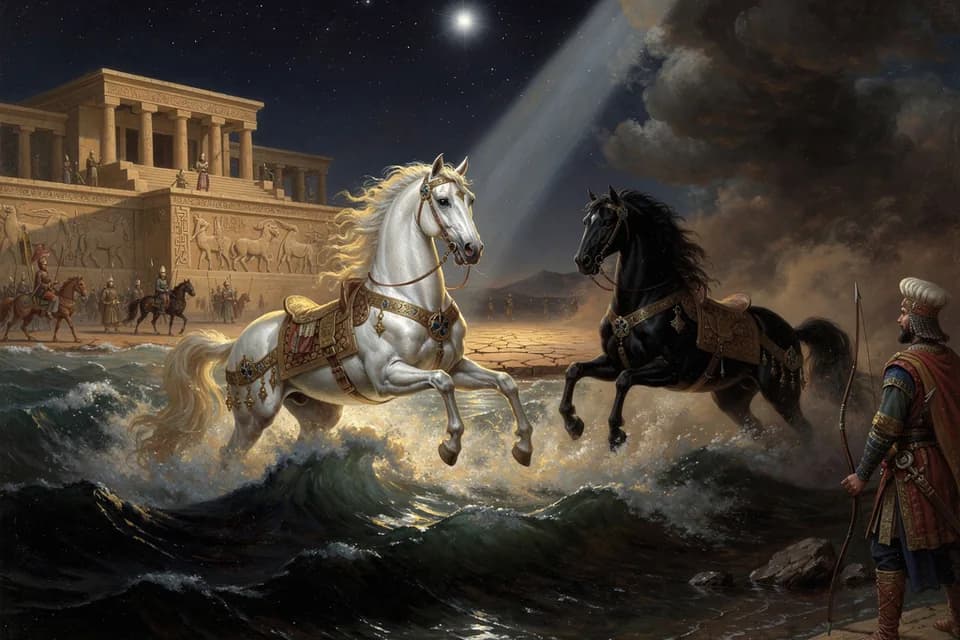
The Tir Yasht, the Avesta's hymn to the star Tishtrya (Sirius), opens with his swiftness. He flies toward the sea Vouru-Kasha as swiftly as the arrow once shot by Erekhsha, the swiftest archer of the Aryans, from Mount Khshaotha to Mount Hvanvant. Ahura Mazda gives him help, and so do the waters and the plants, and Mithra, lord of wide pastures, opens a wide way before him.
Three forms
Through the nights of his rising Tishtrya takes three forms in turn: for ten nights the body of a shining young man of fifteen, for ten nights a bull with golden horns, and for ten nights a white horse with golden ears. In that last form he goes down to the sea Vouru-Kasha, whose waters he must stir up so that they rise as clouds and fall as rain on the thirsty lands.
Defeat
But the demon of drought, Apaosha, rushes down to meet him in the shape of a black horse, black-eared, black-backed, black-tailed, stamped with brands of terror. They meet hoof against hoof at the edge of the sea and fight for three days and three nights, and Apaosha proves the stronger. He overcomes Tishtrya and drives him back from the sea.
Then Tishtrya cries out in distress. Woe is him, and woe to the waters and the plants, and woe to the religion of Mazda: men do not worship him with a sacrifice in which he is invoked by his own name. If they did, he says, he would have the strength of ten horses, ten camels, ten bulls, ten mountains, and ten rivers.
Victory
When Tishtrya receives the worship due to him, invoked by name, his strength returns. He goes down again to the sea as the white horse, and again Apaosha rushes to meet him as the black horse. Again they fight hoof against hoof, and this time, at noon, Tishtrya overcomes Apaosha and drives him away from the sea. The waters of Vouru-Kasha surge and boil over; mists rise from its shores and gather into clouds, and the winds drive the clouds with the rain across the seven regions of the earth, to the fields, the pastures, and the flocks.
Reading the hymn
The hymn joins astronomy and agriculture. The heliacal rising of Sirius in high summer came at the driest time of year in Iran, and the hymn makes the star the champion who wins back the rains. It also makes a point about worship: Tishtrya's defeat is caused by neglect, and his victory by correct ritual in which he is honored by name. The festival of Tirgan, held in the month named for him, remembered both Tishtrya and the archer Erekhsha, later known as Arash, whose arrow in Persian legend fixed the border of Iran.