Slavic Pantheonquestabout 2 min
Vasilisa the Beautiful and Baba Yaga
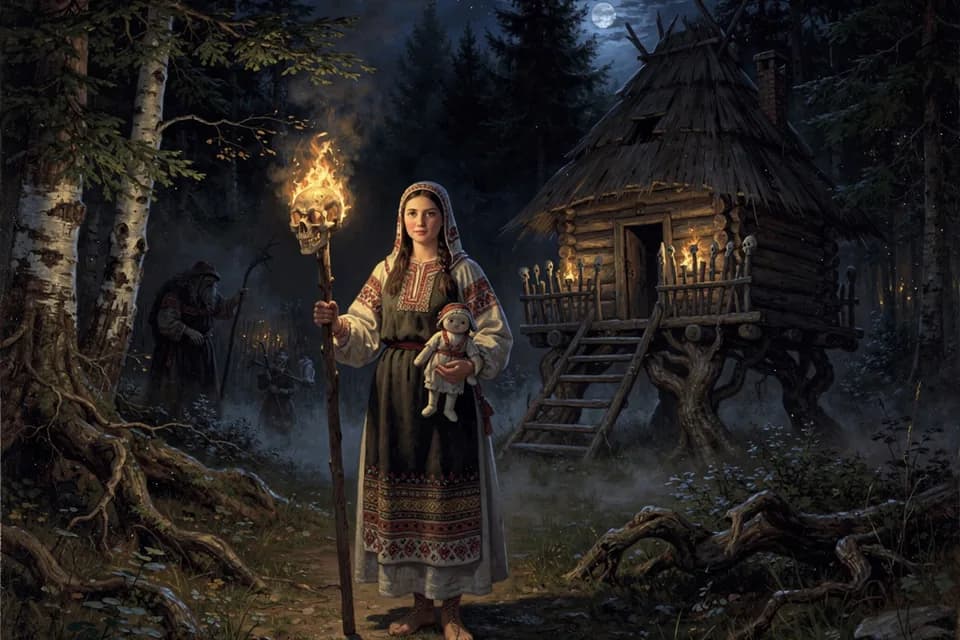
Sent by her cruel stepmother into the forest to beg fire from Baba Yaga, Vasilisa survives the witch's household tests with the help of a doll left by her dead mother, and returns with a fire that consumes her tormentors.
An editorial retelling
The story
A 19th-century fairy tale, not a pagan myth
This tale was collected by Alexander Afanasyev and published as part of Narodnye russkie skazki (1855–1863), the great 19th-century compendium of East Slavic oral folklore. It has no pagan-era attestation and is presented here as folklore, not as ancient religion, though it is among the best-loved and most widely translated Russian fairy tales.
The doll and the stepmother
Before she dies, Vasilisa's mother gives her a small doll, telling her to feed it and confide in it whenever she is in need, and it will help her. Vasilisa's father remarries a woman with two daughters of her own, and the new stepmother, jealous of Vasilisa's beauty, sets her increasingly impossible household chores, hoping to see her fail or worse. On the night the family lets their fire go out, the stepmother sends Vasilisa into the forest to beg a light from Baba Yaga, expecting she will never return.
The witch's tasks
At Baba Yaga's hut, turning on chicken legs and fenced with a bone fence topped with skulls whose eyes light the yard, Vasilisa is set a string of impossible household tasks (separating clean grain from dirty, poppy seed from soil, cooking and cleaning for the witch) which her mother's doll secretly completes for her each night while she sleeps. Baba Yaga, unable to find fault or a reason to eat her, and unsettled by Vasilisa's refusal to ask about anything beyond what concerns her directly, finally sends her home with one of the glowing skulls from the fence as her fire.
The fire's judgment
Back home, the skull's eyes burn through the night, staring at the stepmother and her daughters until, by morning, they have burned to ashes, while Vasilisa is left untouched. She goes on, in the fuller telling of the tale, to weave cloth so fine it reaches the tsar himself, who marries her.
Listen or change reading mode
Highlights
A magic doll completes Baba Yaga's impossible household tasks for Vasilisa each night; the witch sends her home with a skull for a lamp, whose burning eyes consume the cruel stepmother and stepsisters by morning.
Why it matters
One of the most widely translated and illustrated Russian fairy tales, and the primary source for Baba Yaga's best-known characterization as a difficult but fundamentally fair tester rather than a simple monster.
Quick answers
- What is the story of Vasilisa the Beautiful and Baba Yaga about?
- Sent by her cruel stepmother into the forest to beg fire from Baba Yaga, Vasilisa survives the witch's household tests with the help of a doll left by her dead mother, and returns with a fire that consumes her tormentors.
- What themes does Vasilisa the Beautiful and Baba Yaga explore?
- The atlas lists these themes for Vasilisa the Beautiful and Baba Yaga: quiet diligence over complaint, inherited protection (the mother's blessing), and the danger and fairness of the liminal witch.
Sources and further reading
By Elizabeth Stein for Mythos Atlas. About the author. Editorial notes are grounded in the site's cited sources and can be challenged through the contact page.
Works cited
Narodnye russkie skazki (Russian Fairy Tales)
Alexander Afanasyev
Cite this page
No publication date is recorded for this page, so each citation uses n.d. and today's date as the access date.
Keep exploring
One myth a week, with its sources in a short email. The sign-up form is at the foot of the page.